
In considering the blind spots of other generations or cultures from a safe distance, it becomes clear that there is no atrocity, no horror, no injustice which human beings, under some circumstances, will not defend, or even posit as a positive good. Present an injustice or atrocity in a way that appeals to a combination of perceived self“interest, ideological fit, and group superiority, and all classes of human beings, regardless of intelligence, educational level, or social position, will likely embrace it.
The atrocities we can critique from afar frequently fail to illumine our minds sufficiently to steer us away from those closer at hand, for self“interest, ideology, and pride are far more powerful blinders than we realize. Certainly it is difficult for a society as divided as contemporary America to come to a shared understanding on fundamental ethical issues.
Justice Antonin Scalia declares in Stenberg v. Carhart that he is “optimistic enough to believe” that the decision constitutionally protecting partial“birth abortion will “one day . . . be assigned its rightful place in the history of this Court’s jurisprudence beside Korematsu [validating internment of Japanese“Americans during World War II] and Dred Scott [holding white supremacy and racial slavery as fundamental tenets of American constitutionalism].” Justice Scalia is hoping that one day we will be as removed from the abortion controversy as we are today removed from past controversies over slavery and the internment of Japanese“Americans, and that this distance will be the consequence of having clearly and definitively rejected the injustice in question.
The alternatives to Justice Scalia’s “optimism” are either 1) to accept the viewpoint that partial“birth abortion is legally and ethically acceptable, or 2) to fear that America will never reach the place where it clearly rejects such horrific forms of killing. There have been, after all, empires, nations, regimes, and peoples that went through their entire history without ever turning from their particular injustices and atrocities. There is no guarantee of justice being realized in history”including American history”and we cannot be confident that Justice Scalia’s optimism will be vindicated.
Stenberg is historic because it constitutionally validates and protects an extreme and horrific form of abortion bordering on infanticide, while placing this validation in the context of explicitly gruesome descriptions of the various forms of late“term abortion. The legal issues and factual background of Stenberg forced each Justice to confront the raw facts of precisely how abortion brings about the destruction of the human fetus.
Stenberg centered on various methods of post“fifteen“week abortion. The most common method of abortion at this stage, dilation and evacuation (D&E), generally involves the use of surgical instruments to dismember the fetus. Because of a technical point regarding interpretation of the Nebraska statute, the majority in Stenberg felt obligated to emphasize, in clinical language, that D&E involves pulling “a portion of the fetus through the cervix into the birth canal,” where the “traction” of the surgical instrument and the cervical opening produces dismemberment. Just in case anyone could miss the meaning of the majority’s clinical description, Justice Anthony Kennedy’s dissent translated this into lay language:
The fetus, in many cases, dies just as a human adult or child would: it bleeds to death as it is torn from limb to limb . . . . The fetus can be alive at the beginning of the dismemberment process and can survive for a time while its limbs are being torn off . . . . Dr. [Leroy] Carhart [the abortionist who challenged Nebraska’s partial“birth ban] has observed fetal heartbeat . . . with “extensive parts of the fetus removed,” . . . and testified that mere dismemberment of a limb does not always cause death because he knows of a physician who removed the arm of a fetus only to have the fetus go on to be born “as a living child with one arm.” . . . At the conclusion of a D&E abortion . . . the abortionist is left with “a tray full of pieces.”
Under Roe v. Wade (1973) and Planned Parenthood v. Casey (1992), the states are powerless to prohibit D&E, since it is the most common method of abortion after fifteen weeks, and those cases mandate elective abortion until viability, and “health“indicated” abortion until birth. However, when abortion doctors in the early 1990s developed a new method of abortion”denominated variously as dilation and extraction (D&X), intact D&X, or intact D&E”the states and Congress reacted with extensive legislation activity prohibiting “partial“birth abortion.” The essence of this new method was to use obstetrical“type methods to deliver the fetus into the birth canal, with the exception of the head. The physician would then employ what is clinically known as a “head reduction procedure” on the often still“living fetus, and then deliver a relatively intact, but dead, fetus. Once again, Justice Kennedy’s dissent translates the procedure into ordinary language:
The fetus’ arms and legs are delivered outside the uterus while the fetus is alive; witnesses to the procedure report seeing the body of the fetus moving outside the woman’s body . . . . At this point, the abortion procedure has the appearance of a live birth. As stated by one group of physicians, “as the physician manually performs breech extraction of the body of a live fetus, excepting the head, she continues in the apparent role of an obstetrician delivering a child.” . . . With only the head of the fetus remaining in utero, the abortionist tears open the skull. According to Dr. Martin Haskell, a leading proponent of the procedure, the appropriate instrument to be used at this stage of the abortion is a pair of scissors . . . . Witnesses report observing the portion of the fetus outside the woman react to the skull penetration . . . . The abortionist then inserts a suction tube and vacuums out the developing brain and other matter found within the skull.
Justice Clarence Thomas’ dissent contains the testimony of a nurse who had observed such an abortion:
The baby’s little fingers were clasping and unclasping, and his little feet were kicking. Then the doctor stuck the scissors in the back of his head, and the baby’s arms jerked out, like a startle reaction, like a flinch, like a baby does when he thinks he is going to fall. The doctor opened up the scissors, stuck a high“powered suction tube into the opening, and sucked the baby’s brains out. Now the baby went completely limp.
The reactions of the Court majority to the abortion methods in question exemplified the fact that human beings can justify anything. Justice Stephen Breyer, writing for the majority, admitted that his descriptions of abortion procedures “may seem clinically cold or callous to some, perhaps horrifying to others.” Justice John Paul Stevens (joined by Justice Ruth Bader Ginsburg) stated: “Although much ink is spilled today describing the gruesome nature of late“term abortion procedures, that rhetoric does not provide me a reason to believe that the procedure Nebraska here claims it seeks to ban is more brutal, more gruesome, or less respectful of ‘potential life’ than the equally gruesome procedure [D&E] Nebraska claims it still allows.” Justice Stevens labeled it “irrational” to ban partial“birth abortion but not D&E, despite the fact that it is the Court’s own precedents that made it impossible to ban D&E. Justice Ginsburg (joined by Justice Stevens) noted that “amidst all the emotional uproar caused by an abortion case,” it should be remembered that the prohibition of partial“birth abortion would “not save any fetus from destruction,” and anyway that D&E abortion “is no less distressing or susceptible to gruesome description.” Justices Stevens and Ginsburg thus used the fact that D&E abortion is horrific, yet clearly protected by Roe and Casey , not as a reason to question Roe and Casey , but instead to belittle as “irrational” or anti“ Roe any attempt to prohibit the killing of a child partially delivered outside of the mother’s body. Having forced the nation to swallow elective dismemberment of late“term unborn children, these Justices declared it “irrational” and unconstitutional to resist partial“birth abortion.
The hardening of the abortion right, like the hardening of the hearts of the Justices, was visibly on display in Stenberg . The most significant legal issue was whether Nebraska’s prohibition of partial“birth abortion was unconstitutional because it failed to provide a health exception. Nebraska argued that a health exception was unnecessary because partial“birth abortion was never necessary for the health of the mother. Nebraska’s position was buttressed by various statements of the American Medical Association, which had previously supported a federal version of the ban on partial“birth abortion, and which after expert study had been unable to identify any circumstance where partial“birth abortion was the only appropriate procedure. Similarly, a prior statement of the American College of Obstetricians and Gynecologists had concluded that it “could identify no circumstances under which [D&X] would be the only option to save the life or preserve the health of the woman.”
Further, even the abortion doctors who had testified in favor of D&X abortion in fact had never used the technique, leading Justice Kennedy to label their testimony a “courtroom conversion.” The most the majority could say, after reviewing opposing medical briefs, was that although there were no controlled medical studies, and although medically safe alternatives were always available, the disagreement by respectable medical opinion as to whether D&X was ever or generally safer to some degree made it constitutionally mandatory that the individual abortion doctor be allowed to select D&X abortion. Thus, although Justice Sandra Day O’Connor noted that an appropriately worded statute with a health exception might be constitutional, Justice Kennedy explained that such a statute would not prohibit a single partial“birth abortion, for given the Court’s approach every individual physician would have to be permitted to determine whether there were “health” reasons for a partial“birth abortion.
The Court further interpreted Nebraska’s statute as potentially applicable to D&E abortion, and unconstitutional for that reason. This holding was far less significant in itself, since such a defect could be effectively cured by subsequent legislative amendment. More significant was the Court’s return to its pre“ Casey jurisprudence under which it typically interpreted abortion“related statutes to assure their unconstitutionality. Thus, the Court in Stenberg deliberately chose to interpret Nebraska’s statute as applicable to D&E abortion despite a contrary interpretation by the State Attorney General and a plausible contrary statutory construction presented in the dissent of Justice Thomas. The Court, as it had prior to Casey , refused to apply the usual principle that laws should be interpreted to avoid constitutional difficulties, thereby illustrating a unique hostility to laws regulating abortion.
Stenberg represented a significant hardening of the abortion rights position of Justice O’Connor. The Stenberg dissenters repeatedly cited and quoted Justice O’Connor’s abortion opinions from the 1980s, in which she had criticized the Court for operating as “the nation’s ex officio medical board with powers to approve or disapprove medical and operative practices and standards throughout the United States.” She had then emphasized the superior position of legislatures over courts to make such factual medical judgments, argued for the right of states to regulate abortion despite the views of medical organizations on “the physical safety of a particular procedure,” and complained of “an unprecedented canon of construction under which in cases involving abortion a permissible [constitutional] reading of a statute is to be avoided at all costs.” But Justice O’Connor’s prior abortion opinions did not prevent her from adhering in Stenberg to all that she had previously criticized, and now in a context far more explicit as to the underlying horror of late“term abortion.
In 1992, Justices Kennedy, O’Connor, and David Souter had banded together to issue a joint opinion reaffirming the essentials of Roe on the grounds of adhering to precedent, while claiming to create a more moderate standard of judicial review for abortion regulations that would allow room for significant legislative activity on behalf of the unborn. Any one of the three could have provided the fifth vote at that time to overrule Roe , but they chose instead to band together and reaffirm it. Justice Kennedy strove mightily to show that Stenberg was a betrayal, rather than a logical consequence, of their infamous Casey joint opinion, and he has good cause to believe that Nebraska’s prohibition of partial“birth abortion should have been constitutional under Casey ’s approach to interpreting and reviewing abortion regulations.
Justice Kennedy argued that partial“birth abortion could rationally be viewed as worse than D&E abortion because it was closer to infanticide and subverted obstetrical childbirth techniques to kill the fetus delivered partially outside of the mother, thereby particularly endangering the reputation and ethical integrity of the medical profession. Yet, despite his prior vote to protect D&E abortion, Justice Kennedy conceded that “those who oppose abortion” would subject both partial“birth abortion and D&E abortion “to the most severe moral condemnation, condemnation reserved for the most repulsive human conduct.” It is difficult to know whether Justice Kennedy is having pangs of conscience for his role in preserving elective abortion. It is clear enough, however, that now that Justice Kennedy is no longer needed as the fifth vote to uphold Roe , Justices O’Connor and Souter no longer feel bound to accord even minimalistic abortion regulations the more moderate level of review promised in their Casey opinion.
Pity the Stenberg five, for like Pharoah of old their hardened hearts place them in more danger, spiritually speaking, than those whom they oppress. Pity Justice Kennedy, who cast the decisive vote eight years ago to permit “the most repulsive human conduct,” and now gazes upon the gruesome consequences. Pity America, where a woman is not considered equal to a man unless her physician may freely elect between dismembering her baby, piece by piece, onto a tray or partially delivering her baby and then suctioning out the brains. And pity humanity, ever finding fresh ways to express its depths of depravity, and desperately in need of redemption by the God whose image we repeatedly deface in our inhumanity to one another.
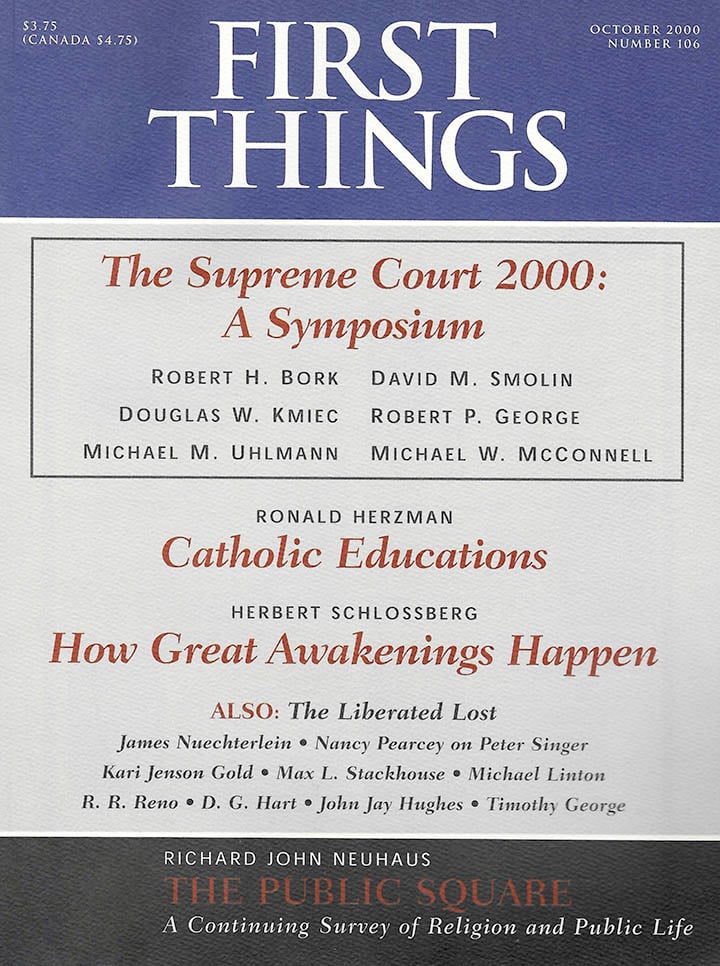
David M. Smolin is Professor of Law at Cumberland Law School of Samford University in Birmingham, Alabama, and Fellow of the Southern Center for Law and Ethics. He was primary author of a medical facts brief in Stenberg that was cited in both majority and dissenting opinions.

YOU MIGHT ALSO LIKE
Moral Certitude and the Iran War
The current military engagement with Iran calls renewed attention to just war theory in the Catholic tradition.…
The Slow Death of England: New and Notable Books
The fate of England is much in the news as popular resistance to mass immigration grows, limits…
Ethics of Rhetoric in Times of War
What we say matters. And the way we say it matters. This is especially true in times…
