Ads


RSS

Print Edition Archive
2010 2009 2008 2007 2006 2005 2004 2003 2002 2001 2000 1999 1998 1997 1996 1995 1994 1993 1992 1991 1990
Aug/Sept 2010
Aug/Sept 2010
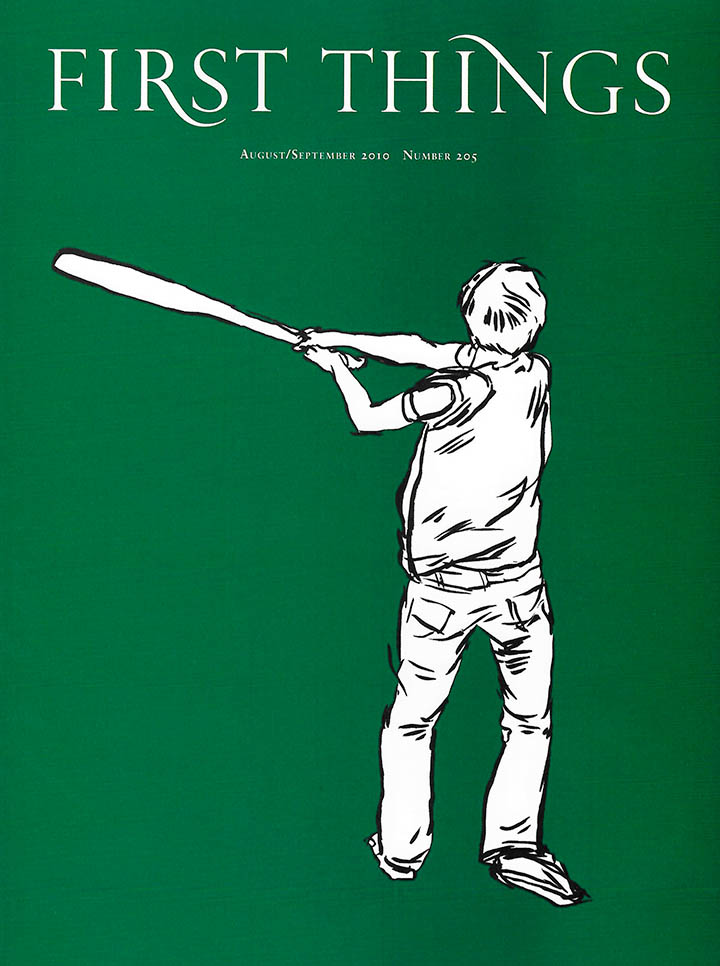
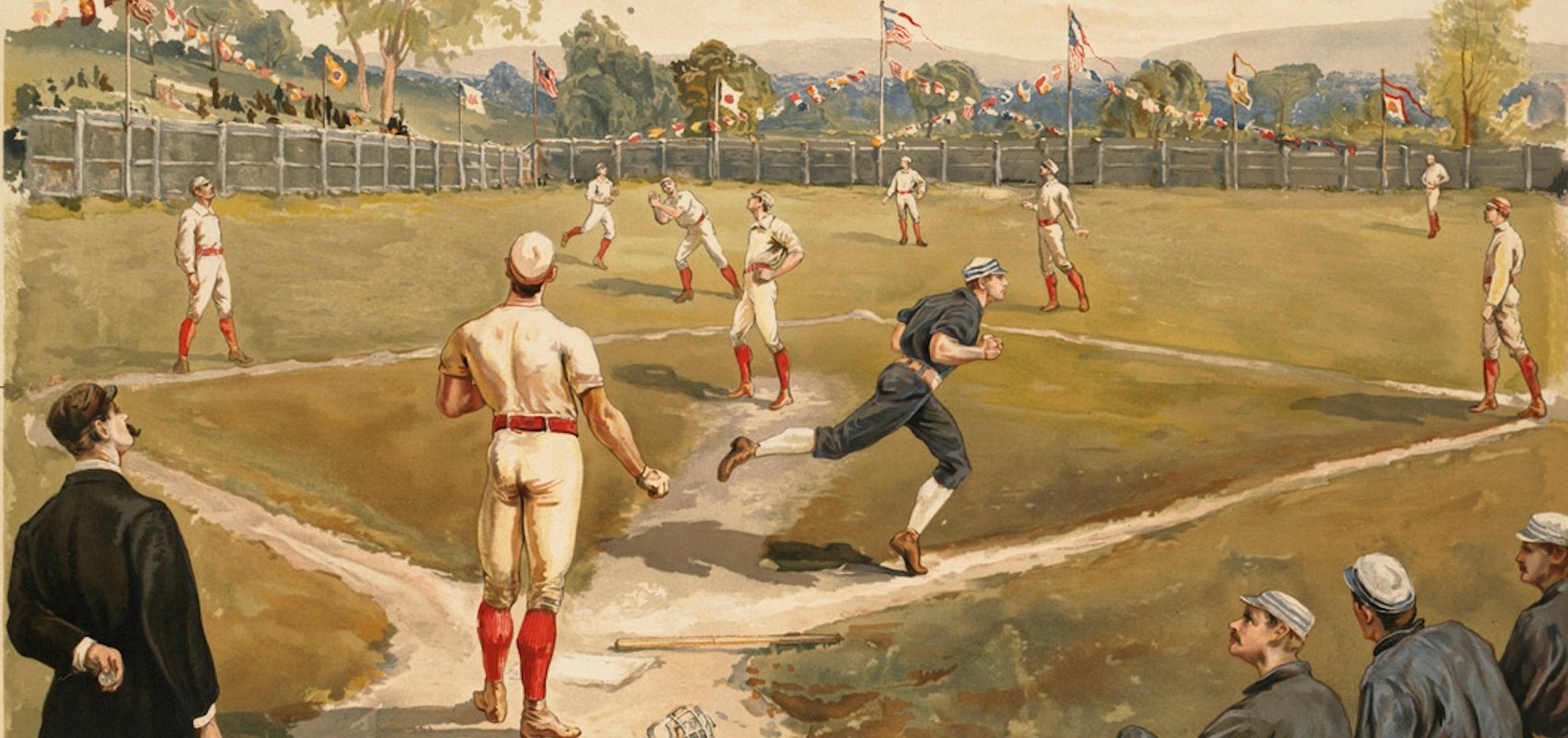
A Perfect Game
The metaphysical meaning of baseball

In his later philosophy, Heidegger liked to indulge in eccentric etymologies because he was certain that there are truths deeply hidden in language. It is one of the more beguilingly magical aspects of his thought and therefore—to my mind—one of the more convincing. Consider, for instance, the wonderful ambiguity one finds in the word invention when one considers its derivation. The Latin invenire means principally “to find,” “to encounter,” or (literally) “to come upon.” Only secondarily does it mean “to create” or “to originate.” Even in English, where the secondary sense has now entirely displaced the primary, the word retained this dual connotation right through the seventeenth century. This pleases me for two reasons. The first is that, as an instinctive Platonist, I naturally believe that every genuine act of human creativity is simultaneously an innovation and a discovery, a marriage of poetic craft and contemplative vision that captures traces of eternity’s radiance in fugitive splendors here below by translating our tacit knowledge of the eternal forms into finite objects of reflection, at once strange and strangely familiar. The second is that the word’s ambiguity helps me to formulate my intuitions regarding the ultimate importance of baseball.

What, after all, will the final tally of America’s contribution to civilization be, once the nation has passed away (as, of course, it must)? Which of our inventions will truly endure? We have made substantial contributions to political philosophy, technology, literature, music, the plastic and performing arts, cuisine, and so on. But how much of these can we claim as our native inventions, rather than merely our peculiar variations on older traditions? And how many will persist in a pure form, rather than being subsumed into future developments? Jazz, perhaps, but will it continue on as a living tradition in its own right or simply be remembered as a particular period or phase in the history of Western music, like the Baroque or Romantic?

My hope, when all is said and done, is that we will be remembered chiefly as the people who invented—who devised and thereby also, for the first time, discovered—the perfect game, the very Platonic ideal of organized sport, the “moving image of eternity” in athleticis. I think that would be a grand posterity.

I know there are those who will accuse me of exaggeration when I say this, but, until baseball appeared, humans were a sad and benighted lot, lost in the labyrinth of matter, dimly and achingly aware of something incandescently beautiful and unattainable, something infinitely desirable shining up above in the empyrean of the ideas; but, throughout most of the history of the race, no culture was able to produce more than a shadowy sketch of whatever glorious mystery prompted those nameless longings.

The coarsest and most common of these sketches—which has gone through numerous variations down the centuries without conspicuous improvement—is what I think of as “the oblong game,” a contest played out on a rectangle between two sides, each attempting to penetrate the other’s territory to deposit some small object in the other’s goal or end zone. All the sports built on this paradigm require considerable athletic prowess, admittedly, and each has its special tactics, of a limited and martial kind; but all of them are no more than crude, faltering lurches toward the archetype; entertaining, perhaps, but appealing more to the beast within us than to the angel.

In a few, peculiarly favored lands, more refined and inspired adumbrations of the ideal appeared. The Berbers of Libya produced Ta Kurt om el mahag, and the British blessed the world with cricket, but, because the running game in both is played ¬between just two poles, neither can properly mirror the eternal game’s exquisite geometries, flowing grace, and sidereal beauties. And then there is that extended British family of children’s games from which baseball drew its basic morphology (stoolball, tut-ball, and, of course, rounders); but these are only charming finger-paint renderings of the ideal, vague, and glittering dreams that the infant soul brings with it in its descent from the world above before the oblivion of adulthood purges them from memory; they are as inchoately remote from the real thing as a child’s first steps are from ballet. In the end, only America succeeded in plucking the flower from the fields of eternity and making a garden for it here on earth. What greater glory could we possibly crave?

You needn’t smirk. I admit that my rhetoric might seem a bit excessive, but be fair: Something about the game elicits excess. I am hardly the first aficionado of baseball who has felt that somehow it demands a “thick” metaphysical—or even religious—explanation. For one thing, there is the haunting air of necessity that hangs about it, which seems so difficult to reconcile with its relatively recent provenance. It feels as if the game has always been with us. It requires a whole constellation of seemingly bizarre physical and mental skills that, through countless barren millennia, were not only unrealized but also unsuspected potencies of human nature, silently awaiting the formal cause from beyond that would make them actual. So much of what a batter, pitcher, or fielder does is astonishingly improbable, and yet—it turns out—entirely natural. Clearly, baseball was always intended in our very essence; without it, our humanity was incomplete. Willie Mays was an avatar of the divine capacities that lie within our animal frames. Bob Feller’s fastball was Jovian lightning at the command of mortal clay.

And there is something equally fateful, as has been noted so often, in the exact fittingness of the game’s dimensions: the ninety feet between bases, the sixty-and-a-half feet between the pitching rubber and the plate, that precious third of a second in which a batter must decide whether to swing. Everything is so perfectly calibrated that almost every play is a matter of the most unforgiving precision; a ball correctly played in the infield is almost always an out, while the slightest misplay usually results in a man on base. The effective difference in velocity between a fastball and a changeup is infinitesimal in neurological terms, and yet it can utterly disrupt the timing of even the best hitter. There are Pythagorean enigmas here, occult and imponderable: mystic proportions written into the very fabric of nature of which we were once as ignorant as of the existence of other galaxies.

How, moreover, could anyone have imagined (and yet how could we ever have failed to know) that so elementary a strategic problem as serially advancing or prematurely stopping the runner could generate such a riot of intricate tactical possibilities in any given instant of the game? Part of the deeper excitement of the game is following how the strategy is progressively altered, from pitch to pitch, cumulatively and prospectively, in accordance both with the situation of the inning and the balance of the game. There is nothing else like it, for sheer progressive intricacy, in all of sport. Comparing baseball to even the most complex versions of the oblong game is like comparing chess to tiddlywinks.

And surely some account has to be given of the drama of baseball: the way it reaches down into the soul’s abysses with its fluid alternations of prolonged suspense and shocking urgency, its mounting rallies, its thwarted ventures, its intolerable tensions, its suddenly exhilarating or devastating peripeties. Even the natural narrative arc of the game is in three acts—the early, middle, and late innings—each with its own distinct potentials and imperatives. And because, until the final out is recorded, no loss is an absolute fait accompli, the torment of hope never relents. Victory may or may not come in a blaze of glorious elation, but every defeat, when it comes, is sublime. The oblong game is war, but baseball is Attic tragedy.

All of this, it seems to me, points beyond the game’s physical dimensions and toward its immense spiritual horizons. When I consider baseball sub specie aeternitatis, I find it impossible not to conclude that its essential metaphysical structure is thoroughly idealist. After all, the game is so utterly saturated by infinity. All its configurations and movements aspire to the timeless and the boundless. The oblong game is pitilessly finite: Wholly concerned as it is with conquest and shifting lines of force, it is exactly and inviolably demarcated, spatially and temporally; having no inner unfolding narrative of its own, it does not end, but is merely curtailed, externally, by a clock (even overtime is composed only of strictly apportioned, discrete units of time).

Baseball, however, has no clock; rather, terrestrial time is entirely subordinate to its inner intervals and rhythms. And, although the dimensions of the diamond are invariable, there are no fixed measures for the placement of the outfield walls. A ball that would be a soaring home run to dead center in St. Louis falls languidly short in Detroit, like a hawk slain in ¬mid-flight. A blow that would clear the bleachers at Wrigley Field is transformed into a single by the icy irony of Fenway’s left field wall, while a drowsy fly ball earns four bases. Even within a single park—Yankee Stadium, for instance—there is an often capricious disproportion between the two power alleys.

All these variations, all these hints of arbitrariness, are absolutely crucial to the aesthetics and moral metaphysics of the game because they remind us that fair territory is, in fact, conceptually limitless and extends endlessly beyond any outfield walls. Home plate is an open corner on the universe, and the limits we place on the game’s endless vistas are merely the accommodation we strike between infinite possibility and finite actuality. They apprise us, yet again, that life is ungovernable and pluriform, and that omnia mutantur et nos mutamur in illis. They speak both of our mortality (which obeys no set pattern or term) and of the eternity into which the horizons of consciousness are always vanishing (the primordial orientation of all embodied spirit). And something similar is true of the juncture of infield and outfield, where metaphysics’ deepest problem—the dialectical opposition but necessary interrelation of the finite and the infinite—is given unsurpassable symbolic embodiment.

Now, of course, when I speak of baseball’s “idealism,” it is principally Platonism I have in mind: Greek rather than German idealism. But I have to admit that, as I have just described it, much of the game seems to speak not only of the finite’s power to reflect the infinite but also of a kind of fated, heroic human striving against the infinite. There are few spectacles in sport as splendid and pitiable as the batter defiantly poised before all that endless openness. We know that even the most majestic home run is as nothing in its vastness, that even the greatest hitter is a kind of Sisyphus, proudly indifferent to the divine mockery of that infinite horizon; and it is precisely this pathos that lends such moving splendor to those rare Homeric feats that linger on in our collective memory: Babe Ruth in Detroit in 1926, Frank Howard in Philadelphia in 1958, Mickey Mantle in New York in 1963, Frank Robinson in Baltimore in 1966 . . .

No other game, moreover, is so mercilessly impossible to play well or affords so immense a scope for inevitable failure. We all know that a hitter who succeeds in only one third of his at-bats is considered remarkable, and that one who succeeds only fractionally more often is considered a prodigy of nature. Now here, certainly, is a portrait of the hapless human spirit in all its melancholy grandeur, and of the human will in all its hopeless but incessant aspiration: fleeting glory as the rarely ripening fruit of overwhelming and chronic defeat. It is this pervasive sadness that makes baseball’s moments of bliss so piercing; this encircling gloom that sheds such iridescent beauty on those impossible triumphs over devastating odds so amazing when accomplished by one of the game’s gods (Mays running down that ridiculously long fly at the Polo Grounds in the 1954 World Series, Ted Williams going deep in his very last appearance at the plate); and so heartbreakingly poignant when accomplished by a journeyman whose entire playing career will be marked by only one such instant of transcendence (Ron Swoboda’s diving catch off Brooks Robinson’s bat in the 1969 Series).

Really, the game has such an oddly desolate beauty to it. Maybe it is the grindingly long, 162-game season, which allows for so many promising and disheartening plotlines to take shape, only to dissolve again along the way, and which sustains even the most improbable hope past any rational span; or maybe it is simply the course of the year’s seasons, from early spring into mid-autumn—nature’s perennial allegory of human life, eloquent of innocent confidence slowly transformed into wise resignation. Whatever it is, there is something of twilight in the game, something sadder and more lyrical than one can quite express. It even ends in the twilight of the year: All its many stories culminate in one last, prolonged struggle in the gathering darkness, from which one team alone emerges briefly victorious, after so long a journey; and then everything lapses into wintry stillness—hope defeated, the will exhausted, O dark, dark, dark, all passion spent, silent as the moon, and so on. And yet, with the first rumor of spring, the idiot will is revived, the conatus essendi stirs out of the darkness, tanha awakens and pulls us back into the illusory world of hope and longing, and the cycle resumes.

All that said, though, one should not mistake the passing moods that the game evokes for the deeper metaphysical truths it discloses; one must not confuse the tone color with the guiding theme. Ultimately, baseball’s philosophical grammar truly is Platonist, with all the transcendental elations that that implies. This is most obvious in the sheer purity of the game’s central action. In form, it is not a conflict between two teams over contested ground; in fact, the two sides never directly confront one another on the field, and there is no territory to be captured. Rather, in shape it is that most perfect of metaphysical figures: the closed circle. It repeats the great story told by every idealist metaphysics, European and Indian alike: the purifying odyssey of exitus and reditus, diastole and systole, departure from and ultimate return to an abiding principle.

What could be more obvious? The game is plainly an attempt to figure forth the “heavenly dance” within the realm of mutability. When play is in its full flow, the diamond becomes a place where the dark, sullen surface of matter is temporarily transformed into a gently luminous mirror of the “supercelestial mysteries.” Baseball is an instance of what the later Neoplatonists called “theurgy”: a mimetic or prophetic rite that summons (or invites) the divine graciously to descend from eternity and grant a glimpse of itself within time.

No—seriously.

I am not nearly as certain, however, that baseball can be said to have any discernible religious meaning. Or, rather, I am not sure whether it reflects exclusively one kind of creed (it is certainly religious, through and through). Its metaphysics is equally compatible and equally incompatible with the sensibilities of any number of faiths, and of any number of schools within individual faiths; but, if it has anything resembling a theology, it is of the mystical, rather than the dogmatic, kind, and so its doctrinal content is nebulous. At its lowest, most cultic level, baseball is hospitable to such a variety of little superstitions and local pieties that it almost qualifies as a kind of primitive animism or paganism. At its highest, more speculative level, it tends toward the monist, as a consistent idealism must.

In between these two levels, however, the possibilities of religious interpretation are numberless, and it may require the eyes of many kinds of faith to see all of them. My friend R.R. Reno sees a bunt down the first-base line, in which the infield rotates clockwise while the runner begins his counterclockwise motion, as a clear evocation of Ezekiel’s vision of the divine chariot’s living wheels, and so an invitation to Merkabah mysticism. A Buddhist acquaintance from Japan, however, sees every home run as a metaphor for the arahant who has successfully crossed the sea of becoming on the raft of dharma.

Of course, the mental and physical disciplines of the game are clearly contemplative in nature. No one could, for instance, no matter how fine his eyesight or physical coordination, hit a major-league pitch with a cylindrical bat if there were not some prior attunement on his part to the subtle spiritual force that flows through all things, a sort of Zen cultivation of the mindless mind, in which the impossible is accomplished because it somehow simply accomplishes itself in us. Japan’s greatest hitter, Sadaharu Oh—whose hitting coach, Hiroshi Arakawa, was a disciple of Morihei Ueshiba, the founder of Aikido—even wrote a book on his discovery of the Zen way of baseball. But there are contemplatives and adepts in all major religious traditions.

One could, I suppose, conclude that baseball is primarily Western in its religious orientation, on the shaky grounds that the game as we know it has a somewhat eschatological logic: Within the miniature cosmos of the park, the game must be played down to its final verdict and cannot end before judgment is passed. No one, I think, doubts that Yogi’s most oracular formula, it ain’t over till it’s over, is a perfectly condensed statement of what for us are the game’s highest spiritual and dramatic stakes. And yet the Japanese will play to a draw with equanimity, content at the last simply to let go, so that all forces can reach equilibrium, and I do not believe their version of the game is necessarily any less elegant or profound than ours.

There are, however, at least two respects in which I suppose baseball could be said to speak to, and speak out of, an essentially biblical vision of reality. First, there is simply its undeniable element of Edenic nostalgia: that longing for innocence, guileless play, the terrestrial paradise—a longing it both evokes and soothes. Bart Giamatti, though, wrote so famously and so well on this topic that I have little to add. I only observe that the ballpark is a paradise into which evil does occasionally come, whenever the Yankees are in town, and this occasionally lends the game a cosmic significance that it would not be improper to call “apocalyptic.” This, in fact, is why that dastardly franchise is a spiritually necessary part of the game in this country; even Yankees fans have their necessary role to play, and—although we may occasionally think of them as “vessels of wrath”—we have to remember that they, too, are enfolded in the mercy of providence.

And, second, the game is, for many of us, a hard tutelage in the biblical virtues of faith, hope, and love. Here, admittedly, I am drawing on personal spiritual experience, but I can do so out of a vast reservoir of purgative suffering. My team, you see, is the Baltimore Orioles. In my youth I was full of wicked pride. The Orioles, for nearly the first two decades of my life, were the envy of the baseball world: winning more games than any other franchise, the only team with a winning record against the Yankees, awash in Gold Gloves and Cy Young Awards, a team that was often said to be “magic.” In those days—the days of Frank and Brooks, Powell and Palmer, Blair and Buford, Eddie and the rest—it was almost unimaginable that a season would pass without a pennant race, or that New York would not tremble before us.

And now?

These—and I shall close on this thought—are the great moral lessons that only a game with baseball’s long season and long history and dramatic intensity can impress on the soul: humility, long-suffering, dauntless love, and inexhaustible faith in the face of invincible misfortune. I could no more abandon my Orioles than I could repudiate my family, or my native heath, or my own childhood—even though I know it is a devotion that can now bring only grief. I know, I know: Orioles fans have not yet suffered what Boston fans suffered for more than twice the term of Israel’s wanderings in the wilderness, or what Cubs fans have suffered for more than a century; but we have every reason to expect that we will. And yet we go on. The time of tribulation is upon us, and we now must make our way through its darkness, guided only by the waning lights of memory and the flickering flame of hope, not knowing when the night will end but sustained by the sacred assurance that whosoever perseveres to the end shall be saved.

David B. Hart’s most recent book is Atheist Delusions: The Christian Revolution and Its Fashionable Enemies.

Bookmark and Share

Comments:

7.15.2010 | 10:44am
john says:
excelente!

7.15.2010 | 11:11am
David says:
As usual, brilliant!

7.15.2010 | 12:38pm
Sean says:
I still need lots and lots of beer to enjoy a baseball game. And that's not just because my team is the Rockies.

7.15.2010 | 5:19pm
James Kindt says:
Poor Sean: Once again he feels moved to confess the limitations of his sensibility. We already know he likes boring prose. One dreads to learn that he is a soccer fan, or a follower of golf.

Anyway, this is wonderful. Baseball is an endless series of mysteries, all of them beautiful and baffling.

7.16.2010 | 1:48am
Nathan Duffy says:
Nice piece. Though some other writers can write just as eloquently about the specifics and peculiarities of their sport that separate it, and elevate it above all others. David Foster Wallace on Tennis comes to mind. And while it may be true that most other sports appeal "more to the beast within us than to the angel", that seems to be, in a certain way, an argument for THEIR superiority--in the sense of them being a truer, more accurate representation of our nature.

7.16.2010 | 5:41pm
Linda L. says:
@ Nathan Duffy

Please, some of us are in the ancient and venerable tradition of Christian Platonism, and regard intellectus as the deepest aspect of embodied nature.

Anyway, some deluded souls may argue that there are better *sports*, but only a lunatic can imagine that there's a better *game*.

7.16.2010 | 9:14pm
Rob says:
One of the chief delights of life these days is to come in from a long week of work and find a new issue of First Things on the counter and even more so to find a new piece from David B. Hart lurking inside. Sitting on the couch beside my ten year old first baseman (watching his beloved Braves) and devouring this essay about this most wonderful of games was a gift indeed. Bravo, Mr. Hart.

7.17.2010 | 10:06am
Richard Miesel says:
Wonderful essay!! I'm trying to take advantage of the option to create a link to the article on my facebook page but instead of simply creating a link it is copying the entire article in what looks like ascii format into a giant note. I'm not sure why it's doing it. Can your tech folks figure this one out? I like sharing links to First Things articles from time to time on Facebook but something isn't working this time.

7.17.2010 | 10:08am
SteveW says:
One of the elements of the game that Hart neglects to consider, except maybe by implication, is how a baseball game is a form of liturgy. That is, like a liturgy, it is governed by "ritual time" -- certain forms must be observed, certain things accomplished before the dismissal, regardless of how long it takes. It is that quality of the game that resonates the deepest with me.

Oh, and Go Braves!

7.17.2010 | 11:36pm
Okie says:
This article fills me with joy, but most of all because it echoes something I always thought: that in the end, America will be remembered first and foremost for its sports, baseball Queen among the rest. Everything else we do is just a derivation of something Europe has all ready done. The rude statement I like to make is that before Americans got a hold of sports, athletics was just a bunch of naked Greeks running around with their private parts flapping in the wind. What's the world cup anyway?

7.18.2010 | 12:12pm
Charles Lewis says:
I loved this story. It was so over the top and yet it worked. Just the other night PBS was replaying the Ken Burns baseball documentary. It was the episode that included the famous 1951 playoff series between the New York Giants and Brooklyn Dodgers. I thought that famous home run in the bottom of the ninth, the "short heard round the world," perfectly captured the spirit Mr. Hart was trying to get at. Only one thing, I couldn't figure out the reference to Frank Howard in Philadelphia.
In any event, maybe others will add to this list of favourity moments:
1. Bobby Thomson's home run in 1951 (see it on YouTube)
2. Bill Mazeroski's ninth inning home run to beat the Yankees in 1960
3. Sandy Koufax striking out 15 Yankee in 1963
4. Bob Gisbson striking out 18 Tigers in 1968
5. Joe Carter's 1993 home run to end the 1993 series against the Phillies.

7.19.2010 | 11:36am
Alan Davis says:
I love it when D. B. Hart tries to see how far over the top he can go while keeping his readers in train. This might be his most Everestian performance yet.

Great stuff. I wish it had dwelled a bit longer on the strategy of the game, but that's a maze where I writer can get lost, I suppose. Once you begin expatiating on the subtleties of the inner game, you never know how to stop.

@Charles Lewis
As for the Frank Howard reference, it hows that Hart knows the game. Hondo hit a lot of outlandishly massive home runs (including 2 into the upper deck of RFK), but his first monstrous shot in the big leagues was the one he hit off of Robin Roberts on September 1, 1958 in Philadelphia. A really legendary blow. Whether it was his deepest is hard to say, but it was certainly his debut in the ranks of tape-measure maestros like Ruth, Foxx, and Mantle.

7.19.2010 | 12:46pm
Alan David says:
That should be 24 into the upper deck, not 2. Sorry.

7.19.2010 | 1:02pm
Alan Davis says:
And that should be DAVIS, not David. I'd better lay of. I can't even type my own name.

7.21.2010 | 12:45pm
Jeffrey J. Stables says:
A truly enjoyable and well-written piece. I expect I'll be quoting you for a while now. Thanks for sharing your love of The Game.

7.23.2010 | 2:03am
Brendan Funnell says:
A lovely piece. Unfortunately, as a fan of Cricket, I cannot help but disagree with it. Cricket is a vastly superior game to it's derivatives, such as Rounders and Baseball.

Why fielders need a leather glove to catch a ball that isn't as hard as a cricket ball always astounds me. All the bases need someone with a glove, but can't Americans catch a ball in their bare hands - or even one hand - as cricket players do?

The range of strokes available to the 'batter' and style of delivery for the bowler (Pitcher) are also more varied and require more skill.

Once again, a wonderful piece. Such a shame I cannot share its conclusions.

7.23.2010 | 12:09pm
Jack says:
A beautifully written piece about a beautiful game. While I agree with many of your observations and and all of conclusions, there is one bit of misinformation that--if corrected--would support your argument.

You say, "Baseball, however, has no clock; rather, terrestrial time is entirely subordinate to its inner intervals and rhythms." That's not entirely true. Baseball has never had an official clock, but for most of its history, before the advent of modern stadium lighting, it was governed by the rising and setting of the sun and the amount of sunlight available to the players. Therefore, there was an inherent urgency with which the game was played, an urgency that in many ways resonates with the seeming finality and arbitrariness of our lives. The game was played--not within a predetermined and unyielding set of minutes--but on an infinite landscape of time, governed only by the single temporal reality over which we have no control: the passing of the cosmos.

Sadly, that element of the game has been irretrievably lost to history.

7.24.2010 | 5:26am
tony o'brien says:
Brendan Funnell is right. Cricket is the Game of the Gods. It's just not American. Even 'football' is better than baseball, and by a country mile.

furhter, see: http://metapsychology.mentalhelp.net/poc/view_doc.php?type=book&id=3389

7.24.2010 | 8:29am
BE says:
Great piece. All games evoke metaphysical and psychological layers of meaning. Cricket can be boring but that is what sets off the truly riveting parts so well, as I learned at a Test Match at Lord's once, when, for fifteen minutes on a lazy summer day, hundreds of people were on their seats' edge. Watching some kind of game or match in the USA one gets a sense of the great nation at play, the gambling behind the scenes, the vast newsmaking machinery constantly updating all around the borders and ccrisscrossing the heartland, destiny and chance playing out their duel all over the country.
And don't get me started on football! (Hint: the ball is guilt). It's about scapegoating.

7.24.2010 | 8:37am
Mick H says:
Nicely written if misguided in sentiments. Baseball is interesting sometimes and boring often. Elegant and profound it is not. It seems to appeal only to Americans and their imitators in the far East. And its players are such fine role models. Have you read Jim Bouton's "Ball Four"? That should tell you something. If you want to see poetry and athleticism in sport, watch Jaialai.

7.24.2010 | 9:04am
Dwaine S. says:
One reason I love baseball is that it inspires better writing than any other sport. When I was a child, I loved to read. But as a teenager, I became more interested in cars and girls--and sports. Though I never played the game myself, I could never figure out why baseball appealed to me even more than the sports I did play (basketball and football--the "oblong games"). As my teenage years passed, the love of baseball did not, even in the off-season. It was then that I sought out books on baseball, the archetype of which is *Boys of Summer*. And books like that restored that childhood love of reading, just in time for me to choose to study literature and philosophy in college, one of the best decisions of my life. In other words, I credit baseball with incubating my childhood love of reading through those dreadful teenage years. And, more importantly, with giving that love back to me afterward.

Oh, and go Twins! Too many National Leaguers around here!

7.24.2010 | 9:12am
Dick Hogan says:
Great Stuff!!!

I always believed two things about baseball: 1.) It is like going to church--many people go, but few people understand. 2.) It always presents
different, infinite narrative possibilities.

7.24.2010 | 10:16am
Richard F says:
and then there's cricket...
like the difference between calculus and addition on your fingers and toes.
No, there is no comparison really

7.24.2010 | 11:42am
Fred Faustroll says:
Malamud’s “The Natural” is steeped in Arthurian symbolism: The Polar Myth (timeless). The diamond is in the form of a quincunx: see Sir Thomas Browne’s “Garden of Cyrus” (1658); the mound a "polar mount." The little white ball is the soul; every ballplayer is trying to send his “home.” Religious? Yes, but non-denominational, as in F. Schuon’s “Transcendent Unity of Religions.” Metaphysical? OK; but really more Pataphysical (A. Jarry), in which the prefix is drawn from the Sanskrit: to fly and to fall, a coincidentia oppositorum (Cusanus).

7.24.2010 | 11:49am
Jim says:
I need smirk. As others have noted, cricket is a vastly, vastly superior game in every way. Baseball is simply boring. This article has little to do with the (mistaken) impression of the supremacy of baseball and everything to do with silly American self-regard.

7.24.2010 | 12:10pm
Rod Nelson says:
Brilliant piece!

>>Jack - good point wrt to the game, before lights, governed by the single temporal reality over which we have no control, but I suggest that he take the time to absorb W. P. Kinsella's epic Iowa Baseball Confederacy for a glimpse at baseball through the looking glass.

7.24.2010 | 12:12pm
PDG says:
It's really quite simple...baseball is the only major sport wherein the officials don't use whistles.

7.24.2010 | 12:17pm
dave eccles says:
One can't actually play baseball - except the underarm pitch version which is more like Rounders played by girls in UK. Little leagers can't even hit that ball.

At least cricket can be played by folks.
All other US major games are size-dependent.

7.24.2010 | 12:29pm
Mark says:
Baseball is fun to play, but boring to watch. As a spectator sport it is in many ways similar to golf.

7.24.2010 | 1:27pm
Mike says:
George Carlin on BASEBALL AND FOOTBALL

Baseball is a 19th century pastoral game.
Football is a 20th century technological game.

Baseball is played on a diamond, in a park . . . the baseball park.
Football is played on a gridiron in a stadium, sometimes called Soldier Field or War Memorial Stadium.

Baseball begins in the spring, the season of new life.
Football begins in the fall, when everything is dying.

Football is played in any kind of weather--rain, snow, sleet, hail, fog…
In baseball, if it rains, we don't go out to play.

In football, you wear a helmet.
In baseball, you wear a cap!

Football is concerned with downs. What down is it? Oh, it's the last down.
Baseball is concerned with ups. Who's up? Are you up? He's up! I'm up!!

Baseball has the seventh inning stretch.
Football has the two minute WARNING.

And, of course, the objectives of the games are also completely different.
In football, the object is for the quarterback, sometimes called the field general, to riddle the defense with his aerial assault, by hitting his targets with deadly accuracy in spite of the blitz, even if he has to use the shotgun. With short bullet passes and long bombs, he marches into enemy territory, balancing this aerial assault with a sustained ground attack that punches holes in the forward wall of the enemy's defensive line.

In baseball, the object is to get home . . .and to be safe! Safe at home.

7.24.2010 | 2:00pm
kalay R says:
The poetry in the prose flows as smooth as a perfect pitch. I will never be able to watch a baseball game the way I used to. Someone said to me some time ago: "There is so much going on in he game... ." and I thought he was exaggerating.

7.24.2010 | 2:16pm
Jon M says:
Someone compared this parochial and pretentious essay to David Foster Wallace on tennis. For anyone who hasn't, I suggest reading "Roger Federer as a Religious Experience". It is a real treat, and the thought and writing are of a different order altogether.

7.24.2010 | 2:58pm
Roy Weston says:
It's been said that baseball is 90% inspiration and 10% perspiration, but only if you see baseball as a game of strategy rather than a sport. Other than that, it's the best cure for insomnia that I can think of.

7.24.2010 | 4:29pm
Peter says:
There has to be a moratorium on intellectual/philosophical paeans to the mostly-stand-around-and-spit-and-scratch game of baseball. Aren't 4,326,875 of them enough?

7.24.2010 | 4:41pm
brady waddington- says:
"sport is the opiate of the masses" -karl marx, paraphrased! truely, this article is a sad reaffirmation that americans are being dumbed down, doped up on sport to avoid thinking about what really matters. in centuries to come, the only things that'll be remembered about the late-great-USA empire will be: noam chosky and alcoholics anonymous

7.24.2010 | 5:32pm
Christopher says:
Baseball, as practiced with the exquisite perfection the great Yankee teams seem capable of, is indeed inspiring - but when compared to what the genius of Mozart, Haydn, and Mahler brings to life, it is nothing....

7.24.2010 | 7:55pm
Andrew Lyttle says:
Jim, and other cricket-lovers, please stop. I'm sure you find baseball boring, since it is usually the case that one is bored by what one doesn't understand. I'm bored by long treatises on differential equations.

When Brits talk about baseball, they always come across as simpletons. I say this as a Brit who has lived in the US for 17 years, who grew up on cricket, and who learned to love baseball. Physically, baseball is the more difficult and graceful sport, and I apologize for my fellow countrymen who make embarrassingly silly claims about batting or bowling in cricket being more difficult than batting and pitching in baseball, or who ask why baseball fielders need gloves (showing thereby that they haven't the foggiest clue what they're talking about). Baseball is also a game of strategy to a degree that cricket simply isn't, because the essential aim of the game is a base-to-base advance of runners. There is plenty of strategy in cricket, but baseball is about moving pieces on a chessboard, and cricket just doesn't compare.

Please also excuse people like 'Jim' and 'John M' who are apparently too slow-witted to recognize tongue-in-cheek humour when they read it. And the English have the audacity to claim that Americans don't do irony!

Dave Eccles has a point though. Cricket can be played by people of normal athletic ability. Baseball is bloody impossible. Softball is no substitute. And, unlike other sports, which can draw their talent directly from colleges, baseball has three levels of minor leagues just to bring players up to playing level, and even then most human beings lack the hand-to-eye coordination, agility, or bizarrely fast reflexes to play the major leagues game. In that sense, cricket is 'superior': it requires lesser physical skills, and so can be played by 'folks'.

I love and have always loved cricket. Baseball is superior in innumerable ways nonetheless.

7.25.2010 | 12:35am
Joe Atheist says:
How conflicted can a guy be? The author almost comes across as a db apoligist for a game that I knew and loved, but no longer have any affection for.

It's as if he writes in order to confirm all the "fashionable" misconceptions about baseball that people I know already have...and shove in my face.

Please forgive me, but this overwrought piece of naval-gazing is counter-productive if you care to hold onto a sensibily consistent with an appreciation for a game that is ineluctably receding from popular consciousness.

[Btw, Oriole-guy: This is coming from a Sox-guy who suppresses the puke reflex at the sight of a Papelbon out-gasm.]

Let's all grow up, though, please? And agree that the "game" [the admin of the "sport" is pathetic] can inspire infinitely legitimate reflection without having the responsibility of carrying our individual existential baggage.

Just read "Big Hair and Plastic Grass," and lose your pretense, man.

7.25.2010 | 1:21am
Norman says:
As a youngster I played all of the sports but baseball was impossible. Tough to hit a baseball; tough to pick up a hard hit grounder; the throw from third to first even Hall of Famer Joe Morgan has said he couldn't do it. Every other sport a person can play even poorly but baseball, for some of us, as way beyond reach.

7.25.2010 | 6:08am
Gilbert says:
@Andrew Little. It is you who should have stopped after you'd rightly pointed out the stupidity of the "why gloves?" argument. Whatever case there may be for saying that baseball is "superior in innumerable ways", you have not made it. Or, given the limitations of space, even suggested what that case might rest on. Anyone of average coordination and physical ability can play baseball just as they can play cricket, or tennis, or rugby.. but only those of special abilities can play these games exceptionally well. Baseball is no different to any other game in that regard and I'm sure it's just as easy to play cricket badly as to play baseball badly, it proves nothing. OK, it's difficult to throw a bullet from third to first, that's why there are specialists in that position .. it's difficult to take sharp catches at bat-pad but some guys can do it regularly, so that's where they field.
The strategic nuances and subtleties of both games are different in many ways but are entirely comparable, and the requirement to read and predict human response and behaviour is also very crucial to both. Test cricket's fluctuating narrative over several days is one of its most compelling attractions and brings in elements of strategy not shared by baseball .. but baseball's intricate orchestration of the runners around the bases is not shared by cricket. Space forbids fleshing all this out but your hyperbole is unnecessary when all that's required is to indicate the foolishness of those who dismiss baseball out of ignorance, otherwise your overstatement is no better than theirs.

7.25.2010 | 7:59am
The Commish says:
Learn how to score a baseball game and all will become clear.

7.25.2010 | 10:03am
William says:
As a Red Sox partisan I am quite comfortable with your suggestion of the Yankees as the serpent in Eden, but I must also note that I found that comment to be the one inelegant bit in this beautiful essay. I have discovered over the years that there are some Yankee fans with both minds and souls, and I would prefer to see your essay revised to be fully ecumenical in tone. Your comment about the Yankees hit a sour note somewhat as if the speaker at an interfaith conference asserted that all the inclusive comments previously made did not apply to one large and prosperous church that was not to the speaker's taste. A very satisfactory alternate tempter, present from the beginning, is at hand: Greed, with his latest presentation, PED's.

7.25.2010 | 2:13pm
Andrew Lyttle says:
@ Gilbert

If I gave the impression that I think baseball superior in every way, forgive me. I said 'innumerable ways', but I could have said the opposite as well. There are also many, many ways in which cricket's nuances give me pleasures that baseball doesn't afford. But for some reason partisans of cricket feel they need to disparage baseball in a way that baseball lovers would never disparage cricket; and invariably those cricket-fanciers show they really don't know anything about baseball, and tend to make embarrassingly silly statements.

They are both beautiful games, with histories that are more intertwined than most people grasp. Baseball is more of a chess game than cricket, but cricket strategy is still deep and elegant. See this link to a wonderful BBC 4 piece about an exhibition regarding that history:
http://news.bbc.co.uk/today/hi/today/newsid_8693000/8693097.stm

On the matter of physical difficulty, however, I will not yield. Baseball really is harder, because of the cylindrical bat, the high velocity of the struck ball, the running game, and the throwing skills needed. The only country where both games are played seriously, as far as I know, is Australia. Many of Australia's best cricket players also play a high standard of amateur baseball; and those Aussies are pretty well unanimous in saying that, as an ensemble of physical skills, baseball is much the harder game. That, though, is not very important.

But the thing that really takes me by surprise in this thread is how many of the readers seem not to recognize that this is not meant to be a serious article. Hart is obviously pulling our legs, expressing his love of his favorite game by making playfully wild metaphysical claims, while throwing off a thousand obscure literary and cultural references. It is an exuberant and delightful joke. I am literally shocked that some of the British readers of the piece feel they have to leap in and begin abusing baseball, rather than playing along by simply making equally wild claims about their favorite game. It makes me wonder if Britain is getting more humourless by the year.

7.25.2010 | 2:35pm
Ibsen Martínez says:
Superb!

7.25.2010 | 2:44pm
D. B. Hart says:
I have been asked by an English friend to add a comment on cricket.

So, for the record, I love cricket as well, if not as much. During my years in England, it became a genuine passion for me, and I continue to study and to follow it. I even buy a nice new edition of Wisden every year. That baseball at the highest level requires a greater range of physical skills, and that batting in baseball is far harder, are simply facts known to any follower of both games; but I don't really see that as a very interesting point of difference.

I do wish British lovers of cricket, however, would not make assertions about baseball, all of which betray only a deep ignorance of the game. Americans who love baseball never, in my experience, make wild and ill-informed claims about cricket. Admittedly, even many baseball lovers have only a vague notion of the complexity of what goes into each play, each pitch, and each game situation. But it should be a rule of thumb that, unless you can explain the permutations of the double steal with runners at first or third, give a quick definition of the infield fly rule, tell from the positioning of the middle infielders what pitch will come on a 3-1 count with two outs and a runner in scoring position, expatiate upon the wheel-play, recognize the proper moment at which to attempt the suicide squeeze, say how to position the first baseman when there is a runner at second with two outs and a right-handed flare hitter at the plate, understand the basic hit-and-run play, make a reasonable argument about whether to use a sacrifice bunt to advance a runner from second in the seventh when behind by only two runs...(etc., etc., etc.), you should probably not venture insulting opinions about the relative complexity of the two games.

But why argue? This essay was hardly intended as a deeply serious piece. Praise cricket, by all means; but don't slander a game of which you have only the vaguest impressions.

7.25.2010 | 3:04pm
Robert O'Connell says:
@ Jon M, Peter, Joe Atheist, and a few others

Uh, guys, I wouldn't want to suggest that you may be lacking in powers of discernment, or that your senses of humor are perhaps a little deficient, but when you read a baseball article that invokes Pythagorean mysticism, neoplatonic theurgy, Buddhist metaphysics, Samson Agonistes, and so on, you should be sharp enough to realize that its author does not intend it to be taken strictly seriously. The point of this essay is to amuse, by being intentionally excessive. I enjoyed it immensely, precisely because I would not be so demented as to read it in a spirit of gravity. Lighten up, for goodness' sake.

7.25.2010 | 3:07pm
Henry H. says:
@ William

If Greed is the devil, then that only reinforces the remarks about the Yankees. What other franchise has been built so entirely on Greed?

7.25.2010 | 4:21pm
Dennis says:
What drivel. So, you like baseball better than other sports? Good for you. But to argue that it is somehow metaphysically superior to others is just absurd nonsense. If the most boring game, with the most dope-enhanced players (though cycling gives baseball players a good run for their money in the doping department), is your idea of a metaphysically and morally superior game, God help us! Baseball must rank high among the blights America has foisted on the world.

7.25.2010 | 6:26pm
Brendan Funnell says:
Andrew Little is talking nonsense. As an Australian who began school in America, I learned to play and love baseball before I knew what cricket was. The discovery of the vastly greater potential with bat and ball that cricket offers (and why non-basemen need a glove has yet to be explained when a cricket ball is far harder) remains a delight to this day. I watch both games, but if one is, say, talking about a different sense of time a five-day Test Match (I wish they still had the Rest Day in the middle) offers more scope than any single baseball game, and a Test series more of the same than even the Series games of baseball.

So I wish baseball fans complaining about cricket fans would take a deep breath and consider what is written or said, rather than leaping to unfounded conclusions.

7.25.2010 | 7:25pm
Jeff says:
i'm an Australian lover and lifelong player of cricket who has had the merest dabble in baseball, but foremost i am a lover of sports and their infinite complexities: kubb vs bocce, cricket vs baseball, australian rules football vs rugby vs rugby league vs gridiron vs soccer. Whatever game you name there will be a devotee to point out your flawed assertions regarding its rival 'code'. i was a hater of gridiron because i love the flow of the other football codes until my one-time American boss pointed out that college-level gridiron has much more flow - and my small exposure to this level of the sport allowed me a glimpse at the intricities and, dare i say it, the pleasures of this game.
But - to the point at hand:
DB Hart says "That baseball at the highest level requires a greater range of physical skills, and that batting in baseball is far harder, are simply facts known to any follower of both games."
Surely you continue to jest. The physical skills required to catch a smaller and harder cricket ball without a glove and those skills involved in ground fielding - stopping the ball, covering the distances of a cricket ground and judging the throw as well as placing all the fielders dependant upon the differing styles of 2 batsmen at any one time and different types of bowlers (regularly up to 4 different styles of bowlers and 5 or 6 different individuals each of whom have variations of deliveries within their style) etc etc can, in no way, be considered lesser than that of baseball.
Sure, a baseball bat is round and therefore it is in theory harder to strike the ball than with a cricket bat but the batsmen must contend with variation of the ball's movement in the air (movement akin to the baseballs movement from a pitcher) as well as movement of the ball off the ground, the surface of which is constantly changing over the course of a match. There are 2 batsmen operating at one time - it is not enough that 1 of them makes his ground, to get a single run each of them must make his ground (therefore there is an element of baseball's movement of on-base runners). Also, the cricket batsman has only 1 turn at bat in some forms of cricket and only 2 in a 5-day match. He is only allowed 1 'out' each time. The cricket batsman needs a bat that is (supposedly) easier to use because he has to do a lot more with it or, at least, has far fewer chances with it.
Cricket also has 3 very different forms of the game that only a few of the very best players are capable of mastering at the highest level - 20-20 games lasting an hour and a half, 1-day internationals lasting about 8 hours and Test matches lasting 5 days of 7 hours. All forms require different skills and the ability to adapt the basic skills and techniques in all facets of the game.
This is merely the tip of the iceberg regarding the differences and similarities between these games. NOBODY with a modicum of intelligence (only those with a personal preference) would state that one is superior to the other in any way shape or form let alone proport that its a simple fact that one requires a greater range of physical skills than another.
now, don't get me started on the bocce vs kubb debate...:)

7.25.2010 | 8:18pm
Decorum says:
This is one of those terrific pieces where the comments are almost more entertaining than the original article, if only for the breathtaking gullibility of so many. It's not quite as extreme as the 2002 World Cup spoof on urbanreflex (see http://www.urbanreflex.com/jun14_02/world_cup.html and the link at the bottom to the extraordinary comments) because the satire there was so transparent and heavy-handed that it makes one wonder if the comments were made up too and were part of the joke.

I prefer cricket to baseball, personally, although I enjoy both after ten years living in the U.S. Alas, I am disappointed to read that I don't meet Mr Hart's pretty steep criteria for eligibility to comment on baseball so I shall pass on that. But I would note that in both sports the essence of the strategic interaction between teams ultimately boils down to one guy throwing a ball towards another guy with a bat. The rest - field placements, steals etc. etc. - are epiphenomena of this relationship and flow from second-guessing the outcome of each pitch/delivery. It's that one-on-one interaction that fascinates me in both games and, for my money, it's a little richer in cricket because it's less constrained. In particular, the dynamic nature of the interaction in cricket is more extensive and allows for more complex - and thus more interesting - strategies. Bowlers in cricket know that they might be delivering 6 or more consecutive balls to the same batsman and they can - and do - take their time to set a batsman up. In baseball the interaction is in practice much more confined (although that adds a new set of intrigues of its own, in that the pitcher needs to consider who's on deck in determining how he wishes to deal with the current batter.)

All in all, though, I don't think you can reasonably complain, Mr Hart, that cricket lovers have over-reacted to your piece. De gustibus non est disputandum (a normative maxim, obviously, given that there are very few things more likely to trigger serious disputandum than assertions about gustibuses) and you can hardly be surprised that a claim about the superiority of baseball to all other sports - no matter how tongue in cheek might be the supporting evidence - elicits some strong reactions.

7.25.2010 | 9:38pm
Andrew Lyttle says:
Mr Funnell,
Perhaps gloves are needed because the cricket bat slows the (harder) ball down, while the baseball bat often speeds the ball up. A 125mph line drive cannot be caught with a bare hand because it tends to break the fingers. I once saw a line drive break a pitcher's femur. And what, pray tell, is a "non-baseman"? An outfielder, do you mean? Are you suggesting that a center fielder running after a ball in the gap and catching it over his head can do that bare-handed? Maybe a lazy fly, but not a deep line drive. But, to make it clear to you: in baseball, the advantage goes entirely to the defense. Outfielders can snag balls in the webbing of their gloves at a dead sprint that are not catchable in cricket, and that's part of the special beauty of the game; the glove is to assist the fielder in limiting what a batter can do, not simply to protect his precious hands. Remember, in baseball a .300 hitter is a very good hitter. Can you imagine the best batsmen in cricket being held to a 30% success rate? There would be no cricket in that event. Baseball is a different game, as surely you grasp; it's about advancing the runners; the fielders are therefore supposed to have the preponderant advantage in any at-bat.

Jeff,
Baseball obviously *does* require a greater *range* of physical skills. I am English myself, not Australian, but I have also played both games for many years now. While I agree that cricket is terrifically demanding, it simply does not require the "five tools" of baseball in anything like the same quantities and varieties. When we play cricket, we don't throw men out at the plate from the outfield, steal bases, rocket the ball from third to first, run down deep line drives over our heads and leap at the walls, slide into third, turn difficult spinning double plays in a split second, or hit diving sliders with a cylindrical bat (to name a few differences). We just don't, and we don't do anything comparable either. There is more and more varied sheer athleticism in baseball. Cricket requires immense skills; baseball requires even more.

Decorum,
You and I share similar backgrounds, it appears, so I won't argue with you. We seem simply to have formed different judgements regarding which game comes first in our affections and which second. As for the one-on-one confrontation, both games require a great deal of thinking, and I wouldn't know how to judge which is more difficult or richer (when a right-handed pitcher has to decide on a 3-2 count whether to go inside with his breaking ball against a dead pull hitter with a penchant for chasing inside, while moving the infield towards the right field line, and while a runner is on first with only one out, and the left-handed cleanup hitter coming up next...well, you see, it gets complicated). But, as for the larger game, I seem to get more pleasure from the chess-board aspect of baseball. It gets so complex at times it almost seems perverse to spend such mental energy on a child's game.
Incidentally, Mr Hart didn't seem to me to be complaining that the cricket fans had overreacted. He was lamenting, rather reasonably, that several of them were saying things about baseball that were atrociously ill-informed. And I think it's also obvious that his claims for baseball's transcendent excellence are meant to be amusing. Some of the cricket defenders that have chimed in here seem curiously unable to grasp that and to respond with comparable whimsy.

Anyway, I tend to think that the skills of the two games complement one another, and that anyone who plays both games is likely to have strokes that one-game players lack. Most Aussies who've made it to the major leagues are pitchers, as far as I can tell, and I would like to know if Australia has produced a major league hitter. But I remember that Devon White, the center fielder that used to play center field for Toronto, grew up in Jamaica and played both games. As I understand it, he has said that learning both games improved his batting technique in both.

7.25.2010 | 9:48pm
Jim Dandle says:
@ Brendan Funnell

I didn't think Dr Hart was complaining about cricket fans. As I understand it, he's one himself. He was complaining about only a few of them, those who were making nonsensical claims about a game they clearly don't know.

I'm an Australian too, by the way, so good to meet you. I find batting in baseball more difficult and more absorbing, I have to tell you. It takes so much precision just to hit the bloody ball squarely, let alone go the other way or bunt or hit a home run. But I'm pretty mediocre at baseball, so it may be that I'm fascinated by what I can't do well.

But surely you're joking about gloves. You try to run a deep drive down between centerfield and left and catch it with your bare fingers before it goes to the wall for a double. If you keep your fingers you still won't hold on to the ball. Anyway, isn't the whole point of baseball that hits are supposed to be rare? So fielders need to be able to snare balls that they couldn't without those gloves. And there are only three of them out there. You can't really be all that mystified by that, not if you really learned the game in your boyhood.

7.25.2010 | 10:52pm
Brendan Funnell says:
Mr Little: A non-baseman means an infielder or outfielder who is not on a base. !st, 2nd, 3rd and Home get gloves. No one else needs them. Very simple.

I've broken fingers and toes fielding at short leg, silly mid-on and even at point,. When a cricket ball is hit hard, it travels as fast or faster than a baseball.

I am suggesting someone catching a deep line drive can do so with bare hands, as cricket players do all the time. have these players no skill or no toughness?

As for batting averages and so forth, when Sir Donal Bradman's stats were converted to baseball he was the finest batter to ever live in either game. Check the statistical analysis. Well over .4.

7.25.2010 | 11:16pm
Bob says:
Andrew Lyttle, you should note that it was traditional in the post-WWII era for a touring Australian cricket team to play a home country's BASEBALL team at baseball as a warm up. Australian cricket teams regularly defeated the baseball teams of England, South Africa and other countries - not surprising given the number of Australian cricketers who were star domestic baseballers - the Chappells, Allan Border, and many more before that. It was a popular winter sport until the early 70s, particularly favoured by 'soccer mom' style parents of the time who didn't want their kids playing Australian football, rugby or rugby league. In the 70s Australian baseball switched to a summer season, and cricketers who had played it as an off-season sport had to decide between the two.

Brett Lee did some training in baseball early in his career with American teams, and despite being a 100 mph bowler (a very rare thing to be), it was his power hitting that impressed observers. With the popularity of the simplified Twenty20 form of cricket in the Subcontinent, cricketers' salaries are approaching those of baseballers, which is the one reason it was surprising more Australian cricketers didn't try their hand at MLB in the 60s-80s. Of course, you don't have to be a cricket purist to gag at Twenty20, but I suppose it's nice if a pool of say 100 Australian players can make an excellent living from the game, as opposed to 20 or so a generation ago.

7.25.2010 | 11:35pm
Andrew Lyttle says:
Mr Funnell, please stop misspelling my surname.

I assume you don't really mean to say the shortstop doesn't need a glove, since he too fields bases. And if the pitcher doesn't get a glove, would you be willing to pay the funeral expenses? In any event, your remarks show you really know far less about the game than you say. Sorry, but that seems clear. The more you talk about gloves, the more out of hand you get.

As a matter of fact, the baseball travels off the bat much faster, when hit squarely, then the ball in cricket does. This is a matter of established fact, not just my opinion. The baseball is more resilient than the ball in cricket, and the bat, being a cylinder, has a much much smaller impact area, and therefore exerts far greater pressure at contact. A cricket ball off the bat, because it is harder and heavier and is struck off a a flat surface, is slower than the ball bowled by a fast bowler. A baseball off the bat is often much faster than the pitcher's best fastball. Fielding bare-handed, even if a line-drive does not break your fingers, it will bounce off your palm before you can close your fingers around it (and leave a terrific bruise and maybe nerve damage to boot).

Anyway, when you ask why the fielders need gloves, all you do is clue the American readers in to your lack of baseball knowledge. First of all, it's nonsense to say that cricket players catch the sort of deep line drives that outfielders do all the time. The sort of ball on a line that an outfielder at a dead run catches over his shoulder is simply a ball that eludes the cricket player altogether. Don't tell me any cricket player has ever made a catch like Kenny Lofton flying into and half over the outfield wall and snagging a would-be home run, or Jim Edmonds sprinting directly towards the wall diving all the way into the warning track in center to catch a ball directly over his head, because it's never happened. Mathew Sinclair's famous 'greatest ever' catch in that New Zealand-Australia match was splendid, but it would be only an average play in major league baseball.

But, even if that were not true, you continue to miss the point. Once again, THE GLOVE IS SUPPOSED TO MAKE HITTING HARDER, not simply protect the fielder's hand. It's one of the reasons that batting is more difficult in baseball than in cricket. It's one of the reasons that outs are so much more plentiful than hits in a baseball game. Without gloves, baseball games would stretch over 8 hours, runs would come by the dozens, and all the precision and drama and subtlety of the game would be lost. In cricket, the batsman is at nothing like the disadvantage of the hitter in baseball, because the two games work completely differently. How can you really not know this?

I have loved cricket all my life. But I'm beginning to think that many of my fellow enthusiasts are far more incredibly thin-skinned and irrational than any baseball enthusiasts I know.

7.26.2010 | 12:06am
Brendan Funnell says:
Mr Little: Of course I mean the shortstop as well. Get a clue. Non-basemen means what it says.

Your claims for the speed of the ball are contrary to the studies I have seen and the feel of both being struck off my bat or into my hand. The variety of deliveries and shots available in cricket is unarguably greater than available in baseball due to the diamond, and bouncing the ball off the pitch. As Victor Trumper said when he hit a string of baseballs over the fence when touring the USA: anyone can hit a full-toss. That variety means fielders have to expect all kinds of different shots and shot-placement unavailable in baseball.

Your claims regarding catching are simply false. Over the shoulder, running backwards and line-drive style catches are commonplace in cricket. Do watch the game or play it sometime.

7.26.2010 | 8:50am
Andrew Lyttle says:
Then, Mr Funnell, I suppose the pitcher need a glove too, because he has to cover first quite often...

Anyway, this is nonsense. For those who don't know, Victor Trumper was a great Australian cricket player who died in 1915, and the only sort of baseball pitch he saw in his late nineteenth century visit to the states was the fastball. In those days, baseball had only one pitch. When the curve was invented, it was thought 'unmanly'. No sliders, changeups, knuckle-balls, curveballs, forkballs, cut fastballs... Nor did he ever face a real pitcher in a baseball game. Moreover, he certainly didn't hit a string of pitches 'over the fences', because he was hitting a dead ball; he may have hit several very deep and a few out. That Mr Funnell cites a 19th century example shows that he knows next to nothing about the game, and is talking through his hat. As does his failure to list the shortstop and pitcher among those who cover the bases.

Also, for those who don't know, his claims about fielding in cricket are nonsense too. Cricket has got a lot more athletic in recent years, but even cricket aficionados have long granted that the defensive side of baseball is the thing that is most impressively different about the game. In his magnificent prime, Ken Griffey Jr. made half a hundred catches that no cricket player has ever dreamed of making. Any week of 'web gems' on Baseball Tonight features defensive plays that exceed in athletic grace, speed, and precision anything cricket demands. And 'shots and shot-placement unavailable in baseball' is an absolutely meaningless phrase.

And there is no question about the greater speed of the baseball off the bat. Simple physics, sir. A cricket ball, being harder, cannot be propelled as fast, especially not off a flat bat. As an experiment, take a softball and a croquet ball, which are roughly the same size, and hit both off a baseball bat (or cricket bat). You will notice, I trust, that the croquet ball leaves the bat much more slowly and travels less far. Greater resiliency plus diminished surface area of impact equals greater velocity. If you are interested, several studies have shown that the struck baseball can travel almost twice as fast as the struck cricket ball.

Anyway, Mr Funnell has nearly spoiled what was a delightfully amusing article for me. He claims to know baseball, but clearly doesn't, and he keeps digging himself in deeper. The two games are lovely and intricate and each provides all sorts of pleasures that the other doesn't.

7.26.2010 | 9:02am
James Hinchcliffe says:
As a lover of cricket, but a man with an American mother and a deep fondness for baseball, may I dissociate myself entirely from Brendan Funnell's remarks, and apologise on behalf of all cricket lovers everywhere? His statements about baseball are deeply misguided and uninformed, even if he says he played the game as a boy.

Believe me, many of us who love cricket appreciate baseball profoundly and admire its subtlety and beauty quite sincerely. We even acknowledge that baseball fielding is faster and more balletic, and that the ball often moves much faster when batted. But the greatness of cricket lies in the greater control the batsman has in building an innings, so it would ruin the game if cricket players had gloves, just as it would ruin baseball if the fielders didn't.

7.26.2010 | 11:21am
Andrew Lyttle says:
@ Bob,

Thanks for that. I was wondering why more Australian hitters don't show up in the American major leagues. It's usually pitchers one sees. My ignorance is so vast that I didn't realize that baseball seasons in Australia were now concurrent with cricket. That's a pity. I think the games could use more players proficient in both. Somewhere out there, in the future perhaps, is the Australian who combines the skills of both W.G. Grace and Babe Ruth, or both Don Bradman and Ted Williams. But how will we find him if Australians now have to play only one of the sports on a regular basis?

I've never seen a match of Twenty20, by the way, and I don't like the sound of it. The logic of baseball requires a game that ideally ends within a few hours, because it's a tight, defensively-dominated sport. But cricket is supposed to stretch over days. It's an epic campaign waged by the batsmen. Twenty20 sounds like a tease to me.

7.26.2010 | 1:46pm
John says:
the hardest thing in all of sport is to hit a round ball with a round bat squarely.

7.26.2010 | 2:11pm
joe r. says:
I confess an almost complete lack of knowledge regarding cricket.

One unmentioned factor which makes baseball difficult to play, most particularly at the higher levels (high school and above), is simply fear. The average attendee at a baseball game, called out of the stands and merely asked to stand in the batter's box against a major league pitcher, would be so frightened that he could probably not do so.

So, is there a similar fear factor for batters in cricket?

7.26.2010 | 4:37pm
Warren Thompson says:
How do the Cubs fit into the metaphysical concept of "perfection"?

7.26.2010 | 9:02pm
jeff says:
Joe R.
there is definately a fear factor in cricket. The fastest bowlers bowl at a speed virtually identical to the fastest pitch - 100mph. But because they bowl into the ground the ball does arrive at the batter slower. Nevertheless the ball can bounce off the pitch differently depending on where it lands AND the bowler is allowed to aim at the batter (but not on the full).
one of the fast bowlers tactics is to aim for the throat/head or for the chest or anywhere else on the body by bouncing the ball off the ground so that it rears up into the batter's face or body. This forces him to defend himself by using his bat, increasing the chances of getting caught. i have had my cheekbone fractured when a ball from an average speed bowler hit me. I have also misjudged a hit and the ball rose up from the edge and split the skin at the edge of my eye socket. In the professional game fast balls have broken through the visor of a helmet and broken noses etc.
i would say the fear factor is well and truely present.

7.26.2010 | 9:03pm
jeff says:
Andrew Lyttle, you claim that "When we play cricket, we don't..." do the following. When did you last play or watch cricket? the 1950s?
"throw men out at the plate from the outfield" - it happens so often it is unremarkable, even i have done it as a no better than average player, a fielder will run 30, 40m or more, dive full length the stop a ball crossing the boundary and throw it 50m ++ to hit the stumps (or to another fielder to knock over the stumps) for a run out
steal bases - in cricket you can get a run, a 'bye', if you miss the ball and both batsmen swap ends before the wicketkeeper (catcher) gets the ball and hits the stumps. equally a batsman can steal a run, or extra runs, at any time from when the bowler releases the ball to when that play is complete whether it is because a fielder loses concentration, fumbles the ball or the like. Rules do not allow you to steal a run while the bowler is in the act of bowling.
"rocket the ball from third to first" - there are endless variations of fielders rocketing a throw from this distance to prevent a run or make a run out. this involves any combination of retrieving the ball by diving, sliding, whatever, and swivelling to an angle to make your throw often in the same motion.
"run down deep line drives over our heads and leap at the walls" - Firstly, cricket doesn't allow you to make contact with the fence or boundary while in contact with the ball (runs will go to the batsman regardless of a catch) so therefore the skill and judgement is in effecting the catch or stop before touching the boundary. Go to YouTube and type in "Incredible Cricket Run Prevention", "Awesome CATCH in ICL", "Cricket Best Catch ever Kiran Pollard", or "David Warner Brilliant Fielding on the Boundary Rope", for variations of this skill
"slide into third" - surely you are just trying to dupe fellow baseball followers. Can you honestly tell me that you have never seen a batsman dive face first along a hard cricket pitch (ground) to make a run before being run out? A feet first (or face first - arm extended) slide into third is exactly the same
"turn difficult spinning double plays in a split second" - double plays are not allowed in the cricket rules, only 1 player can be out in a single play, but there are instances where the batsman hits the ball softly (a bunt) to take a quick run and a fielder or the bowler can run in grab the ball, spin 180 degrees, and throw down the stumps at the end he just came from. Then there is all the reflex catches and fielding from close-in fielders after the batsman has hit a full blooded shot - often these fielders stand little more than a body length from the batsman. at other times it is a combination of reflexs, quick thinking and spatial awareness eg: YouTube ""AB de Villiers - Brilliant run out".
"hit diving sliders with a cylindrical bat" - you claim hitting (with control) a full-pitched ball (which moves in the air) with a cylindrical bat is harder than with a cricket bat. That is obvious. But you rarely hit a full-pitched cricket ball, any bowler who gives them will not be bowling long (even when it moves in the air). The batsman must also contend with movement of the ground and the bowler needs the skill to land the ball in an area (and on the seam of the ball) to make that movement off the ground less than predictable (here we enter the whole realm of seam bowling and legspin and offspin and all their variants that utilise this possible deviation off the ground. There is a Sri Lankan called Dilshan who has perfected a scoop over his head off a bowler delivering the ball at a bit under 100mph - YouTube "Dilshan scoop shot". i used to play a variant of this shot off slow bowlers but he does it off the fastest bowlers. There is no comparable skill in baseball, just as there is no "diving slider with a cylindrical bat" in cricket. So what? the range of controlled shots off the cricket bat is far greater on an oval field than that (allowed by the rules) in baseball.
You state that the cylindrical bat and the use of gloves is designed to make scoring runs more difficult (i never made that association with the use of gloves, so thank-you i no longer think baseballers are wimps for using them) you cannot then use this as justification for the game being more difficult. Cricket puts its premium on not getting out therefore no gloves and a wider bat are designed to make the scoring of runs easier and getting the batsman out more difficult. If you played cricket with a baseball bat you would get baseball scores, if you played baseball with a cricket bat you would get cricket scores. Your point becomes pointless.
finally you believe all this means that "Cricket requires immense skills; baseball requires even more." But, so far you've got nothing - so keep em coming. for every skill and athletic feat in one sport there is comparable (given the confine of rules) in the other.
to watch you pass off your personal preference for baseball as 'fact' of its superior demand upon skill is downright hilarious. Make my day - send in more examples.

7.26.2010 | 9:37pm
Bob says:
joe r. - Fear is a very prominent factor in cricket bowling. The peak of intimidating bowling was in the 1970s, but since then the advent of protective helmets and additional padding has made batsmen fear less for their lives.

Generally, the intimidating bowling (which is exhausting to deliver) commences at the start of a batsman's innings. A fielding captain needs to ration the intimidating tactics out, however, as wayward delivery is often punished, and it is not unusually for teams to field for six or eight hours running (and teams rarely have more than one or two specialist intimidatory bowlers). Rather than facing perhaps 5 pitches from one pitcher, a cricket batsmen aims to stay at the crease for as many balls as they can, hopefully exhausting the opposition's stable of bowlers and battering the ball out of condition in the process.

I think baseball is beautiful in how discrete its batter-pitcher duels, its boxed innings and its little divisions are. Cricket is beautiful in how it dilates from moments in time, to battles in microcosm, through five day matches that both teams are rarely trying to win at precisely the same moment, to ongoing traditions stretching backwards and forwards into eternity. At the start of Philip Roth's enjoyable The Great American Novel - which he cleverly self-criticises as a rabbinic agadah in baseball-novel form in Operation Shylock - , the geometry of the baseball's stitching is discussed lovingly. In cricket, the deterioration and polishing of the ball and the ground conditions are prime tactical and strategic considerations. Baseball is about hard and fast rules that are creatively tested; cricket is about ever discretionary laws and a still somewhat extant idea of what is and isn't 'cricket'. Nothing wrong with either game, in my opinion.

7.26.2010 | 11:12pm
Charles Oneal says:
Nice piece, almost enough to kindle an interest in the game. Spent ten years watching baseball but couldn't figure it out. It seemed like a game you watched while you read a book or did the crossowrd. However, if baseball was the only game available, I would probably watch-but never understand-the game; after football/soccer, rugby league, hurling or gaelic football fits the bill.

7.27.2010 | 12:13am
w.g.grace says:
baseball as the pinnacle of american invention, indeed of all sports? ha! this 'game' doesn't come close to the religious fervour and subtle intricacies that envelop every delivery in a five day test match in cricket. the ball is delivered in a variety of ways - slow, spinning, fast, seaming, curving - and coming off the pitch itself, which deteriorates and changes with the weather and the passage of play across these five days. the fact that there are two batsmen in at any time and the deliveries come in six-ball bursts from one end then the other; and that the batsmen each have just one wicket to defend (get out and you're out - no strike three!); and that there is a small hard ball with no gloves (ok, wicket keeper aside) to catch and field to stop the flow of runs - which must be gained by two batsmen each attaining their ground - and there is sooooo much more to cricket that baseball can ever hope to encompass.

then there is the real artistry inherent in world class football - oh, you call it 'soccer' - that you really oughtn't get me started.

7.27.2010 | 2:09am
Graphite says:
How did this descend into a cricket v baseball debate? As a Kiwi brought up on cricket who didn't see a baseball game until my 46th year, when I lucked into the Twins v Braves World Series of 1991 and have been hooked ever since, I regard both as wonderful sports – but both, like everything in life, flawed.

Cricket's greatest drawback is that it can be dominated by selfish players. Apparently Babe Ruth and Don Bradman met in the 1930s when the Australian team stopped off in New York on their way home from an Ashes series. Ruth was apparently intrigued by cricket not obliging a batter to run if he hit the ball – one of baseball's real strengths. There is simply no place in baseball for players such as Geoffrey Boycott, who's sole aim, seemingly, was to pile up personal statistics with no regard for the outcome of the match. And neither has baseball, from what I know of the sport, been subjected to the sort of tactics employed by the West Indies of the 1970s and '80s, whose battery of fast bowlers averaged something like 12 overs an hour of intimidatory bowling – difficult enough to score from and so time-consuming that running up a decent total was next impossible anyway.

Baseball's most annoying feature – and one that sets it apart from cricket – is the off-field orchestration of every single play. First thing a batter does when he reaches the plate is glance over to the third base coach for instruction, relayed from the dugout, on what to do. Something repeated for seemingly every pitch. Do these professional athletes really need nursemaiding to such an extent. Does a runner coming from first need a coach standing next to third base to tell him whether to continue home or hold up? And that first base coach? Are the players so intellectually challenged that they need coaching on what to do next after being lucky or skilful enough to manage the first step on the way to scoring? For about fifty percent of any game's time it resembles chess without chairs. Let the players play, for God's sake!

With that off my chest, I'll continue to enjoy both. And count myself lucky that I was able to see every pitch of the 2004 ALCS and all bar a few of the 2001 world series.

7.27.2010 | 8:55am
mike mcnair says:
Earl Weaver: You can't run out the clock in baseball"

7.27.2010 | 9:01am
john says:
... here's a brillant counterpoint to Dr. Harts inspired words:
http://www.youtube.com/watch?v=om_yq4L3M_I
thanks David B. Hart as always.

7.27.2010 | 9:19am
Graphite says:
Some more thoughts on this baseball v cricket thing.

Cricket, unlike the democratic baseball, is an elitist sport. It is unfairly tilted toward the batsman; heavily so. By there being no obligation to attempt to score after a hit, a batsman can occupy the crease for as long as he is able to keep the bowler at bay. This is a hangover from its early days when the aristocrats would spend their summer days engaged in the sport as batsmen, cracking boundaries and running singles, or, if the pitch was a bit lively, just sticking around, while the hired hands bowled to them. In the old Gentlemen v Players (amateurs v professionals) games, which weren't discontinued until the 1960s, the Players would invariably win because the Gentlemen couldn't muster a decent bowling attack. (Not a proper pursuit for a gentleman, you see.) A professional wasn't appointed captain of England until the 1950s, when Len Hutton got the job, even though professionals had been employed in the sport for more than a century. How many professionals became county captains before the 1950s I wouldn't know but "very few" would be my guess.

No such nonsense in baseball.

Jeff and w.g.grace are looking at test cricket through rose-coloured spectacles. A nephew of mine, a man in his thirties and a keen cricketer, has attended one test match in his life – at Eden Park, Auckland, about ten years ago, South Africa v New Zealand, second or third day. No wickets fell and very few runs were scored in the morning session (two hours). Forty-minute break for lunch. About an hour into the second session my nephew goes to the bar behind the stands to get a beer. While he's waiting, he hears a roar – a wicket has fallen; some excitement at last. He resumes his seat and watches the rest of the match – the remainder of the middle session and the two-hour final session. Again, no wickets fall and very few runs are scored. He hasn't been back and never will.

That may have been an extreme situation but unfortunately isn't too far from what often happens. The first priority is to run up a score large enough that you can't lose. When that is accomplished, you try to bowl the opposition out. Of course, if the opposition has been put in a position where they can't win, their objective is to stave off defeat. The result – a tiresome draw where only token attempts are made to score.

For all that the test-match "purists" protest (and they seem to take a perverse delight in declaring their standpoint – like classical music lovers who scoff at jazz), the fifty-over and twenty-over versions of the game are far superior. It is in these matches that you'll see the fielding that Jeff describes.

The three-strikes-and-you're-out and four-balls-and-you-walk rules are what make baseball a far more even contest between bat and ball. And it's the taking away from cricket, in its shortened versions, the rule that all wickets have to fall before a result is declared which has closed the gap between batsmen and bowlers in that sport.

7.27.2010 | 10:13am
Don says:
I think Mr. Hart must have taken a bet from someone saying he couldn't write about baseball in a metaphysical sense...Mr. Hart wins...this was such a great article that I actually had to break out my dictionary for some of the words he 'batted' around...lovely piece.

7.27.2010 | 11:26am
Andrew Lyttle says:
@ Jeff
Let's not get angry here.
I agree with almost everything you say, except that you seem to underestimate the degree to which baseball pitchers use the seams of baseballs to create every bit as much movement as a good bowler creates on the bounce, though within or just outside or breaking outside of the strike zone. But I still insist that all of the analogous defensive plays in baseball come faster, throwing technique in baseball is better, and that stealing a base in baseball is a far more complicated and athletic and difficult and daring thing than a bye. As for 'rocketing' the ball, baseball players grow up throwing the ball on a line that is harder and more accurate than one sees as a rule in cricket. Our rockets simply aren't as fast. But, again, you missed my point. When I mentioned double plays, I was not saying cricket is deficient in this sense; I was saying that, because cricket has no multiple out plays, it doesn't require those physical skills. Thus it requires a narrower *range* of fielding skills. Also, because gloves are catching devices (the webbing is the thing, like a lacrosse stick with your arm as the stick), outfielders routinely get to balls and make plays that cricket players can't--because it's not in the nature of the game. Also, a third baseman fielding a hot shot at the corner, leaping to his feet, and making the long throw to first to get the runner by a step is doing something which requires reflex speed that is rarely called for in any other game. A ball pulled down the third base line by a right-handed batter off say a 98 mph pitch may be moving at 123mph, so that from the pitcher to the batter to the third baseman roughly only a second elapses. But this is tiresome. Range means range, and I'm sticking to my guns. That said, in just the last twenty years, cricket fielding has become much more athletic than it once was, in part under the influence of baseball, so maybe my 17 years in the US have left me at a disadvantage when talking about the modern game. As I've said, I've never seen Twenty20, and if, as Graphite says, that's where the baseball like urgency and speed is to be found, maybe I really would like it.
But still, all those Youtube great cricket catches still don't look as fast and as awe-inspiring to me as ken Griffey Jr.'s greatest plays... And some of those double plays where the shortstop goes deep in the hole, or where the second baseman flips from his glove to the shortstop sweeping over the base and leaping over the runner's take-out slide while the first baseman is stretching out to his limit...well that's pure ballet, choreographed and spontaneous at the same time, and it has to be done with unconscious fluid grace. Really, it is a beautiful game on defense.
In mentioning that hitting in baseball is more difficult, by the way, I meant exactly what you mean. That, by its nature, baseball is designed to make batting harder, while cricket gives the batter more scope for success. That was not meant to be a denigration of cricket, but only an observation on how the games differ in logic and execution.

@ him who blasphemously calls himself 'w.g. grace'
What you say about cricket is all true. That you don't realize that, in baseball, there is just as much variety and complexity in pitching, though, makes your point moot.

@ Graphite
You have good points on both counts, I suppose. But baseball is, after all, a board game played between the two managers; so the players on the field are in some sense the pieces the managers are moving around. So the runner at third does what the manager tells the third base coach to tell him to do... That may be annoying, but I've always thought it was fascinating. The whole concept of a sport that is also a kind of chess match on a square board is so bizarre to someone who didn't grow up with it that it just seems incredible at times.
As for selfish batsmen in cricket...yes! There are a few ways, though, in which hitters can be selfish in baseball--swinging for the fences when a controlled sacrifice fly or a productive out is recorded, for instance. Happily, that's more easily discouraged.

Look, gents, if it seems I've overstated my case, all right. I was taken aback by the humourless reactions of some of the cricket enthusiasts to what was obviously a fond and happily tongue-in-cheek article. How dare anyone suggest that cricket is not the pinnacle of all sport! And how dare anyone suggest that an *American* game...! I simply hate that particular brand of Brit chauvinism. I really do love both games, and anyone who loves one of them should be able to learn to love the other.

7.27.2010 | 2:07pm
martin duggan says:
I recall the team David Hart rhapsodizes about as the St. Louis Browns, who featured among other attractions a one-armed outfielder named Pete Gray.

7.27.2010 | 4:35pm
Mad Australian says:
@ Jeff,
Not to make an argument about this, but a bye in cricket is analogous to the runner in baseball advancing on a wild pitch or a passed ball. In baseball, a steal occurs while either the pitcher or the catcher is in complete control of the ball, and that requires considerable prowess and timing.
I suppose a diving batsmen is much the same as a runner sliding into third, but I suspect Mr Lyttle is referring to the speed of the slide after coming around second, or sliding wide and hooking the bag with foot or hand... I have to admit it looks more impressive to me than the more rudimentary move of a batsmen diving to make a run.
One thing I'm quite sure of is that those of us who didn't grow up playing baseball generally can't throw the ball the way those who did can. How they can sling the ball side-arm or throw it overhand with such force and deadly accuracy I don't know, but please don't tell me that cricket players throwing the ball in to hit the stumps are throwing anywhere near as hard or far or on as low a line as a baseball outfielder with a good arm does to get an outfield assist. For one thing '50m' is a short distance by baseball reckoning. An outfielder getting an assist at the plate often has to send the ball far more than 300 feet, and hard. I've watched cricket for 46 years now, and I don't remember many throws like that.
By the way, why does everyone keep describing baseball players as 'Americans'? The sport is dominated by Hispanics these days, with Americans, East Asians, Caribbean players, and a few Aussies thrown in. It's a global game too, you know.

7.27.2010 | 6:27pm
Carl D. says:
No, no, no, Jeff, you can't get away with that. Say a field in Cricket is 430 feet long and 423 feet wide, but the pitch is at its centre. In Baseball, home plate is at the extreme end from the outfield wall, which is more than 400 feet away at its centre. So throwing in to the stumps in Cricket never involves throwing more than 200 odd feet, and that's pretty rare. An outfielder in Baseball throwing a runner out at the plate may well be throwing from deep center field, which means maybe 350 feet or more away. Admittedly, most successful assists are somewhat closer, but it's still a greater distance than a cricket player ever has to cover with a throw.

7.27.2010 | 7:43pm
Dandy Dandle says:
Jeff,
Come on. In Cricket the field is usually about 150 metres in diameter, which is about 480 feet, and the pitch is at its middle. A batsman who strokes the ball over the boundary has to send it at most only about 273 feet, which in baseball would not even be a deep fly ball. In Baseball, the plate is at least 400 feet from the centerfield wall, and frequently farther. No cricket player has to make anything remotely as long as a centerfielder makes to the plate or a rightfielder makes to third, etc. And no cricket player has to run down and catch over his shoulder a ball driven 390 feet, leaving the bat at over 100mph. Andrew Lyttle is absolutely right. If I had to judge the games purely on grounds of athleticism, I'd have to give up Cricket (which would be like giving up my arm).

7.28.2010 | 9:26pm
jeff says:
i am not here as an advocate of cricket, the game speaks for it self far better than any rudimentary words i can tap out. i am here to respond to the idiocy of one-dimensional thinking. Andrew L says his comments are in response to a few idiots who disparage baseball in favour of cricket - i have never done such a thing (my 1st comment said "now don't get me started on the bocce vs kubb debate" which is an obvious send-up of the whole attempt to compare one sport with another and attempts to market your personal preference of one as evidence of its superiority) i responded to Andrew because his way of dealing with those one-eyed idiots was by resorting to their methods (and as to when i ever got "angry", that's beyond me - the "make my day" comment line is, hopefully, an obvious Dirty Harry quote and i was finding it so fun watching others trying to get one-up for their sport that i was inviting more.
all i have ever tried to point out is that cricket has batting, bowling and fielding skills that are analogous to, different from and inferior & superior to those of baseball just as baseball has batting, pitching and fielding skills that are analagous, different, superior and inferior to those of cricket.
The limitations of one sport or the other are set by the rules of the game which limit what can be achieved. it is played by the top sportspeople of their era and area and as the Olympics teach us - no one nation has a monopoly on talent (just more personnel and resources). There is nothing inherent about baseball that makes it a superior sport to cricket and viceversa. The whole concept of one sport being superior to another is a nonsense derived from an individual's socio-cultural upbringing (though i am prepared to make an exception for Winter Olympic Curling) - is that the one with the broom? - and seriously :) the continental bocce is a vastly talentless ball-bouncing abomination compared with the subtle sublimity of Scandinavian kubb...

i have limited interest in continuing this debate - would much rather spend my time playing and/or watching them rather than harping on from a pedestal - so, this is my last post and i'll address a couple of points and leave you with the last word if you find it necessary - i will certainly read it.

Graphite: i don't wear spectacles of any hue. my comments have been general, trying to encapsulate all 3 forms of cricket not just the Test Match. Your nephew saw 1 Test match - and it sounds like a dreary one - you then assume that every match is the same and anyone who finds joy in Test cricket is wearing rose-coloured glasses. I took my American boss to the 2nd Test, West Indies vs India in Chennai in 2002 (we were there for work). West Indies were at their weakest and unfortunately they won the toss and batted, needless to say they struggled and my boss had had enough by lunch - fair enough too. The Windies batsmen were fighting for their lives against some very good Indian bowling and there was few runs on offer, but that was where the intrigue lay. Just as your nephew gave up and went for a beer, it was when the Windies batsmen methaphorically gave up and went for a beer that they got out and just as whenever the Indians metaphorically snuck out the back for a smoke that the batsmen took advantage. Test cricket should be about building and sustaining pressure, and thinking out your opposition - the ability to apply that constantly over 5 days is the pleasure of that form of cricket. I didn't expect my boss to get that, i certainly didn't hold it against him; later he got to see a great evenly-contested tough day of Test cricket at the Gabba. If your love of the game can only be kindled by wickets falling or boundaries being scored - then there is 2 short forms of the game that satisfy in abundance. Personally, i love all 3 forms and marvel at the range of skills on display in all; from the chess-like intrigue of the Test to the power and athleticism of the 20-20 game.
Andrew L: i have never underestimated the range of movement a pitcher can get with the ball, i am fully aware that the seam of a cricket ball just goes around the middle whereas the baseball seam is more complex - i assume that means more movement in the air is created, far more than can be achieved with the swing and dip of a cricket ball including the ability to make the ball swing late or reverse swing. All i said was that a ball bouncing off the ground in unexpected ways adds an element of difficulty not present in baseball. the spin and grip off the ground that a legspin bowler can get can move the ball up to 3 feet sideways after it pitches 6 feet in front of you and a tall fast bowler can release the ball from more than 9 feet high, if he lands the ball in the roughed-up ground of the bowler's footmarks at the other end he can get 2 identical deliveries shoot off in vastly different ways, including worming along the ground or rising sharply into the batsman's neck. Hence the need for a rectangular bat - try to defend your body with a cylindrical bat and you'll be watching the rest of the game from a hospital bed.

Mad Aussie, Carl D and Dandy Dandle all point out my off-the-head comment about throwing 50m - i was probably measuring from my own low-level ability. My local international field is the Gabba and it is not quite an oval but is 170m long by 150m wide, equating to about 560 feet x 490 feet. With the pitch in the middle, a straight drive to the far boundary can mean a throw return of 280feet and if you throw to the far end of the the wicket (and there are reasons to do so) thats another 60feet so we are talking throws of 340feet (105metres) and i know the Adelaide Oval is longer. i have watched cricketers at the Gabba make these throws easily and with power and accuracy. So, if we can all admit that baseball players regularly throw further than it is not by a lot and it is not because the cricketers can't throw that distance just that they don't need to or because of the physical dimensions of the ball (harder, heavier and smaller - i'm no physicist). The fact is, the Australian cricket team has employed an ex-baseball player/coach to teach them better throwing technique, this is testimony to the better techniques taught to young baseball players from an early age. Cricket negleted this aspect of their sport (relying simply on natural ability) until maybe 30 years ago - the rise of the one-day game and the athletic domination of the West Indies teams of the 70s and 80s started to see that turn around. Employing baseball techniques has not given cricketers a vastly greater ability to throw a ball further and with more power (that is partly an innate ability) but it has taught them techniques to be able to consistently throw such balls - my bet is that, today, the best baseball thrower and best cricket ball thrower would send any type of ball about the same distances. 30 years ago, perhaps the best cricketer would have thrown 1 in every 5 balls as far as the best baseballer of that era - in the other 4 throws his technique would have let him down.

Dandy: "no cricket player has to run down and catch over his shoulder a ball driven 390 feet, leaving the bat at over 100mph"
Andrew: "A ball pulled down the third base line by a right-handed batter off say a 98 mph pitch may be moving at 123mph, so that from the pitcher to the batter to the third baseman roughly only a second elapses. But this is tiresome. Range means range, and I'm sticking to my guns."
Yes it is tiresome - you both tout the superior speed of the baseball off the bat as evidence for some mystical superiority of skill yet that is why you have a catching glove. It is a fact that a fast ball in cricket and baseball leaves the bowler/pitcher at about the same speed (~100mph) and a low-full toss (yorker) aimed at the batsmen feet will arrive at the same speed as the baseball. it is a fact that speed off an aluminium bat is faster than off a wooden bat (aluminium is not allowed in cricket - ask Dennis Lillee). It is a fact that human reaction times are the same regardless of nationality or chosen pasttime. So a cricketer catches a smaller and harder ball with his bare hands which is travelling slower than the speed of a baseball - he catches it over his head or shoulder or at his feet etc from a full-blooded stroke and he can be fielding 8 feet from the bat at silly mid-on, or from an instinctive reaction in slips, or after a leap into the air with arm stretched to max length above him or to his side, or after running 30 or 40m after the ball has travelled in the air about 100m. The baseballer has to catch a faster ball but he has a glove that makes the area of his hand bigger and helps retain the ball in the hand. The fact is - i would guess - that, with practice, a baseballer could catch cricket balls in a game scenerio just as well as any cricketer AND viceversa.

Yes, too tiresome this pointless toing and froing. I am not trying to convince you that cricket is superior to baseball - i am trying to convince you that no sport is inherently superior to another... except kubb, king of sports!

7.28.2010 | 10:07pm
Joe Atheist says:
Robert O'Connell asks a few folks such as myself to lighten up. Note that I suggested "Big Hair and Plastic Grass"?

I also recommend "The Last Real Season," a sportswriter's take on how fun the "pastime" [loose representation of the national character] used to be.

This blog became junk when cricket was introduced. Who cares about the comparative abstractions of the games? The entertainment value of the American product on the field/tube is where my interest lies; as I think it does for most of us who've become exhausted by the expectations of our self-serious brethren who self-indulgently pose as the ultimate arbiters of the true motives of a given author's "text." [From your ex cathedral perch, Bob: Does subjective experience still count in literature?]

Of course, in the end, what you meant to write was: "Lighten up on my terms."

Maybe Steinbrenner was good for the general appeal of the game/sport, after all.;-)

Sic transit gloria beisbol? [Lofty/clever enough for the faux intelligentia among us?] "Cheese is cries!"--Luis Tiant, c. 1975

7.29.2010 | 1:45am
Bruce B says:
Somebody said it . I forget who. All sports are absurd. Gloriously absurd in that they refine the human reflex for contest through rules. Without rules human contest readily degenerates into murder or war. But a contest mediated by elaborate rules and tools, balls and bats and playing fields generates beguiling cultures, with each of those cultures seducing whole societies by virtue of upbringing and shared passion. Baseball in America, Cricket in India, football in Brazil and so on. But to suggest that any one of these constructs is any more valid, or any more civilized than any other is a nonsense. The point is that we all suspend our sense of the ridiculous for the games we love - but for the non believer the vital components of any sport are absurd: athletes getting paid millions to kick a ball past other millionaires into a net, men and women chasing a small ball into a hole in the lawn with a collection of sticks; people hitting a pitched ball then running around a set of bags on a diamond. In the end the saving grace for the sports tragic is that no game is inherently more absurd than any other.

7.29.2010 | 11:39am
Andrew Lyttle says:
I surrender, Jeff, at least on defense. I didn't mean to lump you in with the 'baseball is just rounders' louts who jumped onto the thread in the first few hours. And others have told me that throwing in cricket has got better in recent years (I don't see very many matches these days, and so I'm a bit out of touch). I'm glad to hear US coaches have been allowed to help improve throwing technique in Australia. I hope that catches on everywhere. That goes to prove my point that the games complement one another.
My brother tells me, also, that in Twenty20 one sees baseball-style 'circus catches' with fair regularity.
As for batting, I gladly concede the wicked bounces. In baseball, the pitcher has to stay in or around the strike zone, so movement on the ball has a different purpose. A curveball that backs the hitter off, thinking it's about to hit him, suddenly breaks in over the plate. A seeming fastball thrown with split fingers suddenly dives dwon out of the zone and under the hitter's bat. A slider that seems down the middle suddenly shifts laterally away, and only a fine hitter can serve it off the end of the bat the other way down the line while keeping it fair...
As for aluminium bats, that's not germane. They aren't allowed in professional baseball. They're used by schools and colleges that can't afford a decent supply of wooden bats. If they used aluminium in the major leagues (God, what a horrible thought) someone would die, probably a pitcher. In baseball, the ball comes off the bat more quickly because the ball is more resilient and the bat strikes it at a more concentrated impact point (having a rounded surface).
As for Joe Atheist, come off it. This article wasn't hiding its motives. It's clearly meant as a genuinely fond but intentionally absurd piece. Most readers should know how to play along.

7.29.2010 | 11:18pm
Joe Atheist says:
Andrew knows that a "genuinely fond but intentionally absurd peice" was how the author intended this to innocuously play with his audience?

Sure, I wanted to embrace this in that spirit when I first read it on artsandlettersdaily, too. But again, overwrought treatment of this nature reinforces a kind of dismissiveness about baseball that has krept into the culture for years...and has contributed to corrupting the popular imagination of the [now-perceived-to-be-precious(gag)] game to the point where it's become a "caricature of itself": The sports version of Howard Cosell?

[Attend a game at Fenway Park and try to convince me otherwise.]

And please take note of 20+ years of movie/tv approximations of how baseball/mlb is portrayed. Sickeningly saccharine and cliched.

Tongue-in-cheek as it may have been intended, this article is poison to those who'd prefer to reclaim an everyday sensibility about what we once recognized to be an ordinarily charming distraction worth investing some of our interest in.

Odi et amo.

7.30.2010 | 12:33am
Sean says:
To those who are saying that sports are a "distraction": so is/are books, music, movies, art, theater, etc. But that doesn't make them any less important; there's a reason athletic competition has been such an enduring part of human culture since the beginning of time.

Also, basketball > baseball. It's the only true "American" sport (invented here and completely lacking in foreign lineage) and it appeals to such a wide cross-section of people that one could argue that it's the perfect game for an age defined by globalization and multi-culturalism. I mean, how do you beat a sport that can feature both a 7-foot tall German and a 5'3" guy from Baltimore named "Muggsy"?

I think basketball also strikes a perfect balance between the individual and the collective. Baseball skews too much towards the former, while football is largely defined by authoritarianism.

7.30.2010 | 2:22am
Graphite says:
Jeff

My apologies for lumping you in with the other poster (w.g. grace?) who dismissed the shorter forms of the game as abominations. (In this he's at odds with Neville Cardus, whose opinion was that the village-green version was the true form and test cricket the aberration.)

I've been watching test cricket since 1965. First match I attended was England v New Zealand at Eden Park (Barry Sinclair's match, which I can still picture) and in seven years in Melbourne in the early 1970s I took in a few involving Australia. It's a fair stretch to say that because my nephew attended one dreary test I assume that all tests are boring. I assume no such thing. I have seen a number of exciting test matches. I used that match as an example of what can and does happen in test matches, far too often for my liking.

There is something inherently flawed with a sport that does not compel action to be taken. That a batsman can block, block, block for over after over after over and suffer no penalty is frankly ridiculous and has no comparison in baseball, or any other sport that I can think of. And when a batsman does get into full flight, the standard reaction by the fielding side is to scatter the field and bowl wide of the stumps. Again, baseball has no comparison.

As for your assertions that fielders in cricket can throw as well as baseballers – I'm sorry, that is simply laughable. Jeremy Coney told of playing a test at the cavernous MCG, in which New Zealand's David O'Sullivan chased a ball into the deep. As it trickled toward the boundary, his watching teammates were willing the ball forward, or hoping that O'Sullivan would accidentally toe it into the fence. They knew that were he to retrieve it and attempt to throw it back to the stumps, the Australians would have time to run at least half a dozen. (My apologies, that's just one episode and proves nothing. But I'd say that baseball's weakest outfielder – Johnny Damon, he of the "throws like Mary" taunts, perhaps – would be as good as cricket's best.)

Andrew Lyttle

Pretty much everything you've said is correct. Don't apologise. Where I'd take issue is with baseball's glove. I doubt that this came about as a device to tilt the game in favour of the defence. My guess is that in the early days someone hit on the idea that using a glove would protect his catching hand. Then someone had the bright idea to add padding. As all American sports tend to the bizarre (see football – helmets, padding, turning up to play an eleven-man game with 80 players), the inevitable progression led to gloves the size of dinner plates and with enough webbing to catch a small space satellite.

Luckily for baseball, most of the tendencies to the absurd which afflict other sports have been curtailed by the game's guardians.

7.30.2010 | 3:12pm
Andrew Lyttle says:
Graphite,

Actually, the glove did begin as a fairly minimal affair, in the dead ball era. In those days, players would even leave their gloves on the field when not fielding, since they were considered so unimportant. But in the era of the live ball, the extension of the webbing did indeed grow longer as a correction for the greater velocity of the batted ball, and as a way of making the defense more difficult to penetrate. In the modern game, there is no question: arguments regarding regulation glove size all focus on striking the right balance between giving the defense a rational advantage and giving the offense a fighting chance. I saw a wonderful article about this a few months back, but can't recall where.

By the way, only the catcher's glove has much padding on it. As someone who learned to catch playing cricket, it was some time before I learned to catch in the webbing properly. A line drive or a well thrown ball hitting you in the palm hurts like the blazes even when you're wearing your glove.

I agree that American football is bizarre, by the way. It's complicated too, but in all the wrong ways. Baseball strategy is beautiful. NFL tactics are brutal. Of course, without the padding and helmets, they would kill each other: 21-stone blokes smashing into one another at sprinters' speed and all. But, of course, all that padding is what allows these behemoths to hit each other with such psychotic violence. Just like the invention of the padded glove in boxing, which allows blows to be landed with far greater force. And, like boxing, American football leaves behind men with ruined bodies (torn tendons, dislocated joints, compressed vertebrae) and damaged brains.

7.30.2010 | 9:00pm
Joe Atheist says:
Sean:
"Distraction" is not a pejorative. I think Bill Veeck -- hope you know who he was -- once used the word to indentify a big part of the game's appeal.

Btw, sure nobody cares but: Anyone posting here ever play the game -- actual hardball -- past the age of, say, 14? Yours played competetively in frigid New England until 29. No-hit, all arm catcher. Nobody stole vs. me.;-)

Anyway, would be nice to hear from anyone with adult game experience. Know it's a long shot.......

7.31.2010 | 6:12pm
Rollt says:
I played until 21. Hardball that is

8.1.2010 | 12:05am
George Stavros says:
What is David B. Hart's current occupation? He moves around so much I can't figure out where he is now.

8.1.2010 | 7:53pm
Aime Cerf says:
@ George Stavros

Why do you ask? Are you planning to stalk him?

Aime Cerf

8.1.2010 | 11:00pm
George Stavros says:
@Aime Cerf

No, but that is funny. I was just wondering if he currently holds an academic position, is between appointments, has decided to get a real job, or has simply decided to retire all together to a quiet place and write for First Things.

8.2.2010 | 4:22am
Daniel Lynn says:
Baseball is the perfect game. It is no wonder its elegance has been lost on a world that is in too much of a hurry to cook its own meals. I played until I was 18 (I'm 32 now) and I still find great joy in swinging a bat and throwing a ball. I hope video replay never comes to baseball. The game's intricacies, errors and humanity are it's best attributes. The subtleties of the fielders' positioning, the location of the next pitch, the catcher's signs, the crack of the bat, the smack of the ball in the glove, the umpire's call. It's all so beautiful.

Thank you for your over-the-top eloquence.

8.2.2010 | 10:03pm
John Cole says:
My thanks to the gentlemen who confirmed playing later through their youth. It's a brutal game to try to master, physically. I think George Will has said that "we're all failed ballplayers."

At any rate, I'm not signing off, but I've decided that what we recognize as "baseball" is not only "the national belly-button" [Bill Lee, Red Sox, '70's] but also the elephant from the parable: Each of us blind-folk grab a different part and go with that perception.

I have a different perception than the author does, because his abstract sort of appreciation doesn't match my manifold attempt to appreciate it; as player, as fan, and as cultural consumer of the billion dollar "show."

But thank "gawd" [viz. Stephen Crane, "Open Boat"] we havent' been visited by the stat-geek or business-wonk appreciation faction, right?

So, where would Bob Costas or Ken Burns....or Fay Vincent or the late Ernie Harwell register on all of this?....and for that matter, my mother-in-law's high-school classmate, Hall-of-Famer, Carlton Fisk? [Late Commissioner Bart Giamatti is another matter, I suppose; eloquent as he was.]

The topic is too big for the reductionist treatment the original piece afforded. Wish I could have winked at the supposedly transparently satiric "princess-ifcation" of a game that I read. But I can't. It's a difficult game to fully appreciate on any level. It's only when you've struggled with it -- author hasn't sufficiently demonstrated as much -- that you are entitled to toy with your ostensible love of it.

Please read "Big Hair and Plastic Grass.";-)

8.2.2010 | 10:26pm
kovana says:
Wow. Thats a lot of tripe written in such a small amount of time.

Baseball= America

Cricket= The world.

Prefect game my foot. Its great to watch as a movie. But an actual game. Your crazy.

8.3.2010 | 12:57am
James Kindt says:
@ Kovana

Baseball=America? A game followed by hundreds of millions of people throughout North America, Latin America, the Caribbean, Japan, Taiwan, the Philippines, South Korea, and even Australia?

Cricket=The world? How about Cricket=The Empire? Baseball has been adopted by nations throughout the earth. Cricket has never simply been adopted anywhere. It hangs on in all those parts of the world where British culture was once imposed by force of arms and colonial occupation.

As for whether baseball is a game worth watching--well, much depends on understanding the game, and on having the intelligence and good taste to appreciate it. I'm reliably informed that people don't as a rule immediately take to cricket either.

Once again, a cricket fan chirps up with a humorless remark. Perhaps it's a game that appeals to coarse minds.

8.5.2010 | 2:27pm
LawTunes says:
I really liked this article -- enjoyable and thought-provoking. I was surprised by the lack of any mention by the author -- in particular given the religious and related overtones -- of the sacrifice. Maybe it's because other sports have a form of it (the blockers that clear the way for running backs, for example). Or maybe because it is less than completely charitable -- you are helping your team try to win, you don't get charged with an AB, even for a lazy fly ball, and for that you get an RBI, etc. But I do think the sacrifice is key.

8.5.2010 | 4:01pm
Lois says:
Wonderful!

You would all enjoy William Freedman's book, MORE THAN A PASTIME: AN ORAL HISTORY OF BASEBALL FANS.

http://www.amazon.com/More-Than-Pastime-History-Baseball/dp/0786405104

8.6.2010 | 3:20pm
Bryan M Brammer says:
Very well written!! I too am a HUGE Orioles fan growing up in Baltimore. I do have love, faith and hope that one day... we will persevere:)

8.6.2010 | 3:33pm
Anthony says:
This evening, assuming my digestive and gastro-intestinal health allows, I will sit down and watch my team, the Mets, play the Philadelphia Phillies. This is a painful ritual as I am now convinced that someone in Boston hired a spell caster from a disreputable religion mostly long gone, and moved the Red Sox curse over to my team. Only such metaphysical doings could explain the range and depth of injury suffered, the incomprehensible collapse in 2007 (when I witnessed Jose Reyes make two errors on one play against the dreaded Phillies), and their bizarre, nearly bi-polar swings this season.

Having said all of that, it is possible that this wonderful essay will permit me a kind of spiritual detachment this evening as I remember to appreciate the beauty of the game in all its complexity and drama and forget that my team suggests the futility of life more than its grandeur.

8.7.2010 | 12:12am
John Cole says:
In the interest of fairness [re: James K comment], the countries that embrace baseball now are also primarily those that have had the game introduced through cultural imposition. It's just that Uncle Sam is the face of the empire-which-must-not-be-named, in this case. It's a distinction without a difference.

8.7.2010 | 5:48am
Wesley says:
Is baseball transcendental? Or does it share the feature of all too many of our traditional institutions, in that it is all too cirumumscribed? Platonic ... but all too limited by a Wittgensteinian language "game"?

Early afficienados no doubt, were attracted to the Platonic Wright-brothers' sense of somehow, taking to the air; leaving earth with a flying white shape challenging this moral, earthly life itself. But to be sure, it's just a game; the laws are all too fixed. Baseball is all too traditional, ritualistic, rule-bound. And small.

Is this delimited "game," real life? Or is it just an all-too-precious set piece? Baseball, like most games, is a severe paring down of all of experience, to a few rules; as if all of life could be condensed down to, reined in by, a stadium or crisply-mowed 10- acre field. A man that can throw a whitesphere at 100 MPH, might excell in that that limited sphere; but is he really making a great contribution to humanity? Is a pitcher with a great slider, really as great as the man who invented a major medial cure? Or as great as the founders of democracy? It diverts attention from the fact that there are bigger games.

Much of our lives are reined in, by the illusions and delusions of tradition, and ritual; which give us the comforting but deluded impression, that life can be controlled, limited; routinized; circumscribed. Or personified into one central, simple symbol or formulation; like the Archimedian lever.

But Wittegenstein criticized the "language game"; because it depended on imposing a limited mental framework, a particular but singular verbal mental formula, to entrance us with its limited power; while diverting us from the larger picture. We need "freedom"; the freedom to slip beyond the rules, the dogmas, the formulas, the "permissible." Knowing this, Wittgenstein tried to call our attention finally, to a broader life that included other fields, other, bigger games....

... Like soccer, of course. Not a girlie American sport; but the real world game!

Go Manchester United!

8.11.2010 | 10:47pm
John Cole says:
Entertainingly imaginative consideration, Wesley. Like how your noodle works.

Just a far too predictably pedestrian conclusion.

8.12.2010 | 3:30pm
Wesley says:
Indeed, pedestrian; to even a self-parodical or ironic degree!

Was it Marx; or Rolland Barthes; or Guy Dubord; or Baudrillard; or Bordieu; or their followers? That suggested that all of society today is entranced by the "spectacle." By the tempest in the teapot; by a bit of spectacular, ersatz sound and fury. Signifying much less than what we thought.

At most you might say, Sport, with its many rules - and pretentions to divine significance; the eternal agonism of heros - is the new secular religion. The new ritual. The new liturgy. Everyman's theater. It dramatizes an alleged cosmic or eternal struggle; a stuggle between Good and Evil (the Mets vs. the Red Socks). Or the eternal stuggles, wars, between human competitors.

But perhaps it at most, some say, it thus deifies competitive capitalism. At times, as John Cole notes, baseball especially, is almost just another symbol, example, of American cultural hegemony.

Finally in fact, in the end, even the most "spectacular" ritual, critics sugest, is just a very small, "game"; a mere distraction from more important and less controlled things.

At best it is an example of the way American culture and politics, captures our minds; by hynotically focusing us down to a minimal consciousness; to a few buzz phrases. To a single white sphere.

Follow the swaying watch.

Meanwhile, ignore or censor and erase, trenchant critiques; signs of acute failure or inadquacy in our master metaphors, our central rituals.

8.13.2010 | 11:27am
Aime Cerf says:
@ Wesley

You mean Guy Debord, not Guy Dubord.

Actually, you have it all entirely backwards. The "more important" things with which we are ceaselessly supposed to be engaged--politics, popular culture, the acquisition of wealth--are burdensome nonsense, distracting us from what is really essential: play. We are exiles from paradise, and the powers of the world want us to forget that. Baseball is one of those places where the memory of paradise faintly breaks through the spectacle of the ordinary--of the "important"--and reminds us of the dignity we possess as free spiritual beings. Baseball is not distraction, but awakening. It is a glimpse of what is truly important, amid the empty dazzling spectacle that fills a cosmos of alienated spirits, under the rule of evil in high places.

8.14.2010 | 7:39am
Wesley says:
In what sense is baseball "play"? In what sense is it "free"?

1) Baseball is a billion-dollar industry ...

2) ... With thousands of rules. Baseball has more rules in it than the disassembly manual for a particle accelerator.

3) Sport offers at best, barely sublimated physical violence.

4) And related to that, male sexual rivalry (the cheerleaders).

5) Particularly, its illusion of "freedom" is only an illusion.

6) Is it on the other hand, a metaphysics? Possibly. It is a ritual, with a metaphysics; like the Japanese Tea Ceremony. But even there - indeed particularly there - it is not "free." It all-too-slavishly follows a lower-class physicality; barely and crudely sublimated by the (Freudian) hope that ones' ball might get into the predetermined "right" pocket.

Sport is the mere illusion or delusion of freedom.

What REAL freedom - or real accomplishment - is there, in hitting a white ball, with a stick? Play MIGHT be extremely important, in fact; but among other things, baseball is not play. It is an all-too-tightly controlled, rigged setup.

It is amazing that so much of the world allows itseself to be hypnotized by this illusion, this delusion, this rigged "game." As if it WAS real, free "play."

While soccer/football on the other hand, of course, is an entirely different matter.

8.14.2010 | 7:03pm
Andrew Lyttle says:
Um, Wesley old boy, get some sleep, and a sense of humor while you're at it. Play is not supposed to be about accomplishment. And of course there are rules. There's no such thing as freedom without rules; chaos is not freedom, but slavery to the arbitrary and the random.

And there are no cheerleaders in baseball, guy.

8.16.2010 | 11:00pm
Chris Fleck says:
As I sit here reading all these comments, I am listening to my Padres beating up the hapless Cubs. To all those who claim cricket is a better game, no it isn't. It is a different game. I grew up in several countries reared on Little League when in US populated areas & cricket & rugby in Australia. Playing all of these was fun as was watching each of them except cricket!

I went to a 4 day test match once between Australia & Pakistan & was bored to distraction. Good thing the suite we were in was stocked with refreshments! Things were going along at a snail's pace (all Oz could hope to do was play to a draw IF they were lucky) when the play was stopped & the tea cart was wheeled onto the pitch!!!!! A couple hours later the teams broke for lunch. I have never seen such silliness in a 'sport'.

GO PADRES!!

8.17.2010 | 7:04pm
Stafford says:
One of the things that adds to the game's uncanny perfection is the perfectly calibratred dimension of the diamond. Think about it: If the bases were 85 feet apart, it would be too easy to get an infield hit; if 95, too difficult. If 85, it would be much too easy to steal a base; if 95, almost impossible. 90 feet, the perfect dimension--how was the figure arrived at? It's amost as if an omniscient, all-wise God decreed it! How utterly unlike tennis, a sport ruined by the 140 mph serve on a court far too small to accommodate it. Or soccer, where the goals need to be stretched farther apart to create more scoring in a game overly dominated by the ever-growing size and agility of the modern-day goalie. Somehow, almost miraculously, baseball got its dimensions perfect from the start.

The great variety of action in the sport is another perfection. Pitching, hitting, fielding, running, and stealing--so many things going on at the same time. You really need three sets of eyes to fully appreciate everything that happens when the batter hits a gapper with a man on base. How delectable for the fan who appreciates the sport's perfections and intricacies! Just wish I could convince my Argentine wife of it!

8.21.2010 | 10:38pm
Baz says:
Cricket isn't confined to the old British Empire - the Dutch have a go at it as well.

Were I to ask someone to compare the difficulties of playing both games, I would look to the Caribbean e.g. Devon White, formerly of our Blue Jays; for any practical questions about cricket bowling, Australians; batting, Indians maybe; history and stats, Englishmen. If cricket is so much easier to play than baseball, one would expect West Indian players and their national team to dominate the game, given the extraordinary success of baseball players from one part of one Caribbean island.

To know for sure that baseball has inspired more great writing than any other game must have required a fair bit of research. In my lowbrow opinion, Fever Pitch is hard to beat.

These games do share one thing - I have tried to like watching them both and failed.

8.21.2010 | 10:44pm
Baz says:
Andrew Lyttle, I very much fear you have gone native.

8.24.2010 | 10:15am
Murray Byrne says:
A lovely piece that captures the spirit of the game beautifully.Just one question: wasn't the Willy Mays catch in Cleveland? Thanks for the reminder of why I love the game so much. And didn't the blue Jays look good last night with a great win over the Yankees? How about that Jose Bautista?/ Murray in Peterborough.

8.27.2010 | 11:09am
Andrew Lyttle says:
@ Murray Byrne
No, it was against the Indians, but the catch was at the Polo Grounds: game 1 of the '54 series. In Cleveland it would have been a home run.

8.30.2010 | 2:18am
Jon Paul says:
I tried searching for "Astros" and all I could find was "gastro-intestinal." So, I'm here to say thanks to DBH for this inspiring piece, and also....

GO ASTROS!!!

type the text above in the box below

Links

Blogs

Find Us

Contact