

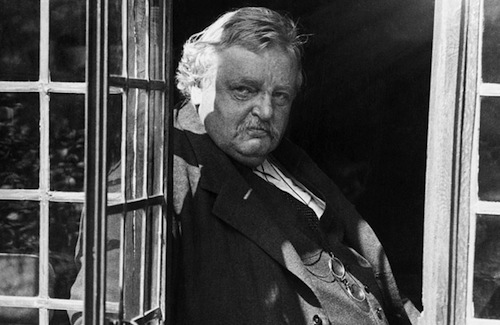
I was wandering through Facebook and noticed a quote by G.K. Chesterton at the top of someone’s profile. The quote was exceptionally stupid. And I thought to myself, So many people repeat these little quips, and so many of them are awful. So I decided to start a collection. I made it through the first two pages (of sixteen) devoted to Chesterton on a popular quotation website. Here are a few of the stupidities I found:
- “People wonder why the novel is the most popular form of literature; people wonder why it is read more than books of science or books of metaphysics. The reason is very simple; it is merely that the novel is more true than they are.”
By this logic, the works of E.L. James must be extremely true.
- “One sees great things from the valley, only small things from the peak.”
One sees small things from the valley, but only at the peak can one see the greatness of which they form a part.
- “Love means to love that which is unlovable; or it is no virtue at all.”
Love means to love what is worthy of love; everything else is vice.
- “Without education, we are in a horrible and deadly danger of taking educated people seriously.”
Maybe it’s because Chesterton wasn’t educated that he believed this, but I find that educated people tend to take each other much more seriously than uneducated people take them. People with college degrees don’t tend to call intellectuals “egg heads.”
- “There is the great lesson of ‘Beauty and the Beast,’ that a thing must be loved before it is lovable.”
This is basically a Sartrean thesis: The will by choosing to love something endows it with the value which makes it capable of being loved. I don’t think I need to explain how pernicious this thought is, since we all know from Thomas “quia bonum intellectum est obiectum voluntatis.”
- “A good novel tells us the truth about its hero; but a bad novel tells us the truth about its author.”
Is this really true? I mean, doesn’t any novel good or bad tell us something about its author? Are bad novels distinctly good at saying something about the people who write them? It doesn’t seem to be the case at all.
- “Poets do not go mad; but chess-players do. Mathematicians go mad, and cashiers; but creative artists very seldom. I am not, as will be seen, in any sense attacking logic: I only say that this danger does lie in logic, not in imagination.”
Poets go mad quite often, and they seem much more frequently to end up totally absorbed in their own creative “genius” and independence than chess players. Maybe the fault is in imagination and not in logic. Or maybe the idea of ascribing some intrinsic danger to either of these faculties is idiotic.
- “A woman uses her intelligence to find reasons to support her intuition.”
This is objectionable on a few different grounds. First off, it sounds (and probably is) misogynistic. Second, this misogyny makes little sense given his antipathy toward “logic”, stated elsewhere. Third, isn’t this true of everyone, and not just women?
- “The poet only asks to get his head into the heavens. It is the logician who seeks to get the heavens into his head. And it is his head that splits.”
Blessed are the logicians who seek to get heaven into their heads, for by the light of glory their heads will be transformed! But woe to the poets who try to insert themselves into the heavens; eternal perdition awaits them.
- “To love means loving the unlovable. To forgive means pardoning the unpardonable. Faith means believing the unbelievable. Hope means hoping when everything seems hopeless.”
It is all too easy to utter a contradiction with a clever-sounding air and fool one’s audience into thinking you’ve been profound.
- “He may be mad, but there’s method in his madness. There nearly always is method in madness. It’s what drives men mad, being methodical.”
Prudence is right reason concerning things to be done. God’s prudence is called providence, and by it he governs the universe, assigning to each thing its appropriate time.
- “Tolerance is the virtue of the man without convictions.”
Tolerance is the virtue of a man who is sympathetic with those who are wrong, because he knows how difficult their lot is.


December 10th, 2012 | 9:13 am
OK, I’ll bite. Why is this “misogynistic”?
“A woman uses her intelligence to find reasons to support her intuition.”
~Theo
December 10th, 2012 | 9:14 am
There is a lot of truth to the last remark. People who talk most of tolerance are usually those who are tolerant of things they care nothing about and bigoted about the things they care about.
December 10th, 2012 | 9:18 am
The problem lies in taking GKC’s quotes out of context. He almost always uses exaggeration, paradox, and wordplay to catch the reader’s attention and then set up something that he subsequently unfolds in more depth. He says something a bit crazy or counter-intuitive to get the reader to step back and take a fresh look at the whole question. Generally speaking, to take one of his one-liners by itself is to miss most of the point he’s trying to make. I wish that a few more of the GKC-quoters would take the time to read his works in their entirety…
December 10th, 2012 | 9:22 am
There is a point to forgiveness being pardoning the unpardonable. Insofar as an wrongful action is mitigated, granting the mitigation is not mercy but justice. Saying that a starving man who steals food is not the same as a thief who has no need to steal is different from forgiving the theft once the sin of theivery is admitted.
December 10th, 2012 | 9:22 am
I am not sure if this post is meant seriously or as irony. If serious, then wow. If it is irony, it seems to stop short of the final point.
December 10th, 2012 | 9:27 am
Chesterton said a number of silly things; I recall one in which he asserted that travel narrows the mind. However, I think I have to disagree with you in this correction of yours: “Love means to love what is worthy of love; everything else is vice.”
God loves and forgives his people, even though they are unworthy. Yet God’s love of his people is anything but vicious.
December 10th, 2012 | 9:37 am
Isn’t the real problem with these that they are taken out of context and become absurd as stand-alone quotes? Some are from the short stories and said by characters who are not the sensible heroes, and Chesterton never meant them to be taken seriously. The same thing is done with Shakespeare and other great writers. Consider how often Iago is quoted on the subject of honor.
December 10th, 2012 | 9:44 am
In more than one quote your are equivocating on the meaning of words relative to Chesterton.
In others, it would be helpful if you understood the point he was making and attacked that, rather than the way he made his point.
And the quote:
“One sees great things from the valley, only small things from the peak.”….
follows this assertion: Humility is the mother of giants.
So you completely misread the point he is making and how he is making it.
You do more damage to your reputation, than you do to to Chesterton….
DDD
December 10th, 2012 | 9:47 am
I can’t think of a writer who’s work is more subject to the distortion of being taken out of context than Chesterton. Maybe that’s also a criticism for people who quote him, but this piece is just cheap.
December 10th, 2012 | 9:49 am
“Love means to love what is worthy of love; everything else is vice.”
Then the God of the Scriptures is surely the most vicious of deities.
December 10th, 2012 | 9:51 am
Oh, come on. Read these quotes in the original context in which they appear.
December 10th, 2012 | 9:57 am
“A good novel tells us the truth about its hero; but a bad novel tells us the truth about its author.” Yes, it IS really true. Chesterton clearly anticipated the Star Wars prequels.
December 10th, 2012 | 10:00 am
I suppose it is easy to take quotes entirely out of context and call them silly, but it’s not particularly enlightening or instructive, particularly with a writer like Chesterton, who is making counter-intuitive observations.
The remark about Beauty and the Beast has precisely NOTHING to do with Sartre’s existentialism, which Milco would know if he had actually read Orthodoxy. In fact, all of his misinterpretations of what Chesterton meant in this post (and they are legion) would likely be resolved if he actually read the passages of which they formed a part.
Milco says, “”One sees small things from the valley, but only at the peak can one see the greatness of which they form a part.” He needs to read that again and ask himself why he did exactly the opposite in a post where he took the small things (quotes) and didn’t bother to read the context out of which they were torn.
There are a lot of writers who would sound silly if you read only one small part of some larger body of work–or in Milco’s case (assuming he’s written anything else), one post on a weblog.
December 10th, 2012 | 10:15 am
That GKC’s quotes are misused or abused by some does nothing to lessen their intent or wisdom within the greater work.
This seems a petty article lacking both Christian charity and love and serves little purpose beyond being contrarian.
December 10th, 2012 | 10:26 am
Uncharitable readings of aphorisms taken out of context make for much less interesting reading than the aphorisms themselves. Reading an aphorism out of context in the manner of an English as a second language student will never fail to yield such stupefying results. I’d like to hear what such a method would produce when applied to various words of Christ. Something like this is likely to follow:
“It is harder for a rich man to enter the kingdom of heaven than it is for a camel to enter the eye of a needle.” – Really? A needle? C’mon Jesus, I know you aren’t that well-educated, but what you’re saying here just isn’t that true.
December 10th, 2012 | 10:26 am
The author of this is piece reveals himself to be a shallow thinker (in my admittedly worthless opinion) by discounting the value of Chesterton’s irony, paradox, and contrarian willingness to force people to think. That is what these snippets do, even when ripped from context… Sadly I fear that is something the author may be uncomfortable with.
I can’t speak for Chesterton, but I loved that quote about the novel precisely because it is so true. Why? Because we are both spiritual and physical beings… and we are also psychologically complex. Even a bad novel at least attempts to deal with these deeper realities and the ways in which they intersect. If we are Catholic, we believe these things to be just as real as those things which we can see or measure. Thus, I agree with the Chesterton quote: in a very real way the novel is a truer form of communication.
The author’s comments on the quote on love are, for me, deeply troubling. YES we are called to love the unlovable, and NO that isn’t a vice… at least if you read the Bible.
“Love your enemies” much? Isn’t that the whole point? Jesus doesn’t say “love only the lovable, else you love vice…”
Perhaps someone has an axe to grind?
December 10th, 2012 | 10:41 am
Milco should probably read Lewis’s An Experiment in Criticism before he goes on another rant like this one, which, incidentally, is unworthy even of a blog attached to the name First Things.
December 10th, 2012 | 10:44 am
Chesterton always makes one think. For example:
Are Elliot Milco’s remarks here really clever?
December 10th, 2012 | 10:46 am
Technically, according to recent research in moral psychology, we all use intelligence to support our intuitions.
December 10th, 2012 | 11:09 am
Remote and ineffectual Don
That dared attack my Chesterton,
With that poor weapon, half-impelled,
Unlearnt, unsteady, hardly held,
Unworthy for a tilt with men—
Your quavering and corroded pen;
Don poor at Bed and worse at Table,
Don pinched, Don starved, Don miserable;
Don stuttering, Don with roving eyes,
Don nervous, Don of crudities;
Don clerical, Don ordinary,
Don self-absorbed and solitary;
Don here-and-there, Don epileptic;
Don puffed and empty, Don dyspeptic;
Don middle-class, Don sycophantic,
Don dull, Don brutish, Don pedantic;
Don hypocritical, Don bad,
Don furtive, Don three-quarters mad;
Don (since a man must make an end),
Don that shall never be my friend.
* * *
Don different from those regal Dons!
With hearts of gold and lungs of bronze,
Who shout and bang and roar and bawl
The Absolute across the hall,
Or sail in amply billowing gown
Enormous through the Sacred Town,
Bearing from College to their homes
Deep cargoes of gigantic tomes;
Dons admirable! Dons of Might!
Uprising on my inward sight
Compact of ancient tales, and port
And sleep—and learning of a sort.
Dons English, worthy of the land;
Dons rooted; Dons that understand.
Good Dons perpetual that remain
A landmark, walling in the plain—
The horizon of my memories—
Like large and comfortable trees.
* * *
Don very much apart from these,
Thou scapegoat Don, thou Don devoted,
Don to thine own damnation quoted,
Perplexed to find thy trivial name
Reared in my verse to lasting shame.
Don dreadful, rasping Don and wearing,
Repulsive Don—Don past all bearing.
Don of the cold and doubtful breath,
Don despicable, Don of death;
Don nasty, skimpy, silent, level;
Don evil; Don that serves the devil.
Don ugly—that makes fifty lines.
There is a Canon which confines
A Rhymed Octosyllabic Curse
If written in Iambic Verse
To fifty lines. I never cut;
I far prefer to end it—but
Believe me I shall soon return.
My fires are banked, but still they burn
To write some more about the Don
That dared attack my Chesterton.-Hillaire Belloc and Yours Truly
December 10th, 2012 | 11:10 am
I forgot the title: Lines to an Elliot
December 10th, 2012 | 11:11 am
Ah, Mr. Milco, you are either a sadist or a masochist – or perhaps you are both. Were you eager to prod the Chestertonian hive, or were you eager to find yourself in the midst of their angry buzzing?
Were you perhaps frustrated at how such a second rate, miseducated, and fat Englishman could have such cache amongst a certain class of Catholic reader? Did you trip over a hardcover of the collected works this morning? Did you find yourself looking at some photo of Chesterton or other and just think, “Goodness, what an ugly man”?
I will admit that all of the quotations you reference are, in fact, stupid, with the exception of four or five. But they are mostly stupid because they are so wildly taken out of context that reliable interpretation is all but impossible.
I can not but think that if you are writing for First Things that you are an intelligent creature, Mr. Milco. We’ll give you the benefit of the doubt, in any case. But please, expound upon these thoughts to prove the case either way, and to give a certain class of Catholic reader something more to buzz about, something worth the time, perhaps?
December 10th, 2012 | 11:12 am
Don’t quite get the point, here. You could indulge in the same exercise – “deconstructing” any isolated quote, no matter how profound or insightful.
For instance:
“One sees small things from the valley, but only at the peak can one see the greatness of which they form a part.”
The impulse to stand at the mountaintop is often tied to the wish to hold in contempt the small but important things that make up the better part of our lives.
December 10th, 2012 | 11:40 am
A good [blog post] tells us the truth about its hero; but a bad [blog post] tells us the truth about its author.
G. K. Chesterton
December 10th, 2012 | 11:49 am
Chesterton’s greatest genius is his ability of making all his critics prove that he has the larger and happier soul.
December 10th, 2012 | 12:01 pm
*“He may be mad, but there’s method in his madness. There nearly always is method in madness. It’s what drives men mad, being methodical.”
*Prudence is right reason concerning things to be done. God’s prudence is called providence, and by it he governs the universe, assigning to each thing its appropriate time.
Who here can reread this and not laugh? That is some funny stuff! Eliot Milco, you are an accidental comic with real ability. Thank you for your entertaining foray into G.K. Chesterton criticism – you unintentionally brightened up my morning.
December 10th, 2012 | 12:11 pm
I’m afraid you’ve picked a fight you’re not going to win, Mr. Milco.
December 10th, 2012 | 12:16 pm
Okay, so you don’t understand Chesterton . To call him “exceptionally stupid” is an insult. I don’t think you know much about the man. If you want to understand him try reading one of his books,,,,the man is a deep thinker. On the surface he may seem to think one way but the thing is to contact http://www.chesterton.org and inquire about him and see if these quotes start to make sense to you.It is easy to criticize but take work to look into what he is really saying not what we “think” he is saying.It is plain you don’t understand him at all.
December 10th, 2012 | 12:17 pm
Wait, I take it back – this is too good! Eliot Milco, I apologize for writing that your foray was accidental. I should be more charitable, and expect more of my favorite journal. Rather, you wrote a fine spoof, a delightful jest. Very Chestertonian of you (I must say). Your ability to write as a joyless intellectual who completely misses the point was so flawless that I mistook the exercise entirely. Well done and very funny stuff.
BTW, I am often at a loss as to how to win new readers to G.K., and am curious to discover if your attempt will bear fruit. I think it is an excellent attempt. Keep us all posted of the results.
December 10th, 2012 | 12:23 pm
I was wandering through Facebook and noticed a quote from the Bible at the top of someone’s profile. The quote was exceptionally stupid. And I thought to myself, So many people repeat these little quips, and so many of them are awful. So I decided to start a collection. Here is the first one:
“So the last shall be first, and the first last.”
December 10th, 2012 | 12:41 pm
Pace AF Zamorro’s comment. Chesterton is not merely beloved by “a certain class of Catholic readers”, but by other classes of catholic Christians. In my (and many like-minded acquaintances) case, a reformed, Calvinist, puritan loving, Protestant.
Yes, we believe he got 3 things wrong, no 4 (and maybe a few others): Roman Catholicism vs Protestantism, he misread the puritans, he misunderstood predestination, and I’d like to talk with him about redistrutionism.
Nonetheless the man is/was a blessing to the church catholic and a continual delight to read. He has taught me much. I’d take GKC more seriously on the points where he is wrong, than I would many on the points where they are right.
December 10th, 2012 | 12:42 pm
Oh, there’s no doubt that GKC said some silly things, and he frequently exaggerated for the sake of emphasis. When people extract his one-liners from their context (historical or polemical), they can very quickly become meaningless, and GKC himself would probably have enjoyed seeing them turned on their heads. Had the title of this blog post been “Against Quoting Chesterton,” it would have been more precise.
But as to the mad poets, GKC prefaces that quotation by naming one poet, William Cowper, who he thinks really went insane. Can anybody name five more reasonably well-known poets who have gone certifiably insane by any clinical or non-clinical definition you care to use?
Narcissism is fairly common in poets, but that’s not often the same thing as insanity.
By the by, I take it the author is intentionally mimicking GKC’s own treatment of the aphorisms of his contemporaries? It’s a nice, ironic turn, but it takes more rhetorical flair to beat him at his own game.
December 10th, 2012 | 1:15 pm
I, too, considered this might be tongue and cheek, and concluded it was not. (I’d be happy to find I am wrong, and will be suitably embarrassed if I am.)
I’m left with two questions for Mr. Milco:
1.) Do you find that acquaintances often begin to tell you a joke, and, on realizing who they’re talking to, break off with a “never mind”?
2.) I have found that, when I completely fail to appreciate something, but it is obvious that many of my intellectual and moral superiors are devoted to it, I probably should keep my opinions to myself.
Waddya think?
December 10th, 2012 | 1:18 pm
Chesterton’s mode of writing was to use shock, surprise and irony through turning things on their head. He can be criticized at times for pushing this too far, perhaps, but to say that these are “stupid quotes” reveals an underlying misunderstanding of the way the man wrote, as well as the absurdity of taking an author out of context, as has been expressed already by so many here.
What you call “stupid” quotes are quotes that cause people to question more what Chesterton is arguing for–which is why he wrote them to that way in the first place. He was provocative, and often enjoyed the shock value of appearing to say unreasonable and yes, “stupid” things. The very fact that you find them to be “stupid” means that Chesterton succeeded in his goal. Each of those quotes is designed to draw the reader further in, to discover what on earth Chesterton is actually saying, but when taken out of context, they seem to make no sense. It would seem you haven’t taken the bait, and have enjoyed debunking one liners which all of the rest of us know to be the proverbial tip of the iceberg of his profundity.
I’m familiar with the vast majority of quotes you excerpted. The question I have is if you know where they come from, and what the context is in which he wrote them, and ultimately if you find Chesterton’s broader arguments and conclusions to be stupid or not. It is easy to take one sentence of an author, (or say, of a Pope about the infancy of Christ and the absence of animals in the Gospel accounts) and totally misunderstand or misrepresent what the author is saying.
As others have pointed out, this list of stupid Chesterton quotes doesn’t reveal so much about Chesterton as it does about the author.
December 10th, 2012 | 1:41 pm
Somebody is in need of bit of Christmas Cheer. I find Chesterton funilly provocative. He must have been great company. He didn’t set out to write the Bible!
December 10th, 2012 | 1:46 pm
I have to side with Milco on this one. There are plenty of times reading Chesterton where I feel he’s trying way too hard to out-clever himself. “In context” or not, he tends to alienate his audience needlessly. Contrast his style with C.S. Lewis, who showed a lot more self-control in his writing and seemed genuinely interested in making his point of view plain to as many readers as possible. I too wouldn’t mind a moratorium on GKC quotes.
December 10th, 2012 | 1:47 pm
Reading the post, it is clear that the author looked at these quotations with an eye only at proving them wrong, so instead of giving them a patient, fair reading, he dug up whatever petty points he could to try to get a jab in at the witty, but ever so stupid, Chesterton. A rather adolescent thing, I would expect something more from the reputable First Things.
This post does give good occasion, however, for examining the current attitude towards Mr. Chesterton in these United States. The trend today, it seems, is to believe that Chesterton ought to be held in contempt. Sure Chesterton is OK for the simple, but that’s because he himself was a simple, uneducated journalist. And of course, since this is the received knowledge, there is no reason to actually read Chesterton, or at least not to take him seriously.
This thing swings both ways though, there are many Chesterton fans who, just like his detractors, have failed to understand him. They read some of his witticisms and they quote them without actually giving them thought or context, which only exacerbates the issue on the other side.
This is the great problem of Chesterton in our age, that everyone wants to make him in to something he isn’t and no one wants to take him as he is. It is a most frustrating thing for those of us who came to Chesterton with no preconceived notions of his rightness or wrongness, genius or stupidity. I cannot express this myself better than Etienne Gilson, the famous Thomist and historian of philosophy, did when he said
“Chesterton was one of the deepest thinkers who ever existed,he was deep because he was right; and he could not help being right; but he could not either help being modest and charitable, so he left it to those who could understand him to know that he was right, and deep; to the others, he apologized for being right, and he made up for being deep by being witty. That is all they can see of him.”
December 10th, 2012 | 1:55 pm
A brief comment: Of the commenters so far, AF Zamarro has things more or less right. I realize that most readers of this blog are probably too sensitive about their love of GKC to admit that these quotations are, as they stand, rather silly. Sure, you can do exegetical acrobatics and rant about context and subtleties and “journalistic wit”, but they were found already stripped of context, and they’re all too often encountered without a context, and it would be naive to think that they carry in them all the subtleties to guarantee a good reading.
Yes, this piece was written as a joke. Who was the butt of the joke? In part, the Chestertonians who so earnestly quote the man left and right as if he were Horace or Confucius or St. Paul. In part, no one — it was just a demonstration of the invertibility of these quips. It began with the realization that a familiar line about how “only a living thing can go against the stream” can be transformed into a defense of virtually anything: suicide, immorality, fortitude, etc. And I thought “It’s pretty ridiculous that this person is holding up such a line as his motto, when on its own it means so much more than he seems to realize.” Then began the inversions…
To all the commenters who think I’m a fool, I want to offer my sincere thanks for being so kind about it. Chesterton’s line about tolerance is true, but I think mine is more needed.
December 10th, 2012 | 1:56 pm
“People with college degrees don’t tend to call intellectuals “egg heads.”
Perhaps because it errs on the side of kindness.
December 10th, 2012 | 2:13 pm
I guess Ezra Pound and Sylvia Plath played chess.
December 10th, 2012 | 2:31 pm
Perhaps I gave Mr. Milco too much credit, but I assumed his point was that one cannot quote Chesterton in these ways precisely because the quotes cannot be understood without context, and on their own they often could be reduced to nonsense. I agree with some other commenters that these quotes cannot be fully understood or evaluated without more information. Thus, perhaps it’s foolish for anyone to quote Chesterton in limited clips through a medium like Facebook or otherwise because they aren’t especially useful in isolation. I had hoped for a concluding paragraph at the end of the piece to confirm my assumption. I would note that other commenters who comment on Mr. Milco’s personality and happiness in his private life ought to check themselves without at least being sure they understood the thesis of the article (and even then, perhaps criticism of Mr. Milco says the same thing of one’s own happiness), but maybe I am the one who does not understand his point.
December 10th, 2012 | 3:32 pm
Cheers to Eliot Milco for not only taking on some Chestertonian nonsense, but for daring to bring the fight into predictably unfriendly territory.
I like Chesterton plenty, but he frequently wrote silly stuff. All the special pleading about his deliberately paradoxical style and sense of irony can’t much shade the fact that he was often just wrong, egregiously wrong, in his aphorisms.
And it’s particularly rich to have so many commenters rise to his defense, claiming that aphorisms should not be judged out of context (!!!) — considering that Chesterton himself once marked up a book of aphorisms with his own witty rejoinders! Check it out – Platitudes Undone http://brandonvogt.com/platitudes/. It is as fun a read as a chest-thumping Chestertonian can have.
December 10th, 2012 | 4:17 pm
Now I remember why I don’t read this site any more. First Things now has someone writing about how silly quotes are on Facebook?
Seriously?
December 10th, 2012 | 4:25 pm
This was a phenomenal troll post, but I think you missed April 1.
Unless you’re serious…
December 10th, 2012 | 4:30 pm
It seems sad to pile on, but it should be observed that it is a dangerous business using Aquinas to criticize Chesterton. Étienne Gilson on GKC’s “Saint Thomas Aquinas”: “I consider it as being, without possible comparison, the best book ever written on Saint Thomas… the few readers who have spent twenty or thirty years in studying St. Thomas Aquinas, and who, perhaps, have themselves published two or three volumes on the subject, cannot fail to perceive that the so-called ‘wit’ of Chesterton has put their scholarship to shame.”
December 10th, 2012 | 4:59 pm
Remember the old saying: If you shoot at a king, you’d better be sure to kill him.
December 10th, 2012 | 5:07 pm
Brade,
So if Chesterton didn’t write like he did, then he would be better? I have no patience for this observation. In another context the mistake shows up better: if only Bach wrote more like Beethoven… Plus it might be helpful to find out what C.S. Lewis thought about Chesterton’s writing before you put too much stock in your comparison.
@ Matthew M.
I am no Chesterton scholar, but I am fairly confident that the argument about taking Chesterton’s quotes out of context is spot on, and you are comparing apples to oranges with your link. The quotes picked by Mr. Milco were not written as aphorisms (to my limited knowledge – please correct me if I am in error), but as part of a larger essay. Sure, Chesterton critiqued the aphorisms of some of his contemporaries, but at least they were written as aphorisms, and not pulled out of context.
December 10th, 2012 | 5:46 pm
G.K. Cheserton said of William Shakespeare–that the playwright is “one of the most quoted authors and one of the most misquoted.” What is true of Shakespeare in this regard, is true of Chesterton.
Chesterton’s quotes, out-of-context, are misleading and this is the problem with dropping isolated Chesterton quotes.
One easy example, in Orthodoxy, Chesterton famously affirms, “The madman is not the man who has lost his reason, he is the man who has lost everything except his reason.” One will find this quote several places on the internet–blogs, social-media profiles, quote sites–yet one will seldom find Chesterton’s elaboration on this affirmation. In the chapter “The Suicide of Thought,” Chesterton clarifies, “I said that ‘the madman is the man who has lost everything except his reason,’ not to attack reason but to defend it. For the whole modern world is already at war with reason and the tower already reels.”
That is, Chesterton defended true reason against a reductive use of reason–a positivist reduction of reason that recognizes nothing beyond what is verifiable through physical and empirical methods (“physicalism,” to borrow Alsdair MacIntyre). Chesterton defended true reason in the face of a narrow positivist purview that, to evoke Pope Benedict’s imagery in his Bundestag address, encloses reason in a concrete bunker. Life inside the bunker is akin to living, in the word’s of the late Monsignor Luigi Giussani, with “a serious case of myopia.”
In the bunker, one thinks the world out in square inches–as one who views a painting up-close in square inches, as a serious of spots (the former is a paraphrase of Chesterton, the latter, Giussani). Thus, we who wrestle with God in our narrowness and littleness fail to recognize “Thou who makes us,” since we look everywhere except the obvious–as Chesterton affirms, “A thing can be to big to be seen, or to evident,” apparently hidden in the most evident yet unexpected places, a manger, on the Cross, in the faces of sinners transformed by Christ’s love.
Thus, Chesterton invites us to take step back and, as Pope Benedict XVI challenges us, open the windows wide open and see the wide world for the first time. Life outside the bunker allows one to broaden reason and oneself, so that reason becomes a window to a reality that one never ceases to enter–evoking imagery from Giussani. Chesterton’s writing are Christian in his continual invitation to continually see, encounter and experience reality anew–in and with the eyes of Christ, so that one recognizes reality as a sign of Christ; this way is the true measure toward which are reason and lives are called.
Singular Chesterton quotes can be appropriate, depending on the quote especially. Yet, the view of Chesterton as a “quotable author” reduces the scope and true treasure and joy of his work and witness.
One more note. In the aforementioned chapter of Orthodoxy, “The Suicide of Thought,” Chesterton makes essentially the same anthropological and philosophical observation and insight that C.S. Lewis and Monsignor Lugi Guissani later make in respective works. Lewis makes the same case in “The Abolition of Man,” and Giussani, in the sixth chapter of The Religious Sense, “Emptying the [Religious] Question.” Essentially, Chesterton, Lewis and Guissani–in their respective works and in terms appropriate to their works–articulate the same reality: the trivialization, emptying and abolition of the question of human destiny is a ultimately a trivialization, emptying and abolition of human life.
December 10th, 2012 | 5:59 pm
I was all set to defend Chesterton before you posted, but to be honest I think there are some Catholics who revere him a bit too much. I think he said some great and amusing stuff that encourages one to consider things in a new way, but I think he was wrong a fair amount of the time. He feared women suffrage would end or deny distinctions between men and women. Some might still argue that’s true, but Utah had women’s suffrage in his day and plenty of Utahans still have beliefs in gender/sexual distinction. I’m not saying he hated Jews, but going by his autobiography he did lean toward the idea they should have an ethnic-state and not live among Christians. I think even the most orthodox of Catholics don’t want all Jews to leave for Israel. And though it’s steeped in Catholic teaching there’s really no evidence, that I know of, that a Distributist economic system could work on a national level.
December 10th, 2012 | 6:37 pm
@Mr. Milco,
Your efforts at joking and taking on sacred cows aside (which Chesterton, incidentally, would have applauded), your statements in your comment above do nothing to exonerate you. In fact, they could be applied to pretty much anyone who quotes anyone about anything. Anyone can “transform” (as you so aptly put it) a quote into a sense that renders it ridiculous if one is committed to doing so. The real challenge to any scholar of worth is to resist this temptation.
I’m sorry that you don’t care for the taste of Chesterton; we all have our particular writers that irk us for whatever reason. Your point here to the loathsome over-quoters should perhaps have just been: Chesterton in particular is a writer who demands context to his counter-intuitive statements, and each person does him a disservice when they act as if these statements stand alone. But it’s a banal point; it doesn’t drive traffic to First Things or your piece, and you then don’t have warrant to call his words “exceptionally stupid.” Maybe next time.
December 10th, 2012 | 10:02 pm
I’m not sure I see the point of this piece as a comic one. To tease earnest Chesterton readers? If so, it’s rather a nasty joke; the piece didn’t gently tease, but called the aphorisms stupid nonsense. To tease the commenters who rose to defend? If someone asserts that an author one respects and admires writes stupid nonsense, isn’t it simple decency to speak up and say ‘You’ve got it wrong’?
If the point was that quotes taken out of context can be interpreted in ways wildly divergent from their original meaning, all I can say is: this is news? If you spend five minutes on Pinterest and you’ll wonder why you just picked on GKC. At least his are still interesting when taken out of context.
To make fun of people who post out-of-context GKC quotes? Okay, I’m sympathetic, but as I think abot it, even that’s uncharitable: might we consider that perhaps at least some of them have indeed read the full works from which the line came, and are posting it with an awareness of context? I mean, I have a GKC quote on my Facebook ‘about’ page, and it’s a reminder that his book The Catholic Church and Conversion was very important to me. If that makes me a loser, okay.
I suppose this isn’t a big deal in the long run, but our culture has too much irony, too much pretend wittiness that’s really just mockery of what others have done in earnest, already.
I suspect that the proliferation of GKC quotes suggests a hunger at least in some people for the kind of wonder, joy, and freshness of thought that GKC offers – which is, I think, rather to be encouraged than suppressed.
December 10th, 2012 | 10:03 pm
Either way above me, or just plain dumb. Either way, I won’t be back. Vivat Chesterton!
December 10th, 2012 | 10:27 pm
A little learning is a dangerous thing. Reminds me of nitwit high school kids who start freshman year of college and get invited to their first wine-and-cheese thingy with the tweedy prof., or their first semi-serious symposium in their major: they get a couple of glasses of pinot grigio in them and think that, because they were the clever wit at Central High they should strike a pose as an Oscar Wilde-ish wag, dropping Dorothy Parker-isms and proclaiming that Shakespeare is just too, too overrated and Karl Rahner is just a frightful old bore. Instead they should just shut the hell up and LISTEN and maybe learn a thing or too. To borrow and bend Mark Twain, “When I was an M.A. candidate, I was amazed how ignorant the old man was; once I became a professor, I was amazed at how much he had learned.”
December 10th, 2012 | 11:27 pm
“Water runs downhill because it is bewitched.” This statement is exceptionally stupid unless read it context in which case it becomes part of the most devastating critique of scientism ever written. The OP is exceptionally stupid.
December 10th, 2012 | 11:31 pm
Fortunately the author summarises his attitude to GKC on his own site:
“If I were to describe Chesterton to someone who had never heard of him, I would say he was an overly bombastic apologist from the last century who is still revered by the “conservatives” of our day as a great wit, probably because he gives the impression of having destroyed the Zeitgeist with little quips, when actually he just rattles off an endless series of paralogisms and bad metaphors.”
http://paraphasic.blogspot.com.au/2012/12/how-do-you-really-feel-about-chesterton.html
If that’s how the author feels, well naturally GKC fans will regard him with utmost pity. But what did FT think the world stood to gain from sharing the derogatory and weirdly hostile opinions of someone who is so unashamedly, superficially critical?
December 11th, 2012 | 12:21 am
I have now taken the trouble to read the authors entire blog, from the beginning.
What an insufferable, self-impressed, sophomoric little annoyance he is! He is the embodiment of a grand reason for extending schooling: a Yale BA and a penchant for trying to sound like a Oxford undergraduate trying to sound like an Oxford don do not a mature partner in dialogue make. This is what comes from high school students who get their hands on a copy of The Crito or The Symposium and think they understand it, or undergrads who read some Russian lit. and a couple of existentialists and come to the conclusion that they have become Western Civilizations’ equivalent of The Buddha.
December 11th, 2012 | 12:33 am
You could probably go through the book of Proverbs and make the same kind of one-sided, debunking interpretations.
December 11th, 2012 | 12:38 am
“There is the great lesson of ‘Beauty and the Beast,’ that a thing must be loved before it is lovable.”
This is basically a Sartrean thesis: The will by choosing to love something endows it with the value which makes it capable of being loved. I don’t think I need to explain how pernicious this thought is, since we all know from Thomas “quia bonum intellectum est obiectum voluntatis.”
By this lights, Jesus died for us because we deserved it. Pernicious indeed! Perhaps even the conflation with Sartre manifests as a fine example the danger of education the uneducated Chesterton noted. It seems to me someone is tossing pebbles at a giant.
December 11th, 2012 | 12:47 am
It’s a common disease of the Late Modern Age to take all texts as remorseless and prosaic literalisms. Poetry, metaphor, humor,… play are foreign to their spirits.
The quote about the valleys and the mountaintops, for example, is clearly a parallel to comparisons of looking at people at street level versus from the tops of skyscrapers — they look like insignificant ants from up there. Additional context is hardly needed. The same goes for many of the other excerpts, such as novels being truer than books of science. It is only confusing to people who themselves confuse “truth” with “fact.”
December 11th, 2012 | 1:32 am
I do pray that Mr. Milco is not serious about his criticism of good old Mr. Chesterton. If he is then I can only feel bad for him. I would add though, that I wouldn’t mind seeing a few more of Hilaire Belloc’s quotes. For such a serious historian that man had some odd stuff! Perhaps his most random:
-“Be content to remember that those who can make omelettes properly can do nothing else.”
-“Is there no Latin word for Tea? Upon my soul, if I had known that I would have let the vulgar stuff alone.”
-“The Llama is a woolly sort of fleecy hairy goat, with an indolent expression and an undulating throat; like an unsuccessful literary man.”
December 11th, 2012 | 3:11 am
“Fortunately the author summarises his attitude to GKC on his own site…”
Ah I see. Yeah I guess this guy is pretty much just Anti-Chesterton. I do think Chesterton kind of goes for an alcohol-loving Medievalism that isn’t really where I’m at as a Catholic either, but I still like much of what he says and he said/did so many things it’s hard for me to see being this negative. Possibly the author has to deal with some of the more annoying Chesterton fan-boys (“He’s a Prophet”, “We should canonize him right away”, “Vote Distributist!”, etc) whereas I usually don’t. Sometimes I find myself saying I “hate” a musician I’m actually indifferent about because I’m annoyed by their fans. I don’t know if Lady Gaga’s music is all that terrible, but the weird personality-guru aspect around her can get nauseating. What I’ve seen of it some of the more extreme Chestertonians are irritating. I’m not sure if that’s it though.
December 11th, 2012 | 4:34 am
Troubling to see Msgrs. Zamarro & Milco decide to authenticate rumors about how their Ex-Lax treatments have so utterly & obviously failed.
December 11th, 2012 | 6:58 am
Wow, what a troll piece this is. Pretty soon Facebookers will be using Milco quotes in their status lines? Maybe not.
December 11th, 2012 | 7:30 am
Just like the Dilbert comic strip’s deconstruction of the golden rule, yesterday. The pointy-haired boss says something like ‘we all need to do unto others as we would have them do unto us.’ Dilbert says, ‘then give me $100, or be forever known as a hypocrite.’ Pointy-haired boss then screams that he hates the engineering mindset, as Dilbert, Wally, and fist-of-death woman jeer ‘see, that’s better!’
December 11th, 2012 | 7:45 am
This post displays a high ignorance of the Catholic tradition of theology and I am shocked that First Things published. With respect to the Beauty and the Beast quote, no, it is not a Sartrean thesis, it’s a Christian thesis. A thing must be loved before it is loveable, because a thing cannot exist unless God first loved it enough to will it the good of existence, a key thesis of the Augustinian teaching on Christian charity, the Thomistic teaching on grace as well as the Thomistic teaching on the divine causality. Furthermore, it is firmly rooted in the traditions of Scripture. In fact, one would have to take Pelagianism to a severe extreme to deny that thesis.
December 11th, 2012 | 9:39 am
With all due respect to the deeply embittered commenters, it seems that many of them have missed the point that Mr. Milco’s little article, snarky or not, is directed not against Chesterton or his oeuvre but against Chesterton quotations as used on Facebook. (That Mr. Milco happens to dislike Chesterton is immaterial.) To complain that the quotes are out of context is to validate the piece’s basic premise that they don’t seem to work as isolated quotes.
As for those who complain about a “high ignorance” of his theology—*Cough* Mr. Torres *Cough*—Mr. Milco’s FT bio alerts us that he is currently pursuing a Master’s in Theology under the Dominicans.
That being said, I think the best way to read the piece is light-heartedly. No need to accuse the man of being a troll.
December 11th, 2012 | 10:37 am
I came over here with the intention of shaming Mr. Milco for writing such a smug and thoughtless article. Upon reading it, I changed my mind. Nothing I could say could equal how much he has embarassed himself with this exercize in self-satisfied ignorance.
Elliot Milco, I charitably suggest that before writing about Chesterton again, you try reading him, rather than confining yourself to mere quotes. This would require the hard work of thinking, of course, but I have every confidence that you’re up to the task. You might also think twice before engaging in this sort of ridicule again against a man whose writings have brought joy to millions, and to whom hundreds of people owe their conversion to the Catholic Church. Seriously, you can do better.
For anyone interested in engaging Chesterton’s wit, intellect, and holiness in a mature and honest manner, come on over to the American Chesterton Society web page. Better yet, subscribe to Gilbert Magazine at http://www.chesterton.org/store/#ecwid:category=447371&mode=category&offset=0&sort=normal
Sean P. Dailey
Editor-in-chief
Gilbert Magazine
December 11th, 2012 | 11:18 am
Gadzooks: seeing this kind of response, you’d think he’d insulted Ayn Rand!
December 11th, 2012 | 4:09 pm
I think Milco is right to pull the quotes out of context. It’s the conservative slant to the iPhone generation, where the depth of thought is whatever cool quote fits on a photo edited in Photoshop. But, Chesterton is fun to quote. The quote on tolerance is my last hurrah to my senior class, who are the kind of folks that believe anything (so they believe nothing) and need to wake up to that reality when reading that quote in the yearbook.
December 11th, 2012 | 4:09 pm
That should read “to criticize those who pull the quotes…”
December 11th, 2012 | 5:00 pm
As I said in my comment above, Chesterton is one of the most misquoted authors–so much so, that he is often attributed to quotes that he never wrote. The final quote in the blog post, “Tolerance is a poor man’s virtue…” is a perfect example–Chesterton never wrote this line in any of numerous written works–journalism,non-fiction, essays, novels,mysteries poetry, theater–and there is absent any documentation that he uttered these words.
Chesterton in fact said something akin to what Matt says above, that a man who will believe in anything ultimately believes in nothing. Tolerance, rightly understood, refers to a bearing with a pain, grievance or opposition. Chesterton evidenced great tolerance in his life–a tolerance clear in his great friendship to Shaw and Wells. Nonetheless, Chesterton never confused tolerance of wrong-minded positions with complicity and cooperation with evil. Chesterton lived the Pauline diction, “Test everything, retain only what is good.” He retained what was good and true in his Wells and Shaw, yet also illuminated where there went astray and what was lacking. Chesterton displayed hospitality, the gift greater than mere tolerance. Chesterton welcomed the humanity that he recognized in Wells and Shaw while also pointing out their ideas that failed to respect, honor and due justice to this humanity.
In Chesterton’s works–read in their totality, rather than isolated, many recognize a larger than life humanity in love with existence; a large man who recognized his littleness before the great Fact, brilliant yet seemingly hidden in the least likely of places. In Chesterton, we find an unlikely signpost that illumines this seemingly hidden yet evident way.
December 11th, 2012 | 6:46 pm
“Mr. Milco’s little article, snarky or not, is directed not against Chesterton or his oeuvre but against Chesterton quotations as used on Facebook.”
Really? The Facebook element seems only incidental, while the derogatory comments are directed solely at the quotations themselves: ‘exceptionally stupid’, ‘awful’, ‘stupidities’.
If Mr Milco intended to critique the use of quotations on Facebook perhaps he should have spent more time doing that, and less time composing tin-eared replies to a popular but long-dead writer?
December 11th, 2012 | 9:19 pm
@David Michael: Actually, here you are incorrect. One of the reasons I look so unfavorably on this truly terrible little article is this: the author is an opponent of GKC and his readership but packaged this piece as simply criticizing the act of quoting him. Given he fact the author stated on his blog that if he were studying with Chesterton in the library he would “stab him with his fountain pen,” and given the fact that on this piece he calls GKCs words “stupid,” I don’t think your observation holds up. Furthermore, I wouldn’t call the commentators “embittered” at all.
It would have reflected more favorably on the author if he was more open and honest about his beliefs and motives. If there is anything approaching genuine upset on the part of this reader it is this: the publishing of this piece, and others like it, represents a new direction for First Things… Publishing openly hostile authors who are disdainful of much of the readership. An interesting editorial decision that. One wonders why they made it.
December 11th, 2012 | 9:48 pm
Elliot:
Cast not your pearls before swine, for they are humorless and curmudgeonly, and take not your article with grains of salt, but bitter gall. Your pillorying here at the hands of the “cheerful” Chestertonians is not unlike the pillorying that happens when one meekly suggests that the old Latin Mass isn’t the pear of great price capable of stopping the incessant drumbeats of progressivism and moral decay that the Trads fervently declaim in hushed whispers at Mass, lest the sublime priestly caste overhear them during the inaudible Eucharistic prayer, and assign additional paternosters.
In all seriousness, I appreciate your use of humor in questioning the appropriation and deployment of Chestertonian thought in modern discourse. I find him wordy and unwieldy and, unlike Wagner, whose operas I can patiently endure with great pleasure, not worth the tedium of reading, in order to sift the copious chaff from the meagre grains of wheat.
December 11th, 2012 | 9:49 pm
*cough* Mr. Michael *cough* I don’t see what else someone could be if they claim that the proposition that “a thing must be loved before it is loveable” is Sartrean thesis rather than one in complete conformity to the tradition of theology in the Church.
December 11th, 2012 | 11:29 pm
Mr. Milco, one of the essences of a joke, if we are to believe that it is indeed one, is that you don’t end it by saying “that was a joke.”
and…
it should be funny.
December 12th, 2012 | 1:50 am
“I believe what really happens in history is this: the old man is always wrong; and the young people are always wrong about what is wrong with him. The practical form it takes is this: that, while the old man may stand by some stupid custom, the young man always attacks it with some theory that turns out to be equally stupid.” In the out-of-context words of Chesterton.
(1) Mr. Milco’s intent is perhaps only to stop people from quoting Chesterton as some sort of great Catholic theologian, when he was only a rather amusing and intelligent, but imprecise writer. This tipping of the sacred cow is worthy.
(2) That being said, by randomly taking quotes out of context and twisting them, the author has failed to achieve his aim: he has not provoked any critical thinking on this subject from his readers. Unfortunately, it appears that Mr. Milco is writing more for his own amusement than for the betterment of his readers, and that lack of thoughtfulness is justly censured, whatever the author’s original intent.
I respectfully look forward to more carefully argued presentations from Mr. Milco in the future.
December 12th, 2012 | 8:15 am
The setting up of a straw man to burn down does not offer one much hope for better things to come, nor does it advance Mr. Milco’s thesis an iota.
One example, as others have already provided more:
“One sees great things from the valley, only small things from the peek.”
This is, obviously, a poetic reference to the beatific vision of the humble and the blindness of the proud. Mr. Milco’s blind response demonstrates the latter half of the quote perfectly.
December 12th, 2012 | 11:19 am
Erik you are wrong. Humor isn’t a necessarily democratic ideal, in which success is judged by how many people get the joke – if so, then Larry the Cable Guy or Jeff Dunham are competing to be the Platonic Form of humor – but can be, and certainly is, a fiercely oligarchical endeavor, in which the few can enjoy what the many do not. Explaining that it is a joke can assist in defusing the mass hysteria. There is no shame in letting one slip over your head, old boy!
(It is mass hysteria, really, judging from those who are getting entirely too worked up about it in the comments above…I mean, questioning one’s theological orthodoxy for not liking GKC and amusingly twisting his words around IS a bit much. Ronald Knox might have cautioned against that sort of enthusiasm).
December 12th, 2012 | 1:54 pm
In the end, there is no accounting for taste. I am puzzled by the animus (note that there is animus, and then there is animus) exhibited by some towards Chesterton. But I am puzzled by Chesterton’s own animus toward Samuel Beckett. Chesterton never missed an opportunity to tear Beckett apart.
Chestertonians can rest assured in the near-universal agreement that Chesterton is a man of genius. I am likewise untroubled that certain molds of men find many of his quotations silly. They are quoted so often because they resonate with so many.
Well, says the Chesterton critic, Britney Spears is very popular, too. Well, Chesterton quotes have been popular for going on a hundred years now, so he’s got Ms. Spears beaten by a fair bit.
Let’s praise the abundant God that made man with such variety that there are even some out there who cannot appreciate Chesterton.
And a note to the comment moderators – I have made comments that were humorous, if not intelligent on this site before, and had them rejected with a bizarre email notice. Commenter “antigon” has a quote that is neither humorous, nor helpful, nor intelligent. I have no problem with you posting it, but it makes me curious as to why you accepted his comment, while mine at least had the value of being funny.
December 12th, 2012 | 8:54 pm
As a young (15 years old) Chestertonian, I’m thrilled to see so many responses to this post. Having been linked to the blog post by Mark Shea, my “neighbor down the road”, it’s interesting to see how many people I know reply to this post -Nancy Brown, whom I met at the Chesterton conference in Reno, and Martin Cothran, my logic teacher via DVD, to name a few.
For myself, I’m an avid lover of Chesterton and am disappointed to see the result of a common misconception among individuals…namely, that Chesterton with context is just as good as Chesterton without. This blog post shows that context is actually deeply important. I would argue, along with multiple other commentators, that simply reading some of Chesterton’s work would clear up much of the confusion.
I believe fans of Chesterton can do him a disservice by simply throwing out quotes without any explanation or context. Chesterton never meant for his work to be an easy read or simple quote- it’s so much more than that. Mr. Milco, I would strongly encourage you to look at the American Chesterton Society’s work (www.chesterton.org) and simply pick up one of GK’s essays. You may find that instead of being “unbelievaby stupid,” that there is actually quite a lot of common sense in what he has to say.
And I would agree, Chesterton was of course a titanic-sized man! But I would argue that he was also a Titanic Hero in the eyes of the literary world.
December 12th, 2012 | 11:21 pm
All of this is quite amusing. Those with an appetite for even more appalling Chesterton quotations (albeit with slightly more context) might make their way over to The Hebdomadal Chesterton from time to time. Exercise your wit by taking GKC down a notch every week.
December 13th, 2012 | 10:31 am
@TJA A certain uncle Screwtape once gave good advice concerning jokes. In letter 11, Screwtape delineates humor into the categories of Joy, Fun, the Joke proper, and Flippancy. Chesterton had a gift for the first and second of these, whereas Mr. Milco’s post missed the target of the Joke Proper (was the post intended to be Fun? I can’t imagine so), and then plunked down in Flippancy. Your own excursus against the Trads followed suit. I am no Trad, but I would caution you to avoid any further situations where your wit might be compared to Chesterton’s (unless you are trying to grow in humility).
@Brandon,
I award you the trophy for the finest post of the entire exchange: indeed the larger and happier soul!
@Milco,
Chesterton happily slogged it out against the writers of his day and begged no quarter. You started this fray with some bold strokes, but I find the milquetoast-esque “It may be prudent for me to remind readers that they don’t know me, that this blog is something I write primarily for myself, and that my sense of humor is rather unusual. It’s true, I don’t like G.K. Chesterton. Yes, in your eyes that probably means I deserve to be burned alive, or eaten by a million vermin less repulsive than myself. But for God’s sake, please remember that I’m just a grad student who wrote a satirical blog post and not the anti-Christ.”, or again “Chesterton’s line about tolerance is true, but I think mine is more needed[Tolerance is the virtue of a man who is sympathetic with those who are wrong, because he knows how difficult their lot is].” either unseemly, lacking conviction, or maybe just too inconsistent. Take courage; I am not as bothered that you dislike Chesterton as much as by what I perceive to be a lack of resolve. You have posted your writing at First Things; remember that we like a robust discussion here.
December 13th, 2012 | 3:02 pm
Regarding this one:
‘ “Without education, we are in a horrible and deadly danger of taking educated people seriously.”
Maybe it’s because Chesterton wasn’t educated that he believed this, but I find that educated people tend to take each other much more seriously than uneducated people take them. ‘
I see what you’re saying, but on the other hand, I think the anecdote in “Expecting Adam” about the Smurf Pool is something those who have done graduate work can sympathize with: A friend of the author is doing psych research involving swimming animals, and they were swimming in the cheap kids’ wading pool with smurfs on it. So the author referred to it in passing, in conversation with fellow students and professors, as “watching mice swim in a Smurf pool”. They all nodded knowingly, and someone made reference to “Professor Smurf” and the good work he was doing. Sometimes you have to be there to see people faking it :)
December 14th, 2012 | 1:14 am
Peter, you are right: if being compared unfavorably to GKC means that I’m pithy, clear, and funny, then it would most assuredly test my humility. That being said, I suspect there is still room for flippancy in the kingdom of Heaven; if St. Jerome managed to get in, so can we poor souls who, despite the howls of outrage or the ponderous and condescending replies of the Chertetariate, do not like Chesterton, and are willing to joke at his expense (my feelings towards my experience of Trad-culture being besides the point). Though, I must say that Prof. Lewis’s categories there are sufficiently vague enough as to be easily applicable to any situation in which someone makes a joke we don’t like.
Thankfully, in the end, the Church is large enough to embrace all of us, while providing writers and thinkers that speak to the soul. God speed to the folks manage something out of GKC.
Finally, I can’t help but mention that I took the same tone as yourself and other commenters on this thread, so that begs the question as to whether you ought to ignore the speck in my eye. I thank you for your concern though, old boy!
December 17th, 2012 | 9:46 am
Thanks for being brave on Chesterton. Now how about lists for his progeny Milbank and Zizek?
December 18th, 2012 | 8:09 am
Your criticism of Chesterton, those who read him and/or those who quote him has no base. I don’t mean that you’re wrong to make fun of all of those parties, I mean that you don’t have a point. There is no concise element to either this spread or the spread on your blog or anything that actually says what your issue is… unless it is simply that you do not like how famous the man is.
Because you don’t have a point you can’t be challenged on any of your opinions. You slither away from all of the responses because you have not made any real claims. There is nothing for criticisms of your article to object to.
Do a three part analysis – attack first the man, then the followers and then the blind quoters. Fire on all cylinders, make your voice heard! I am certain your books will fly of the shelves! But please, next time you decide to tackle a giant (and it can be done) enlist more of your mental capacity than Ad Hominem.
December 20th, 2012 | 1:18 pm
I think the world of Chesterton, but the ire that this post has drawn from his defenders calls to mind Lewis’ concept of the “inner ring.” God have mercy on those outside the GKC ring!
December 21st, 2012 | 5:55 am
“A woman uses her intelligence to find reasons to support her intuition.”
More times than I care to count my wife will suggest Z to a problem, when I am in the midst of if A then B, then C,, to find a solution..
I’ve learned not to dismiss Z, but to thoughtfully consider, and more often than not -she’s right. I am not alone in this experience. I cannot explain it, but it is certainly not misogyny to point this out. It’s praise of the feminine nature. It only appears to be misogyny because it is not hard masculine which our society tells us “all must be”.
Ah gender, male and female He made them, viva la difference.
December 22nd, 2012 | 10:44 am
The only frivolity of Chesterton was that he was a journalist – something he considered completely frivolous.
Links
Blogs
Find Us
Contact