

SUBSCRIBER LOGIN

Search
First Things

Loading
« Previous  |Home|  Next »         

Saturday, December 22, 2012, 5:39 PM

holyfamily

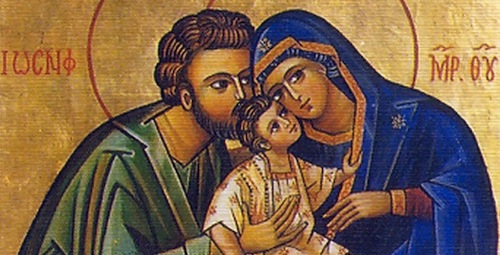
Were Joseph and Mary married? The Catholic Church, Eastern Orthodox, and some Protestants teach that Mary remained “ever virgin.” Some, though, claim that a marriage has to be consummated to constitute a real marriage. Is this true? And what is the Church’s position on such marriages today?

Under Roman law of their time, Mary and Joseph were clearly married. Nuptias non concubitus, sed consensus facit (It is not sleeping together, but agreement that makes marriage), wrote the prominent Roman jurist Ulpian (170-228). In his famous letter written to the Bulgarian prince Boris I in 866, Pope Nicholas I takes the same view, “according to the laws (leges), the consent of those whose union is arranged should be sufficient. If that alone is absent, all the other solemnities, even including coition, are in vain, as the great teacher John Chrysostom attests, who says: Not intercourse but will makes marriage.”

Yet the declaration from the book of Genesis, “and they shall be one flesh,” suggests that consummation is essential to marriage. That is what the great canonist Gratian of Bologna thought in the twelfth century. However, Peter Lombard thought otherwise, insisting that it was the agreement, the meeting of minds of the couple that makes marriage, leading to a lively debate between the universities of Bologna and Paris.

The Parisian view was adopted by Pope Alexander III (1159-1181) in answering a case propounded to him by the Archbishop of Salerno, declared that if consent de praesenti (“de præsenti” is an ellipsis for “de præsenti tempore”—“words in the present tense”) was expressed by such words as these “I accept you as mine.” “and I accept you as mine”, whether an oath was interponed or not it was unlawful for the woman to marry another and if she should contract a second engagement by promise even although followed by sexual intercourse she should be separated from the second and should return to the first husband. (Corpus Juris Canonici Decretales Gregory IX lib iv tit iv cap iii) Alexander III confirmed the Parisian view in another decretal, “Veniens ad nos G.”

And what of Genesis? The Parisian school countered with First Corinthians: “The wife hath not power of her own body, but the husband: and likewise also the husband hath not power of his own body, but the wife.” From the moment of the marriage the man has no power over his own body. His body is already his wife’s and her body is his. Therefore, this is the moment at which they become “one flesh.” Their agreement makes them “one flesh” by giving to each power over the other’s body; the sexual union is mere matter of fact. As the great English legal historian, F W Maitland put it, “We must distinguish between the perfection of a legal act and the fulfillment of obligations which that act creates.”

Alexander III, following the ancient tradition of the Church declared that “After a lawfully accorded consent affecting the present, it is allowed to one of the parties, even against the will of the other, to choose a monastery (just as certain saints have been called from marriage), provided that carnal intercourse shall not have taken place between them; and it is allowed to the one who is left to proceed to a second marriage” (III Decretal., xxxii, 2). But this is a case of the dissolution of a marriage, not a declaration that there was no marriage to dissolve. The Council of Trent makes this clear: “If anyone shall say that a marriage contracted, but not consummated, is not dissolved by the solemn religious profession of either one of the parties to the marriage, let him be anathema” (Sess XXIV Can vi). In Maitland’s words, “a marriage is a marriage, and it cannot become more of a marriage than it already is.”

The answer, then, is yes. Whether viewed in light of Church law today or of Roman law of their own time, Joseph and Mary were fully and truly married.

45 Comments

    Gabriel Rossman
    December 22nd, 2012 | 6:42 pm

    Wouldn’t Halachic law be more relevant than Roman law for these purposes?

    molli vassar
    December 22nd, 2012 | 6:48 pm

    And thus in laymens language, what would be the pastoral advice given to a couple today whp are considering entering into such a marriage? What would their marriage vows consist of(would they still be asked if they will “welcome children”)?

    John Burford
    December 22nd, 2012 | 6:55 pm

    I don’t know–I’m somewhat skeptical of this whole line of reasoning.

    For instance, the Church’s primary argument against gay marriage is that marriage is not just consent-based, but is rather a union of persons that must necessarily involve both consent (union of mind) and sexual intercourse (union of body). This is because human beings are creatures of both mind and body, not just spirits inhabiting impersonal organic suits.

    It is also why the Church will not consent to the marriage of a man and a woman where one of the partners is unable to have sex (for instance, due to a war wound). Sex is not just an optional add-on to a consent-based union, it is integral to the mind-body institution of marriage.

    I looked up the Church’s canon law, and unconsummated marriages have a weird in-between status. An unconsummated marriage can prevent you from getting validly re-married without getting a dispensation first, but it can also be dissolved, which an unconsummated marriage cannot be.

    My impression from the canon law is that an unconsummated marriage is invalid, but since the canonical presumption is that you have consummated the marriage, a dispensation is required so that you can prove to the Church that it was in fact unconsummated.

    Also, the canonical law does seem to imply that the Genesis “one flesh” thing is, in fact, referring to bodily union and not just mutual ownership resulting from a consent-based union: “Canon 1061.1 A valid marriage between baptised persons is said to be merely ratified, if it is not consummated; ratified and consummated, if the spouses have in a human manner engaged together in a conjugal act in itself apt for the generation of offspring. To this act marriage is by its nature ordered and by it the spouses become one flesh.”

    So I don’t buy it. Mary and Joseph may have been married by contemporary Roman standards, but their relationship doesn’t seem to meet the standards for a sacramental Catholic marriage since it was never consummated.

    John Burford
    December 22nd, 2012 | 6:58 pm

    Correction: “An unconsummated marriage can prevent you from getting validly re-married without getting a dispensation first, but it can also be dissolved, which a consummated marriage cannot be.”

    Jonathan Brumley
    December 22nd, 2012 | 7:25 pm

    Wouldn’t Mary and Joseph be able to get an annulment under canon law, since their marriage was never consummated?

    David Nickol
    December 22nd, 2012 | 7:36 pm

    I don’t see how Mary and Joseph could be considered married according to What Is Marriage? by Girgis, George, and Anderson:

    Marriage is the union of a man and a woman who make a permanent and exclusive commitment to each other of the type that is naturally (inherently) fulfilled by bearing and rearing children together. The spouses seal (consummate) and renew their union by conjugal acts—acts that constitute the behavioral part of the process of reproduction, thus uniting them as a reproductive unit.

    David Nickol
    December 22nd, 2012 | 9:08 pm

    Note that since Mary and Joseph were not baptized Christians, they could not have been sacramentally married even if they could be considered to be in a natural marriage.

    Of course, in many ways it makes absolutely no sense to try to classify the relationship of Mary and Joseph, since there was never anything remotely similar to it before and never will be again.

    Ioannis S.
    December 22nd, 2012 | 9:24 pm

    It has never been the teaching of the Orthodox Church that the Joseph and Mary were married. You can find this both in the hymnology of the Church as well as the early hagiographical writings. Joseph is known as Joseph the Betrothed, “betrothed” being the pertinent word here distinct from being married. Furthermore, we sing to the Theotokos “Rejoice Bride without Bridegroom”.

    Poorly researched article.

    Mary
    December 22nd, 2012 | 9:50 pm

    It was indeed essential for Joseph and Mary’s union that they could have had sexual intercourse.

    peg
    December 22nd, 2012 | 10:59 pm

    What were the implications of being betrothed? I gather it meant more than what we would call “engaged”. Joseph’s considerations suggest he had some clout as to Mary’s status (he was thinking of quietly putting her away when he discovered her pregnancy).

    Would Roman betrothal customs or marriage laws apply to them, or would these humble provincials follow Jewish practice?

    Michael Paterson-Seymour
    December 23rd, 2012 | 7:03 am

    It is worth looking at the facts in Alexander III’s decretal “Veniens ad Nos,” in response to the Bishop of Norwich

    “”A certain William appealed to us, and showed in his report that he received in his house a certain woman by whom he had children and to whom he swore before many people that he would take her as wife. In the meantime, however, spending the night at the house of a neighbour, he slept with the neighbour’s daughter that night. The girl’s father finding them in the same bed at the same time compelled him to espouse her with present words [per verba de praesenti desponsare]. Recently, William standing in our presence, asks us to which woman he ought to adhere. Since he could not inform us whether he had intercourse with the first woman after he had given his oath, we therefore order you to examine into the matter carefully, and if you find that he had intercourse with the first woman after he had promised he would marry her, then you should compel him to remain with her. Otherwise, you ought to compel him to adhere to the second one as his wife, unless he was compelled by a fear which could overcome a steadfast man.” [Decretales 4.1.15 ]

    This was always taken as settling the law that an agreement in the present tense constituted a marriage.

    Lord Stair is always thought to have given an accurate summary of the pre-Tridentine canon law, which remained the law of scotland after the Reformation, when he says, “Marriage itself consists, not in the promise, but in the present consent, whereby they accept each other as husband and wife; whether that be by words expressly, or tacitly, by marital cohabitation or acknowledgment, or by natural commixtion, where there hath been a promise or espousals preceding; for therein is presumed a conjugal consent de præsenti” [Institutions of the Law of Scotland 1681 (B i tit 4 sect 6)]

    The last point about a promise, followed by copulation is based both on Veniens ad Nos and on a decretal of Pope Gregory IX in 1234 [IV. 1. c 30]

    The relevance of Roman Law is that St John Chrysostom and Pope Nicholas I, in his reference to “the laws” are obviously quoting Ulpian’s maxim as agreeing with Church teaching.

    S.
    December 23rd, 2012 | 7:51 am

    Or maybe, as the Bible says, Mary and Joseph were married and waited until after Jesus was born to consummate the marriage (Matthew 1:24-25) and had additional children (Matthew 12:46-47, John 2:10, Mark 6:2-3, etc.). The doctrine of Mary’s perpetual virginity has always seemed strange to me in light of the Gospel narratives.

    JP
    December 23rd, 2012 | 10:53 am

    S;

    Concerning Matthew 1:24-25, the narrow passage only meant that St Joseph didn’t touch Mary during her pregnancy. It certainly does not mean that they consumated their marriage afterwards, even though many people may assume so.

    Also, many if not most of the Disciples knew St Mary personally. St John was charged to care for her after Christ ascension. His own followers such as St Polycarp would have had first hand knowledge of St Mary and her life before and after Christ. The Holy Traditions of the Roman Catholic Church preceed the Canon, and beliefs in such as the prepetual virginity of Mary were not just the fruits of idle speculation.

    This debate is an ancient one that pits Ireaneous and Polycarp on one side, and Tertullian and Origen on another. Catholic Orthodoxy has been consistently for nearly 2000 years. Catholic Tradition insists that St Joseph and Mary never consumated their marriage; Joseph was a widower and had children from a previous marriage. When Joseph wed Mary, his older children became hers. Ergo, Jesus certainly had brothers and sisters – step siblings. Additionally, the true Spouse of St Mary is the Holy Spirit. The Holy Spirit and Mary consumated their union, and the fruits of their consumation was Christ. Joseph was fully aware of this. I know it is difficult for people of this Post Modern era to imagine a life without sex. But, we should remember, that the graces that people recieve from God far outweigh thier physical and emotional drives. Countless Christians over the centuries attest to this grace.

    Michael Paterson-Seymour
    December 23rd, 2012 | 12:48 pm

    Whilst I personally agree with JP against S, that still leaves open the question of whether they had a “real” marriage, assuming it was never consummated.

    John Burford writes, “It is also why the Church will not consent to the marriage of a man and a woman where one of the partners is unable to have sex (for instance, due to a war wound)”

    Of course, for the grant of the right of which 1 Corinthians speaks presupposes the existence of the subject-matter of the grant. If I sell you a horse which, unknown to both of us, is dead, then the sale is void; if it is alive, it is your property (and at your risk) from the moment of agreement. It is a complete contract of sale, though, even before you take possession.

    That is why Mary is right, when she says, “t was indeed essential for Joseph and Mary’s union that they could have had sexual intercourse.”

    David Nickol
    December 23rd, 2012 | 2:06 pm

    Catholic Tradition insists that St Joseph and Mary never consumated their marriage;

    Agreed.

    Joseph was a widower and had children from a previous marriage.

    I don’t think this view is officially endorsed by the Catholic Church. Otherwise, why all the arguments that references to brothers and sisters in the Gospels may refer to cousins? I believe there are non-canonical works that claim Joseph was a widower, but that doesn’t mean that the Church has declared Tradition confirms he was. One has to be careful to distinguish between Ttradion and traditional beliefs.

    Additionally, the true Spouse of St Mary is the Holy Spirit.

    I have read claims along these lines, but it seems to me basically metaphorical, along the lines of the Church being the bride of Christ. Matthew twice refers to Joseph as Mary’s husband:

    Matthew 1:16
    Jacob was the father of Joseph, the husband of Mary—of whom Jesus was born, who is called the Christ.

    Matthew 1:19
    Joseph her husband was a righteous man. Because he didn’t want to humiliate her, he decided to call off their engagement quietly.

    Additionally, Luke refers to Mary and Joseph as Jesus’s parents, and Mary refers to Joseph as Jesus’s father when they find the 12-year-old Jesus in the Temple:

    Luke 2:48
    When his parents saw him, they were shocked. His mother said, “Child, why have you treated us like this? Listen! Your father and I have been worried. We’ve been looking for you!”

    Both Mary and Joseph seem strangely to have forgotten that there is something extraordinary about their son when he says, “Did you not know that I must be in my Father’s house?” They don’t understand him.

    David Nickol
    December 23rd, 2012 | 2:08 pm

    It was indeed essential for Joseph and Mary’s union that they could have had sexual intercourse.

    Mary,

    Where do you find in the Gospels that Joseph and Mary could have had sexual intercourse?

    David Nickol
    December 23rd, 2012 | 2:18 pm

    I think this discussion highlights the folly of trying to come up with a universally applicable, timeless, absolutely precise definition of marriage. Joseph and Mary obviously were married. Joseph is referred to as Mary’s husband. Mary, speaking to Jesus, refers to Joseph as “your father.” Any definition of marriage that results in the conclusion that Mary and Joseph were not “really” married contradicts the Bible and common sense. (And, it seems to me, the definition of marriage in What Is Marriage? results in the conclusion that Mary and Joseph were not “really” married.)

    Michael Paterson-Seymour
    December 24th, 2012 | 4:50 am

    David Nickol

    I think the definition of marriage in “What is marriage?” is one that no Civilian or Canonist would subscribe to.

    Both the jurists of the Imperial period and the canonists of the 12th century were trying to produce a definition of marriage out of those elements which we can conceive as common to the marriages of all people in all ages. In addition, the Canonists were not unaware of the question of the marriage of Mary and Joseph.

    Both came up with a simple rule: a mutual manifestation of consent, between parties under no impediment to marry.

    As to how that consent was to be proved, they developed a number of rules, summarised by Lord Stair: “whether that be by words expressly, or tacitly, by marital cohabitation or acknowledgment, or by natural commixtion, where there hath been a promise or espousals preceding; for therein is presumed a conjugal consent de præsenti” These are rules of evidence, nothing more.

    For them, marriage was one thing and the fulfilment of the obligations which marriage creates was another. Talk about “consummation” blurs the distinction between the two.

    That their definition is a workable one is shown, not only by its adoption by the Catholic Church, but by all the civil codes of Europe.

    gentlemind
    December 24th, 2012 | 10:45 am

    I said this on another thread, and was challenged. So i will say it again. A marriage starts at consummation.

    If i agree to meet my friend for supper but never show up, does this mean no agreement was made? No. Does it mean we did not eat together? Yes. The agreement is not the food. The food is the food. If a marriage is a spoken agreement, then marriages are not necessarily sexual.

    Much of the confusion lies in the interplay between natural marriage and legal marriage. Consummation is a physical act. Non-consummation is legally necessary so that people can leave a legal marriage that never became a natural marriage.

    Clement ng
    December 24th, 2012 | 4:55 pm

    David Nickol wrote:

    “(And, it seems to me, the definition of marriage in What Is Marriage? results in the conclusion that Mary and Joseph were not “really” married.)”

    If you have Anderson, Girgis and George’s new book (not just the article published two years ago), you will see that the question of whether or not Mary and Joseph were married is addressed in footnote 4 of the appendix. An unconsumated marriage is still a marriage – it just is not *complete*. Marriage is a process involving several steps, not a one-time event like the taking of vows. This explains why non-consummation was once grounds for annulment (not divorce) in the English common law, which itself borrowed from ecclesiastical law.

    The book points out that Aquinas considered the Holy couple married, despite the dogma of Mary’s perpetual virgnity, because he argued that they consented to consummating on a condition that they never thought was met. So, assuming that Mary and Joseph *intended* to consummate prior to the Annunciation, they remain married throughout their life together.

    Michael PS
    December 25th, 2012 | 5:58 am

    Clement ng

    “This explains why non-consummation was once grounds for annulment (not divorce) in the English common law, which itself borrowed from ecclesiastical law.”

    In England, the courts christian had exclusive jurisdiction in matrimonial causes from 1071 to 1857. Under the Canon law, which those courts applied, non-consummation after three years raised a rebuttable presumption of impotence, leading to a declaration of nullity.

    In the common law courts, impotence could only be proved by sentence of the ecclesiastical judge and he might dismiss a suit on the grounds of approbation or want of sincerity.

    David Nickol
    December 25th, 2012 | 3:34 pm

    So, assuming that Mary and Joseph *intended* to consummate prior to the Annunciation, they remain married throughout their life together.

    Clement ng,

    Thanks for pointing out what is in the book but not the paper. I have only just begun to read the book.

    So, assuming that Mary and Joseph *intended* to consummate prior to the Annunciation, they remain married throughout their life together.

    I see Aquinas “inferred that they must have consented to consummation, but on condition,—i.e., if God so willed—that they never thought was fulfilled.” I presume Aquinas began with the assumption that they were indeed married, and “inferred” what he did to justify his assumption. There is, of course, absolutely nothing in Matthew or Luke that justifies a conclusion about what Mary or Joseph consented to regarding the consummation of their marriage. Also, Aquinas would have had to infer that Joseph was physically capable of consummating the marriage. There is nothing in the text of Matthew or Luke to say that he was, and it seems to me it is impossible for Joseph to have known with certainty that he could have consummated the marriage had he been called upon to do so. So it seems to me that while one might make fairly reasonable assumptions, we can’t know, and even Joseph himself couldn’t have known that his intention to consummate the marriage (if he had such an intention) could have been successfully carried out.

    I found this interesting commentary in a “Google book” called Marriage in the Western Church: The Christianization of Marriage During the Early Medieval Periods.

    One sometimes had to determine [in Roman law] when a marriage had begun. According to a dictum from Ulpian in the Digest, a marriage begins as soon as the woman is received as a wife (duct), even if she has not yet come into her husband’s bedchamber, for marriage is created by agreement and not by sexual intercourse: “videtur impleta condicio statim atque ducta est uxor, quamvis nondum in cubiculum mariti venerit. Nuptias enim non concubines, sed consensus facit.” . . .

    It would be rash to attribute to Roman law the purist variety of consensualism that was introduced by Augustine and taken up again by certain influential authors in the twelfth century (such as Hugo of St Victor). From this perspective, sexual union and procreation seemed to be something additional and even incidental to marriage, so that Mary and Joseph were in the fullest sense married to one another. The high medieval consensualists not only affirmed that marriage was created by agreement alone but also denied that in agreeing to be married one agrees to have sexual intercourse.

    Clearly, the function (or necessity) of “consummation” for marriage depends very much on your theory of marriage. Defenders of same-sex marriage might want to read up on Augustine and the consensualists.

    David Nickol
    December 25th, 2012 | 6:38 pm

    I have lost count of how many times, in how many different discussions I have quoted this, but it always seems pertinent. It is from John L. McKenzie, Dictionary of the Bible:

    Marriage in Israel was neither a religious nor a public concern; it was a private contract, and it is this conception which leaves so little room for it in Hb law, which deals only with the exceptional cases. The contracting parties were not the bride and groom but the families, i.e., the fathers of the spouses; the brothers of the bride had the disposal of the girl if the father were dead.

    Of course, this does not rule out some kind of understanding or “contract” between the bride and groom.

    Also, a Jewish man in first-century Palestine would have entered into a marriage knowing he could divorce his wife at any time. Depending on what school of thought he belonged to, the divorce could have been for any reason at all (e.g., he didn’t like her cooking) or only a very serious reason. It was in responding to a question about these schools of thought that Jesus said a man may not divorce his wife for any reason. But obviously that was a long time after the betrothal of Mary to Joseph.

    Michael Paterson-Seymour
    December 26th, 2012 | 6:28 am

    David Nickol

    A great Scottish judge once observed, “It is a curious fact, though true, that there must always be in Scotland a considerable number of persons who could not say off-hand whether they were married or not. It is only when the question has been decided in a court of law that their doubts can be removed. But although they do not know if they are married, and no one could tell them with certainty till the action was tried, it is nevertheless true that they must be either one or the other. There is no half-way house.” That seems to me to be true, not only in Scotland, but generally; pre-contract, for example, or error, or defective consent can never be absolutely excluded. The most one can say is that, assuming no latent impediment to exist &c.

    What the book you cite refers to as the “consensualist school,” is really the result of an underlying principle of both Roman Law and Catholic theology, namely voluntarism, or the primacy of the will and of the free self-determination of the autonomous self. Applied to marriage, it will naturally stress the element of existential decision – “I accept you as mine,” to quote Alexander III.

    As you will see from my quotation in the article, not only Augustine, but Chrysostom were of this view, Chrysostom following Ulpian, word for word; Hugo of St Victor gives the general doctrine of the Parisian school, whose chief representative was Peter Lombard. In any event, this is clearly the doctrine of Alexander III and Gregory IX and, hence, the settled teaching of the Catholic Church, at least until the late 20th century and the rise of “naturalistic” views.

    Clement Ng
    December 26th, 2012 | 7:27 pm

    Michael Paterson-Seymour:

    Thanks for that. It reinforces our understanding of the significance of consummation generally.

    David Nickol:

    “I see Aquinas “inferred that they must have consented to consummation, but on condition,—i.e., if God so willed—that they never thought was fulfilled.” I presume Aquinas began with the assumption that they were indeed married, and “inferred” what he did to justify his assumption. There is, of course, absolutely nothing in Matthew or Luke that justifies a conclusion about what Mary or Joseph consented to regarding the consummation of their marriage. Also, Aquinas would have had to infer that Joseph was physically capable of consummating the marriage. There is nothing in the text of Matthew or Luke to say that he was, and it seems to me it is impossible for Joseph to have known with certainty that he could have consummated the marriage had he been called upon to do so. So it seems to me that while one might make fairly reasonable assumptions, we can’t know, and even Joseph himself couldn’t have known that his intention to consummate the marriage (if he had such an intention) could have been successfully carried out.”

    Yes, the text says nothing about intention. Given what we know about Jewish marriage custom, these assumptions are, as you say, fairly reasonable. An intention need not be explicit to be culturally standard (that is, intentions can be implicit), nor does someone always need to know whether or not he is capable of successfully executing an act before he can intend it.

    Boonton
    December 27th, 2012 | 11:36 am

    I think this discussion is fascinating because it undercuts most of the anti gay marriage arguments. Assuming Mary and Joseph were married, for what purpose was their marriage? Not procreation since Jesus was already conceived. If you adopt the view that Mary and Joseph had children after Jesus, you’re running up against the doctrine of perpetual virginity. If you adop the view that Mary and Joesph were married but never had sex (hence never had a marriage based on creating new children), then you’re running up aganst the idea that marriage’s purpose was procreation….unless you want to say Jesus was raised in a failed marriage….which seems both unkind and unsupported by the evidence we have.

    David Nickol
    December 27th, 2012 | 12:24 pm

    An intention need not be explicit to be culturally standard (that is, intentions can be implicit), nor does someone always need to know whether or not he is capable of successfully executing an act before he can intend it.

    Clement Ng,

    But in the case of the conjugal theory of marriage, there must not only be an intention to consummate the marriage. Consummation must be possible. If we take a hypothetical couple (to avoid talking about the intimate lives of Mary and Joseph!) with all the right intentions, if they are not capable of having sexual intercourse at least once after the marriage ceremony, there is no marriage.

    Canon 1084.1 Antecedent and perpetual impotence to have sexual intercourse, whether on the part of the man or on that of the woman, whether absolute or relative, by its very nature invalidates marriage.

    Canon 1084.2 If the impediment of impotence is doubtful, whether the doubt be one of law or one of fact, the marriage is not to be prevented nor, while the doubt persists, is it to be declared null.

    A few years ago there was a much publicized case in Italy in which the Church refused to allow a Catholic man and woman to marry because the man was a paraplegic and was impotent. The woman knew this and still wished to be married.

    It seems to me that in the case of our hypothetical couple, who have not had premarital sex and who, let us say, mutually decided sometime after the wedding ceremony but before the wedding night to commit themselves to lifelong virginity, it simply cannot be known whether they are “really” married. Of course, it would only be reasonable to give them the benefit of the doubt. But the only way to know for sure if a man and a woman are capable of having sexual intercourse is for them to attempt and succeed.

    To quote myself from above, I think this discussion highlights the folly of trying to come up with a universally applicable, timeless, absolutely precise definition of marriage.

    Michael Paterson-Seymour
    December 27th, 2012 | 12:30 pm

    Bootom

    But if one takes the view that the purpose of marriage is not procreation, as such, but filiation, that is, establishing the juridical bond of father and child, no difficulty exists.

    Boonton
    December 27th, 2012 | 2:20 pm

    In other words you’re saying the purpose of marriage is to advance biological fraud? What’s in it for the man then? He is legally held to be a father even when it’s beyond doubt he biologically isn’t?

    Boonton
    December 27th, 2012 | 3:05 pm

    Also Michael, I suggest you examine the question you cited Alexander III addressing:

    A man William slept with a woman and got her pregnant and she had the child. He promised, in front of many, to marry her. But he then spends a night at a neighbor’s house and is discovered in bed with the neighbor’s daughter! He then is pressed to marry the daughter.

    If you are correct in your assertion that marriage is about filiation then, aside from sounding like a bad joke, this issue would appear to be quite moot. The first woman already had children with the man before they were married. Presumably the second woman did not get pregnant from the encounter with the man. So why all the fuss over both sides wanting him to marry one of the women?

    The first woman’s kids would be illegitimate even if she marries the man. The second woman, assuming she isn’t pregnant, doesn’t have to worry about having someone to identify as a father. And yet all this fuss by everyone demanding the man fulfill his promises to marry one or the other women?

    Clement Ng
    December 27th, 2012 | 11:42 pm

    David Nickol wrote:

    “It seems to me that in the case of our hypothetical couple, who have not had premarital sex and who, let us say, mutually decided sometime after the wedding ceremony but before the wedding night to commit themselves to lifelong virginity, it simply cannot be known whether they are “really” married. Of course, it would only be reasonable to give them the benefit of the doubt. But the only way to know for sure if a man and a woman are capable of having sexual intercourse is for them to attempt and succeed.”

    The hypothetical couple cannot be certain whether or not they are married only if marriage is a one-time event, not the staged process that has a telos. Now I did not offer an opinion on the dispute between the Bolognesians and the Parisians. I only wished to point out that Mary and Joseph could be considered married on the conjugal view expounded by Anderson, Girgis and George. Nowhere do they say that coitus is a necessary condition for *establishing* marriage (in an initial, provisional state). Rather they claim that coitus is the *consummation* (a completion or a perfection, but not the only one) of marriage. The quote you gave from the 2010 article amounts to this. Just as a marriage without children is, in one sense, imperfect, so a marriage without consummation is, in a similar sense, unfulfilled. These are first and foremost *ontological* and *moral* claims, not legal ones.

    So, given Anderson, Girgis and George’s version of the conjgual view, I do not need to deny that my wife and I were married immediately after we pledged our troth. Our marriage remained *ontologically* incomplete at that point, however (despite its legal validity).

    Anderson, Girgis and George take care to distinguish between the legal and metaphysical questions, I should note. We can analyze the nature of marriage *simpliciter* without considering the history of legal norms, though such analysis would not be very illuminating in addressing relevant concerns.

    Finally, you cannot intend to do something which you know is impossible, I agree. If you do not know whether or not an act is possible, then you can still intend to try. We can assume that Joseph intended *this* much prior to the visitation by the angel, as recorded in the text. None of this invalidates Michael Paterson-Seymour’s conclusion that Mary and Joseph were married under Roman law and, viewed today, under Church law.

    Michael Paterson-Seymour
    December 28th, 2012 | 2:59 am

    Booton wrote, “The first woman’s kids would be illegitimate even if she marries the man…”

    Nor so, for the Canon Law follows Roman Law and most modern civil codes in recognizing legitimation per subsequens matrimonium, but that is by the by. Again, the father of the second lady, when he insisted on an immediate marriage could not have known whether she was pregnant or not.

    Of course, individual motives for marrying may be quite unrelated to the public purpose of marriage. The purpose of the army is the defence of the realm, but an individual may join it for any number of personal reasons: adventure, for travel, for comradeship, to learn a trade, to avoid a prison sentence or for a host of other reasons. Note that none of these are incompatible with the army’s main purpose.

    David Nickol
    December 28th, 2012 | 1:48 pm

    Finally, you cannot intend to do something which you know is impossible, I agree. If you do not know whether or not an act is possible, then you can still intend to try.

    Clement Ng,

    When it comes to conjugal marriage (or marriage within the Church), the most sincere intention to consummate a marriage counts for naught if it turns out that the person is in reality unable to do so. If a man and woman enter into a marriage in total good faith, but they discover after the ceremony that they are (and will always be) unable to consummate the marriage, they are in fact not married (i.e., the marriage can be annulled, meaning there never was a marriage).

    So it seems to me that by the “rules” of conjugal marriage and Catholic marriage, it is simply unknowable (humanly) whether Joseph and Mary could have consummated their marriage. It might be reasonable to assume that they were both capable of consummation with each other, but it is certainly not beyond the realm of possibility that they were not. Consequently, it is impossible to know that they were married either according to Girgis, George, and Anderson’s definition of conjugal marriage or the requirements of canon law. As I understand it, canon law would assume a “ratified” but not consummated marriage unless there were proof to the contrary. But it would be impossible to know.

    As I have said before, this says more about the folly of trying to come up with universally applicable, timeless, absolutely precise definitions of marriage than it does about the relationship between Mary and Joseph. In Biblical times, a Jewish woman married to a Jewish man had no way of getting out of a marriage unless her husband divorced here. There were no tribunals to hear cases brought by Jewish wives whose husbands would not or could not consummate the marriages. Joseph and Mary were married according to their own understanding and the understanding of the time. Which to me makes it rather foolish to try to determine whether they were “really” married.

    Boonton
    December 28th, 2012 | 7:46 pm

    Nor so, for the Canon Law follows Roman Law and most modern civil codes in recognizing legitimation per subsequens matrimonium, but that is by the by. Again, the father of the second lady, when he insisted on an immediate marriage could not have known whether she was pregnant or not.

    This doesn’t save your case, it actually harms it. If filiation was what was important here, then the girls father could have waited to see if his daughter was pregnant. If she was, then he could press for marriage in order to ensure his grandchild was legitimate….which as you say could happen even if the marriage happens after she gave birth. If she wasn’t pregnant then the father could tell the cad to hit the road and protect his daughter from marrying such an unsavory character who would have already had to have divided his resources to care for children he bore with another woman. This wouldn’t require a lot of time, one would only have to wait until the girl’s next cycle to know if pregnancy was an issue. We’re talking a month at most here and since the dispute was working its way up to the Pope it would seem that amount of time had already passed.

    Of course, individual motives for marrying may be quite unrelated to the public purpose of marriage. The purpose of the army is the defence of the realm, but an individual may join it for any number of personal reasons: adventure, for travel, for comradeship, to learn a trade, to avoid a prison sentence or for a host of other reasons. Note that none of these are incompatible with the army’s main purpose.

    True but here public authorities are asked to weigh in. Was the response of anyone in this dispute along the lines of “don’t bother us as there’s no need to determine paternity of any children involved here”?

    Consider the case of a man who is a bit older who wants to joint he army for any of those personal reasons. The army will evaluate the request based on whether or not it’s compatible with its purpose of defence of the realm.

    Your filiation argument fails because it makes a heroic assumption that just because filiation is something that’s useful for the public in regards to marriage then that must be ‘THE PURPOSE’. Let’s consider your analogy to the army.

    A realm may have multiple uses/purposes for an army:

    1. Defense from external enemies.
    2. Offense.
    3. National Pride.
    4. A source of training and discipline for young males (and women).
    5. Domestic security from insurgents, rebels, terrorists etc.

    One particular policy may fit just one or several of the above purposes but not all of them. If you choose a single purpose, say defense from external enemies, then that might lead you to reject a policy that was well suited for others. If you were incorrect in assuming that an army was just for one purpose and that purpose was #1 then you’d incorrectly argue against helpful policies.

    David,

    As I have said before, this says more about the folly of trying to come up with universally applicable, timeless, absolutely precise definitions of marriage than it does about the relationship between Mary and Joseph. In Biblical times, a Jewish woman married to a Jewish man had no way of getting out of a marriage unless her husband divorced here. There were no tribunals to hear cases brought by Jewish wives whose husbands would not or could not consummate the marriages. Joseph and Mary were married according to their own understanding and the understanding of the time. Which to me makes it rather foolish to try to determine whether they were “really” married.

    This still seems pretty problematic to me when one considers that doctrine says Jesus was God. Did Jesus accept his parents as married? If so then it seems pretty bold to say the Church’s ‘modern definition’ of marriage trumps that. Joesph and Mary might be excused from having a proper theological understanding of marriage. Saints they may be but they were still humans who lived long ago. But if Cannon Law is in conflict with Jesus then it’s not going to be very coherent to say the former should win. True there’s nowhere in the Bible where Jesus talks about the nature of his mother and Joesph’s relationship but the circumstantial evidence seems to indicate that he viewed them as both parents. If they were unmarried then this would make sense if Joseph was a biological parent. If he was not then I’m pretty sure Jewish law would have required Joseph to be married to Mary for him to be considered a stepfather.

    Michael Paterson-Seymour
    December 29th, 2012 | 5:32 am

    Booton wrote, “Was the response of anyone in this dispute along the lines of “don’t bother us as there’s no need to determine paternity of any children involved here”?”

    Obviously, the legitimacy of the children of the first union would be in issue. If he had not married their mother, they might be his biological children, but not his legal ones.

    Again, the Bishop of Norwich is instructed, “Otherwise, you ought to compel him to adhere to the second one as his wife,” so subsequent issue were possible, whose status would depend on the validity of the second union.

    Whichever way the case went, both actual and potential questions of filiation were involved.

    Boonton
    December 29th, 2012 | 12:38 pm

    Except he already freely acknowledged the children of the first woman leaving there no need for society to have a judicial system to determine paternity.

    Michael Paterson-Seymour
    December 29th, 2012 | 5:08 pm

    Booton

    Acknowledgement, without legitimation, gave no right of succession, otherwise a childless man could fraudulently acknowledge an heir and deprive the lord of his escheat.

    Boonton
    December 30th, 2012 | 9:49 am

    1. Why would this be a fraud? If the state or King is entitled to a man’s property after he dies, then the state or king can claim it. If the state or king is not, then what difference does it make if a man leaves his estate to his ‘legitimate’ son or his ‘illegitimate’ one?

    1.1 This new argument fails to account for why marriage was such a society-wide institution. For much of human history, inheritances were a concern only for a tiny elite of society. The vaste majority of people could be expected to live and die leaving little or no property behind to worry about going to the state or a ‘legititmate heir’.

    2. You’ve established and argument based on circular reasoning. Why does the public have marriage? To decide whose a legitimate versus illegitimate child. What makes a child legitimate? Whether or not the parents are married. At least with the original filiation argument you were touching upon a valid public concern, deadbeat fathers trying to offload responsibility for their wives kids on the state or others by claiming they doubted the kids were really biologically theirs.

    Michael Paterson-Seymour
    December 30th, 2012 | 2:09 pm

    Booton

    Inheritance was of vast concern to a peasant society, in which the family farm, held in return for rent-service on the Lord’s demesne, was transmitted by succession. The titles of many farms or 4 to 15 acres can be traced back through barony or manor court records to the 11th century. With common grazings, such farms could support a family, although not in affluence. In many burghs, shop property descended to the youngest son; presumably, he stayed at home to help with the business.

    On the issue of fraud, the maxim was that only God could make an heir and the only proof of filiation allowed was marriage (or legitimation by marriage, which, in England, but not in Scotland, was phased out in the early 13th century) After all, an unmarried woman owed no duty of fidelity, so a man’s acknowledgement was disregarded.

    The purpose of marriage was to ensure that the legal, biological and social realities should coincide. The legal included paternal authority and duty of filial support as well as inheritance rights.

    Boonton
    December 30th, 2012 | 8:21 pm

    The purpose of marriage was to ensure that the legal, biological and social realities should coincide

    And yet you cite an example where none of this applied. The man who slept with his friend’s daughter did not have a child, and given that he was being put up at other people’s homes seems to have had no plot of land to worry about passing on to a ‘legitimate’ heir.

    Your filiation argument doesn’t seem to be based on making biological reality match social reality but about biological fraud. A collective decision to ignore reality and pretend a faithless marriage where we will pretend that children created outside of marriage were in fact created inside marriage.

    My point is that filiation was/is simply pragmatic. It’s a lot of work for courts to handle a lot of spurious ‘he said she said’ cases of husbands claiming their wives cheated hence their children should not be entitled to their support in the pre-DNA era so filiation was a very pragmatic way to keep all but the most serious paternity questions out of the court system.

    Let me put it another way, suppose a society switched over to 100% DNA testing for all paternity questions. Would that mean such a society should abolish marriage since, per your reasoning, marriage’s public purpose is to establish paternity….a purpose which would be rendered moot by DNA testing?

    Clement Ng
    December 31st, 2012 | 12:50 am

    David Nickol:

    In re-reading the posts, I realized I misunderstood you. Your point was that Joseph and Mary never knew (in their earthly life) whether or not he was impotent since they never had coitus. If he was impotent, then their relationship would not have been a matrimony at all under Anderson, Girgis and George’s account. So, if we wish to treat Joseph and Mary as a married couple on this view, then we have to assume he was potent. That is correct.

    Now this is not an implausible assumption. If one is prepared to believe that Mary’s virginity was protected by divine action, then one could also believe the same about Joseph’s potency. Granted, I have no scripture or tradition based evidence for this. It is akin to presuming a subject’s innocence, until he is proven guilty.

    I am prepared to say that Joseph and Mary’s marriage (assuming he was potent) lacked something central and important and Anderson, Girgis and George imply as much in the beginning of the second paragraph of the appendix footnote (“According to the conjugal view, a marriage is certainly *incomplete* without consummation”). They were joined together spiritually but not materially. Of course, in many other ways, their relationship exceeded other matrimonies, Joseph being the guardian of Jesus and Mary being the bearer of God. The honour they had in fulfilling these tasks overshadowed the loss they felt in not being able to have one another sexually.

    Consider the alternative, however, if coitus is not required to complete and renew a marriage, (ontologically, not legally). Sex would be an optional feature, since it would not be required to perfect the marriage. The difference between the legally wed couple who have not consummated marriage and the legally wed couple that has would not be morally significant. This result should strike us as untenable, though. The husband who has had sexual intercourse with his wife has given *all* of himself to her, and vice-versa. They are united in heart, mind *and* body, whereas the non-consummated but legally wed couple is united in heart and mind only. If our bodies are an essential part of us, then we will want to unite bodily with those we desire. Even advocates of legalizing same-sex marriage should accept this (of course, they would have a different understanding of ontological unity than the natural lawyers).

    Michael Paterson-Seymour
    December 31st, 2012 | 4:20 am

    Clement Ng wrote, “The husband who has had sexual intercourse with his wife has given *all* of himself to her, and vice-versa…”

    The Parisian school would argue, on the basis of 1 Corinthians 7:4, that what matters is the creation of the right: “the wife does not have authority over her own body but yields it to her husband. In the same way, the husband does not have authority over his own body but yields it to his wife.” That is the effect of matrimonial consent and it is that which constitutes marriage. As Maitland says, “We must distinguish between the perfection of a legal act and the fulfilment of obligations which that act creates.” That seems a sound distinction. Compare a grant of land: the grant confers ownership; taking possession is a mere consequence of that and ownership is complete without it.

    Michael Paterson-Seymour
    December 31st, 2012 | 4:31 am

    Booton

    A system of universal DNA testing would establish biological paternity, but would ignore the legal and social aspects. Filiation is concerned, not merely with the begetting, but with the upbringing, of the child.

    The reasons the child of a man’s wife is his is that she is his – “whoever bulls my cow, the calf is mine.” What constitutes the unity of a household is the authority of the householder and the family’ is united under the authority of its head.

    Boonton
    December 31st, 2012 | 12:00 pm

    The ‘unity of the household’ would seem to be not something that is a byproduct of filiation but a second social or public purpose of marriage. Even a household without children can be treated as a ‘unity’. The moment you admit other purposes for marriage, your argument collapses.

    Clement Ng
    January 2nd, 2013 | 12:15 am

    Michael Paterson-Seymour wrote:

    “The Parisian school would argue, on the basis of 1 Corinthians 7:4, that what matters is the creation of the right: “the wife does not have authority over her own body but yields it to her husband. In the same way, the husband does not have authority over his own body but yields it to his wife.” That is the effect of matrimonial consent and it is that which constitutes marriage. As Maitland says, “We must distinguish between the perfection of a legal act and the fulfilment of obligations which that act creates.” That seems a sound distinction. Compare a grant of land: the grant confers ownership; taking possession is a mere consequence of that and ownership is complete without it.”

    Yes, I understand that this view amounts to the claim that marriage involves an exchange of conjugal rights that may or may not be exercised (and that it is even possible to exchange these rights without intending to exercise them). It does not seem to me that this undercuts the judgment that Mary and Joseph’s marriage lacked something central and important and was incomplete to that extent, unless we hold that consummation is not morally significant or that Joseph did not desire Mary in an erotic way (and thus had no sexual desire that went unfulfilled), the same way I desire my own wife.

    Again, Anderson, Girgis and George are not merely setting out a theory of what it means to be legally married. They are asking what it takes for a marriage to be morally complete. No would would say that I have a genuine relationship with a piece of land that I own but have never visited.

=