
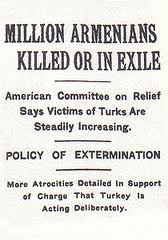
 Today is the 98th anniversary of the start of the Armenian Genocide, an ethnic cleansing campaign in the last years of the Ottoman Empire. Although the Genocide had many causes—political, economic, social—law and religion were major factors.
As Christians, Armenians had a precarious position in Ottoman society. They could exist, even thrive, but only if they accepted the second-class status that classical Islamic law allowed them. In the 19th Century, under pressure from European governments, the Empire had adopted a reform program, known as the Tanzimat , that granted legal equality for the first time to Armenians and other Christians. Conservative Muslim opinion could not accept this, and the Tanzimat led to a violent backlash against Christians in the 1890s, particularly in the Anatolian provinces, in which hundreds of thousands of Christians, mostly Armenians, died. A pattern of resistance and oppression ensued, until finally, under the cover of World War I, the Ottoman government decided to remove the Armenian population of Anatolia. Historians estimate that between 600,000 and 1.5 million Armenians, as well as tens of thousands of Syriac Christians, died during the death marches into the Syrian desert.
The story of the Genocide, and how it led to the first international human rights campaign in American history, is told well by Colgate Professor Peter Balakian in his book, The Burning Tigris . For my own reflections on how the failure of Ottoman reform contributed to the Genocide, please see here .

YOU MIGHT ALSO LIKE
The Possibility of Possibility
"Might could” is a Southern expression meaning “maybe I could” or “I might be able to,” conveying…
The False Promise of No Contact
Around the time nineteen-year-old Alice began cutting ties with her family, she announced on social media that…
Moral Certitude and the Iran War
The current military engagement with Iran calls renewed attention to just war theory in the Catholic tradition.…
