Ads


The Long-Term Employment Bust

High levels of unemployment may last indefinitely. A number of economists (including this writer) have been warning about permanent joblessness, and the idea is now seeping into popular magazines.

More than 8 million American jobs were lost since 2007, based on the most recent revision of the overall job count of U.S. establishments. But that is not the worst of it, because the establishment survey fails to capture smaller businesses and the self-employed. By the Bureau of Labor Statistics’ broadest measure of unemployment, including the forced part-time workers and so-called discouraged workers, the unemployment rate rose to 17 percent from 8 percent before the recession. That is 9 percentage points, corresponding to slightly over 12 million adults. A website called Shadow Government Statistics includes “long-term discouraged” workers defined out of the labor force by the BLS, but that alternative measure has tracked the BLS broad measure quite closely in the past few years.
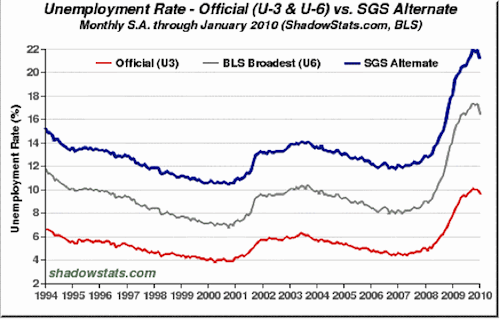

Unemployment Rate

There are several reasons to believe that most of these jobs never will come back. That is a less contentious statement than it might appear, because the jobs lost in the recessions since 1981 never came back. Some sectors, notably manufacturing, continued to shrink, and other sectors, such as heath care and retail, replaced them. The difference in 2010 is that it is not apparent where new jobs will come from.

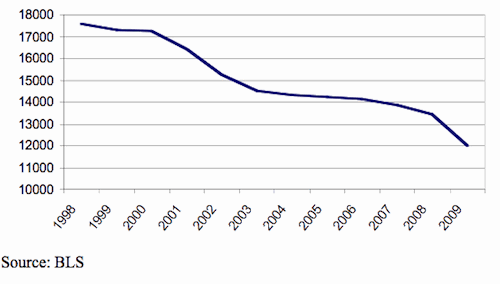
There was no recovery in manufacturing jobs after the last recession, for instance. The total fell from 17.263 million in 2000 to 16.441 in 2001—and continued to fall every year through 2009.

Manufacturing Employment, 1998–2009 (1000’s)

Manufacturing Employment, 1998-2009

At just 12 million, manufacturing employment is such a small portion of the 138 million employed Americans that any likely change would have a negligible impact on overall employment levels.

What replaced the lost manufacturing jobs? The sectors showing the largest increase in employment since 1993 (the end of the “employment recession” of the early 1990s) are shown in the table below, along with the change in employment since 2007:

Employment Change

The largest contributor to employment growth turns out to be professional services. This includes everything from real estate to accounting to law. We observe that construction gained about as many jobs (2.851 million) between 1993 and 2007 as manufacturing lost (2.895 million)—if off-the-books labor were counted, the number would be much higher. The “professional services” category was buoyed by the real-estate boom. That is why it lost almost as many jobs (1.155 million) as construction (1.396 million) after 2007.

In fact, of the sectors contributing most to employment growth during the long employment boom of 1993–2007, only education, health, and government (which partially overlap) sustained employment increases between 2007 and 2009. It is reasonable to expect that the aging U.S. population will require more health services going forward, but hiring is likely to be incremental at best. Government spending under the Obama stimulus plan helped postpone layoffs at the state and local level, but is unlikely to create many new jobs.

The construction boom is over for a generation or more. Residential housing is vastly overbuilt. As I wrote earlier this year:


In 1973, the United States had 36 million housing units with three or more bedrooms, not many more than the number of two-parent families with children—which means that the supply of family homes was roughly in line with the number of families. By 2005, the number of housing units with three or more bedrooms had doubled to 72 million, though America had the same number of two-parent families with children.

From other cross-sections of the data we see that the job losses have hit hardest the blue-collar working class, but also they've hit the upwardly mobile with some college training:
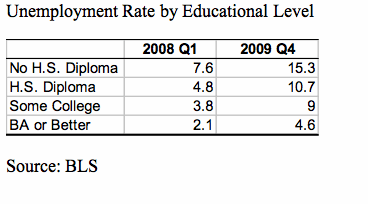
Unemployment Rate By Education Level

Workers with a B.A. degree or greater show a relatively low unemployment rate, although these numbers do not take into account long-term unemployed.

Given the inability of manufacturing industry to absorb many workers, and the poor likelihood that construction will do so, it is not clear where, or if ever, a large part of the American blue-collar labor force will work again. The semi-trained white collar labor force with an associate degree or a couple of years of college found ready work in the services expansion associated with the real-estate boom, but it is not clear what will happen to them now.

In previous recoveries, virtually all net new job creation came from new businesses. Most new businesses, to be sure, are small businesses, although the ones that created the most jobs were startups that grew very quickly. The most common estimate is that new business accounts for about two-thirds of net job creation.

During the 1980s, cellular phones, cable television, and other new technologies were an important source of new job growth. During the 1990s, the tech boom funded tens of thousands of startups, and, during the 2000s, the real-estate boom. Every deadbeat could get a job in the 1980s installing cable televisions, and every starving artist became a real-estate agent during the 2000s.

For the past fifteen years, the American economy has been geared to invest inflows of foreign capital in the household balance sheet, using the proceeds to import goods from the countries who lent us the money. That came to a bad end in 2007. All the employment associated with investing foreign savings and spending the proceeds—real-estate sales, mortgage banking, retail trade, and so forth—is no longer required. With a rapidly aging population, America will see less residential investment and more savings. America should be investing in high-value-added manufacturing and exporting. That would help America’s balance sheet, but it won’t do much for aging, semi-skilled workers who are too old to learn a completely new trade. Nor, as noted, will manufacturing in the best of cases create many new jobs.

There is some analogy to the Great Depression in the present situation. Between 1918 and 1939, American agriculture was in permanent decline, because the end of the First World War reduced demand for American exports, and because the substitution of the tractor for draught animals freed up an enormous amount of land set aside for animal feed. There was nothing to be done but to get the farmers off the land into other occupations, and that was not accomplished until the Second World War.

Americans, in short, have grown old in bad habits, and there is no way to avoid substantial and prolonged pain. The proposals that Reuven Brenner and I have offered in recent issues of First Things—a shift in the tax system to place the burden on consumption while exempting investment income—will help in the medium term, but certainly will not help some labor-intensive service industries (e.g., gaming) in the short run.

The temptation will be to emulate Britain after World War II, that is, to have the government provide jobs. If we do that, we will end up looking like Britain: permanently unemployed and permanently economically irrelevant. The difficulty is that no economic policy can prevent a very painful adjustment.

David P. Goldman is senior editor of First Things

Comments:

2.18.2010 | 10:18am
The problem with this analysis, I fear, is that it is true.
2.18.2010 | 11:10am
Joe Legris says:
Instead of scanning the horizon we should be exploiting the resources under our very noses in North America, instead of, as we do so well here in Canada, wasting them and whining for government aid. The easier, softer way of the disease of entitlement that we have enjoyed while politicians buy votes with our taxes will unlikely stop until we have collectively hit the proverbial brick wall and been brought to our knees. It is the way of meaningful life changes for individuals; why should we feel we are different??
2.18.2010 | 12:08pm
NF says:
It's interesting to note how consistently our educated professional class, which suffers relatively little from unemployment, is vociferously in favor of measures (environmental restrictions, small business regulations, minimum wage laws, union privileges, etc.) all of which directly suppress employment for the less skilled and less educated, but not their own.
2.18.2010 | 2:54pm
I express it this way: What is next?

*80's we had the integrated circuit revolution brewing

*90's we had the PC's creating businesses like crazy because they allowed for cheap distribution of CAD tools > ( I worked at such a place )

*2000's Where spent rolling to a stop

*2010's to be spent waiting for the next "big thing" such as genetic engineering of fuel sources?
2.18.2010 | 3:31pm
PaulRath says:
I have come to the conclusion that all of these problems are the logical result of modern Central Banking.

If the Federal Reserve did not exist – there would have been no bubble-blowing with low interest rates in the first place, no mis-allocation of the employment of millions of people into chasing imaginary real-estate riches, no ability for the Federal Government to maintain disastrous Government political and social-engineering projects such as Fannie Mae and Freddie Mac, no $1.6 Trillion Federal Gov’t deficit bought by imaginary Fed Dollars, no "too big to fail."

We should begin to imagine what the world would look like without Central Banks.
2.18.2010 | 3:49pm
Hoskyns says:
Excuse me? Britain is permanently unemployed? As any consultation of OECD data will suggest, the UK has for some time had substantially lower unemployment rates than the US, and in the current crisis has proportionately lost far fewer jobs than the US.
2.18.2010 | 4:59pm
Mr Goldman, thank you for your analysis.
A profoundly depressing article, as is the Atlantic column you linked to. What you and Mr. Peck at the Atlantic almost completely fail to mention is the role that virtually unrestricted legal and illegal immigration has played in the unemployment picture.
The outlook may be bleak but there is really no reason why it should be, the fact is that the US has failed to identify opportunities and has pursued a policy of promoting public over private sector employment. This coupled with the ignorance and naiveté of the US political class in failing to formulate policies to strengthen US business and commerce has led to stagnation of our economy. While we have been concentrating on empire, Japan, Germany and China, in particular, have concentrated on commerce.
If we look at World population trends we see a movement towards more and larger cities. This inevitably produces demand for infrastructure in energy, water, transport, etc. that the US should be well placed to meet. Another critical need is for city and infrastructure management expertise, we could position ourselves to take advantage of this if we embarked on a massive program of privatizing functions currently performed by overpaid and under worked unionized bureaucrats in our Federal, State and Municipal governments. There really is no need for any branch of government to employ accountants, lawyers, architects, engineers, tradespeople, etc. All of these functions can be supplied by the private sector, as can police and other emergency services. Such a policy would have the additional benefit of bringing the salaries and benefits of now public “servants” more into line with earned value rather than extorted reward, thus reducing the massive unfunded liabilities crippling our economic future. Private companies acquiring expertise in these fields would accumulate a valuable exportable skill.
I believe you are correct in your assessment of the need to impose consumption rather than income taxes. VAT has been a tool of trade manipulation used by almost all other major economies. In addition it is a money machine for government, unfortunately our current crop of leaders would probably use the additional income derived from a VAT to increase public expenditure. That is why we need to select, work for and elect responsible politicians who will act in the nation’s interest rather than their own.
You mention Britain; since 1945 there has been a concerted effort by Marxist agitators allied to the Labor party to generate feelings of victimization, which are then morphed by political opportunists into attitudes of entitlement and envy. The Conservative party, with the honorable exception of Margaret Thatcher, has done almost nothing to reverse this. The result is that Britain is now a broken country; broken politically, broken economically, broken socially and broken morally.
2.18.2010 | 7:40pm
This is not a cyclical crisis, but the end of this economic system. Capitalism is beset by five simultaneous crises:
•Profitability crisis - squeezing the lifeblood of capitalism,  capital has always had a "free lunch" from the earth and workers, now that's over
•Environmental crisis - undermining the natural basis for civilisation
•Resource crises -  oil, water, food, minerals, land, you name it
•Imperial crisis - U.S. Power is declining, but global capitalism cannot support a bigger hegemon
•Legitimacy crisis - both the leaders and the led are loosing faith in capitalism's destiny as it becomes more transparently undemocratic

This spells PERIL!
Political systems can withstand 1 or 2 problems and work around them, but these are occuring simultaneously with no solutions available. Typically this is how civilisations end.
Many candid comentators give the system about another thirty years before total collapse ensues. This sounds realistic to me. There will be many minor and not-so-minor crises before then. It's a massive system, but the trends are now clear.
2.18.2010 | 7:55pm
Good stuff.

Fwiw, work by top innovation scholars, growth economists and research organizations indicates that popular online markets for customized education will catalyze the creation of *many* jobs.

From OpportuniTV.com/many-jobs/:

From a November 6, 2009 article in the Wall Street Journal:

"According to the Census Bureau, nearly all net job creation in the U.S. since 1980 occurred in firms less than five years old. A Kauffman Foundation report released yesterday shows that as recently as 2007, two-thirds of the jobs created were in such firms. Put more starkly, without new businesses, job creation in the American economy would have been negative for many years."

From a 2005 report by The Nielsen Company:

"By enabling entrepreneurs to start a business online and immediately reach a market of 157.3 million registered users worldwide, eBay has become the best place to start, grow and operate a small business."

Harvard Business School professor Clayton Christensen is the originator of the canonical Model of Disruptive Innovation, and a co-author of the 2008 book Disrupting Class: How Disruptive Innovation Will Change the Way the World Learns. From Disrupting Class:

"Students need customized pathways and paces to learn.

…The second [phase of the disruption of standardized education] will be the emergence of a user network, whose analogues in other industries would be eBay…"

From The Flat World and Education: How America’s Commitment To Equity Will Determine Our Future, a forthcoming 2010 book by Stanford professor and Obama education adviser Linda Darling-Hammond:

"21st-century schools should integrate new technologies for learning and create personalized structures for supporting students."

Stanford economist Paul Romer is the originator of New Growth Theory, which updates growth economics for the information age. From Romer’s entry on Economic Growth in the 2007 edition of The Concise Encyclopedia of Economics:

“The country that takes the lead in the twenty-first century will be the one that implements an innovation that more effectively supports the production of new ideas in the private sector.”

“Perhaps the most important ideas of all are…ideas about how to support the production and transmission of other ideas…North Americans invented the modern research university…As national markets for talent and education merge into unified global markets, opportunities for...innovation will surely emerge.”

From The Mystery of Economic Growth, a 2004 book by Harvard economist Elhanan Helpman:

"Interest in growth theory abruptly revived…in the 1980s. The two key papers were by Romer (1986) and Lucas (1988).

…Romer (1990) also initiated the second wave of research on the “new” growth theory.

…A more detailed study of the U.S. economy is provided by Jones (2002). He found that between 1950 and 1993 improvements in educational attainments, which amounted to an increase of four years of schooling on average, explain about 30 percent of growth of output per hour. The remaining 70 percent is attributable to the rise in the stock of ideas that was produced in the United States, France, West Germany, the United Kingdom, and Japan."

Much more detail at OpportuniTV.com...

There is also good reason to believe that many people will enjoy customized education even if they did not enjoy standardized education...

Contact me with any questions, etc.

Best,

F
2.18.2010 | 9:41pm
Dan Reed says:
The adjustment is needed. The Wasted Generation that is the Boomers have systematically soaked up resources they didn't earn, and are going to continue until we hit rock bottom. In the meantime, they are distorting the market for younger people today (housing is arguably still too expensive), creating new barriers for entry, and--in the longer term--increasing our tax burden so we'll spend our whole lives digging out of the hole they've created for us, rather than building something new and better for ourselves. The only hope is that technological breakthroughs replace what has been taken in terms of lost economic opportunities, but we seem to be becoming less innovative, not more.
2.18.2010 | 11:36pm
"In 1973, the United States had 36 million housing units with three or more bedrooms, not many more than the number of two-parent families with children ... By 2005, the number of housing units with three or more bedrooms had doubled to 72 million, though America had the same number of two-parent families with children."

The same number of two parent families as housing units? Isn't that like no change? Did you mean as in 1973? That doesn't seem likely given population growth.
2.19.2010 | 12:27pm
Mr. De Waal -
Thanks for your comments. Can you describe the system that will replace this one?
Thanks again -
- Charles Cassil
2.19.2010 | 1:00pm
Mr. De Waal -
Thanks for your comments. Can you describe the economic system that will replace this one?
Thanks again -
- Charles Cassil
2.21.2010 | 7:29am
Our analysis is prospectively titled: "Why global capitalism is tipping towards collapse, and how we can organise for a decent future"

It may be finished this month. It will be available on-line or in printed format. It will run to about 100+ pages, with references.

Will such a co-operative system replace this one?
Maybe. That depends on the actions of billions of people.
If capitalism continues approximately 90% of the world's population will be dead in 50 years time. (according to acknowledged experts) Will you be one of the lucky 10%?
Just like the survivors of a nuclear war, you would have to reconsider whether survival was worth it. I don't think it would be for me.
2.25.2010 | 12:23pm
Artaban says:
@ Peter de Waal:
1. Cite some of these "acknowledged experts" that say "approximately 90% of the world's population will be dead in 50 years time" because of capitalism. I think what you meant to say was "acknowledged crackpots".

2. Read your history, Stalin believed the same things about capitalism you're pushing back in the 30s. Capitalism brought more prosperity and progress, and the USSR went the way of the dodo.

I would be curious to see the degree to which the disintegration of the traditional family has contributed to these busts (housing and otherwise). I personally have seen more wealth destruction caused by divorce and single parenting than any other factor. I have a friend that may have to sell her home if she wants to continue the custody battle for her child.

Consider all the money expended on lawyers during proceedings. Consider the cost of selling large family homes at reduced prices because the spouses now need to buy individual smaller homes. Don't forget the verified drops in academic achievement and increases in drug and alcohol abuse that are inflicted on the children of divorce. Factor in the cost of rehab, counseling, and lost work.

The money couples used to conserve by living together is eaten up in two rents or mortgages.

I'd also suggest that lack of serious education reform is also a significant factor in economic decline. When the average student loan debt (undergrad) in 2009 was $19,000+, and the cost of education is the only thing increasing more quickly than healthcare costs, we have problems. Total government expenditures on education (most of which is at the state or municipal level) in 2005 exceeded the bugdet of the Dept. of Defense--even with the Iraq War additions!
3.2.2010 | 2:28am
Mish Unemployment Projections Through 2020 - It Looks Grim
http://globaleconomicanalysis.blogspot.com/2009/11/mish-unemployment-projections-through.html
3.3.2010 | 1:31pm
Someone help me out here. Did we have to work in Paradise? Isn't all progress aimed at returning to Paradise? If we don't have to work, would we want to? This is all good news, folks. (Or is it...?)
3.5.2010 | 7:50pm
no one can fix our countries economic and employment situation by sitting around and complain and gripe about what we have done to this country. yes, i believe we not only have done our country in but continue to do so. we are fighting 2 wars and attempting to overcome a terrible recession and we still refuse to pay for anything, instead perfering to borrow to pay for all this.
still we are far better off than families during the depression. during that time some 25% of workers lost their jobs. when the job was lost, that was it. no unemployment benefits. there were very few 2 job families so when the father lost his job the mother had no job to suppliment. It took us years to overcome the depression and really didn't really overcome it until ww2 created jobs. get off your duffs and again support our country and raise taxes to pay for our follies.
3.7.2010 | 11:15pm
Hello Charles Cassil, "Artaban" and other readers of this blog. Please find the link to our research on the end of capitalism below. It is fully referenced. We welcome your considered comments.
Regards,
Peter de Waal
•••

‘Beware! The end is nigh!’
Why global capitalism is tipping towards collapse,
and how we can act for a decent future


This 20,000 word essay, by Grant Morgan of Socialist Worker-New Zealand, is now available:

UNITYblog website:
http://unityaotearoa.blogspot.com/2010/03/grant-morgan-beware-end-is-nigh.html

This essay will form the entire contents of the March 2010 edition of UNITY, Socialist Worker's quarterly Marxist journal for grassroots activists. Following editions of the journal will expand on the existential crises which are converging to tip global capitalism towards collapse. To subscribe to UNITY journal, email Len Parker, . UNITY is posted to your letterbox four times a year. Price: $25 for NZ subscribers, NZ$40 offshore fastpost.


To give you an idea of the essay's contents, here is a list of chapter and section headings:

PART 1: HISTORY LESSONS
The fable behind the stereotype
Wild times of late feudalism
Complex and random
Convergence of five existential crises

PART 2: FOLLOW THE MONEY
Growth gene dominates capitalism's DNA
Three strands of neoliberalism
A global Ponzi scheme
Feeding the unfinancial monster
Marxists dispute why, not what
'Doomsday cycle' risks world 'collapse'
State nationalises economic crisis
'Make the rich pay for the crisis!'

PART 3: INTO THE FIRE
'If the climate were a bank'
Deep fracture inside world system
The rights of Mother Earth
Profiteering from pollution
'Now it's up to us all'
Broad spectrum of ecological hazards

PART 4: RUNNING ON EMPTY
Peak everything in the 21st century
Searching for a miracle
False hope of conservation
Hooked on fossil energy
Can capitalism switch to renewables?
War of all against all
No smooth transition
Self-organising for social prosperity
Our scale must be global
'We're not wired for autonomy'
Mixed messages in dying days

PART 5: CHANGING THE GUARD
Capitalism's first hegemon
Superiority of scale
Rise, dominance, decline, ouster
A date with Uncle Sam
Poor performance in recent times
Collapse of 'New American Century'
New American Dream: warbots on coal
First Law of Social Domination
The rise of China
Decline triggers escalating conflicts
A lying sort of Big Truth
China can't rule the world
What about a world government?
'Doomed to systemic disintegration'
The throne will forever remain empty

PART 6: THE TIDE TURNS
Back to the future of Marx
Outer limits and inner conflicts
Scenario chimes with Marx
Successful revolts since World War I
Overview of conflict dynamics
Long waves and short waves
Historical pluses and minuses
An evolutionary rebalancing
Materialist approach to history
'I never was truly my own master'
A two-way street
Political instability was once about Iran
Colonisation of the public mind
'People are frightened and angry'
The negation of the negation
Diverse diviners of capitalist collapse
Growing weight of evidence
Perfect storm spells P-E-R-I-L
'Great revolutions originate in fear'
The Great Disunity
The Global Uniting
'It will blow like a whirlwind'
Think global, act global
The word in common
'Free-will factor becomes central'

PART 7: FUTURE ACTS
Educating the human actors
Global acts done locally
Local acts done broadly

ENDS
6.30.2010 | 7:12am
Many of the societal changes would be an improvement. Let’s concentrate on the number of employed, 130+ million, instead of the unemployed. There are plenty of jobs to support our population. True, we must do a better “job” of preparing ourselves if we want to be a part of the labor force. But we have neglected our duties as parents and homemakers for decades and this will force us to reevaluate our true priorities. We need to concentrate on getting at least one person gainfully employed in each household. Those that have properly prepared for retirement need to go ahead and do so.
1.6.2011 | 2:13pm
HH Gregg says:
All of the fluctuations in employment (LOSSES) are scary too look at on paper. But it seems like this is something that has always occurred and will continue to occur. While it is something I will continue to pay attention to so as to remain knowledgeable about current events and what's going on in the world, I would still rather spend my time focusing on the more positive aspects of my time here.
type the text above in the box below

Links

Blogs

Find Us

Contact