

Ads


Who Will Bail Out the Bailer-Outers?

Just when we were told that the governments and central banks of the world had put the financial crisis behind us, the governments of Europe found it necessary to commit more than a trillion dollars to support of the financial system – a $962 billion facility to support the weak periphery of the Eurozone, plus an unspecified volume of outright purchases of government bonds by the European Central Bank as well as Germany's Bundesbank, not to mention an emergency swap facility by which the Federal Reserve will lend Europe all the dollars it requires.

The banking system really was about to come down. The reason is that sovereign debt is a bigger problem than subprime mortgages ever were. We know from available data that two-thirds of the US deficit, according to available numbers, has been financed by domestic as well as foreign banks during the last quarter of 2009 and the first quarter of 2010. This is clear from the Treasury's data on international capital flows, which shows $50 to $60 billion a month worth of purchases of US Treasury securities from abroad, almost all of it from London or the Caribbean, that is, offshore banking centers. US banks meanwhile are adding Treasuries to their portfolios as fast as they shed commercial and industrial loans. Detailed data is not available on international banks' holdings of Greek, Spanish, Portuguese or Italian bonds, but we know from anecdotal evidence that the weak sisters of southern Europe have been financed by bank treasuries just as the United States has.

It's all been done by smoke and mirrors. The governments bailed out the banks in September 2008, and again in various increments through the Spring of 2009. The great Keynesian stimulus that was supposed to guarantee recovery left most industrial countries with government deficits in excess of 10% of GDP. How does the US finance a deficit equal to 12% of GDP with a savings rate of 2.5%? By bank leverage. The banks, once bailed out by the governments, in turn bail the governments out. And when the weaker governments threaten to go belly up, the banking system freezes up.

The cost of insurance against defaults by European banks reached an all-time record for that reason last Friday, and banks stopped lending to each other on the interbank market – portending an imminent collapse of the financial system. That was not a drill. It was the real thing. And that is why the European governments shifted from official complacency only days ago to total mobilization mode.

The market got a peek at the man behind the curtain. It wasn't the Wizard of Oz; it was the ghost of John Maynard Keynes. And it didn't like what it saw.

Keynes assumed that people have a very short-term view of things. If you inflate the currency, the workingman will see the same number of shillings in his pay-packet and spend more, he wrote in the first pages of the General Theory (1936). By the same token, if the central bank reduces the interest rate to zero, investors will shift portfolios to stocks, everyone will feel richer, and consumers will spend more – which is more or less what happened during the past two quarters of putative recovery in the United States. They won't mind that government deficits have ballooned to 12% of GDP (or 18% of GDP in the United Kingdom, if unfunded pension liabilities are taken into account).

The fact is that Keynes was right, at least some of the time. Investors tend to focus on the next turn of the market, because professional investors are paid to follow the pack rather than work out what is a worthwhile investment and what is not. Keynes had contempt for investors; as he wrote in 1931, "A sound banker, alas, is not one who foresees danger and avoids it, but one who, when he is ruined, is ruined in a conventional way along with his fellows, so that no one can really blame him." Every banker in the world had to short the market on Friday, and every banker in the world had to buy the shorts back this morning – which is why European stock indices are up nearly 10% as of 8:00 a.m. Eastern Standard Time.

The trouble, though, is that the long-term sometimes peeks in. Issuing lots of government debt is a good idea if the economy can support it. The trouble with Europe is that forty years from now, there won't be enough Europeans to pay the taxes to fund the government debt. Here is a projection of Europe's dependency ratios from the United Nations World Population Prospects website, assuming constant fertility:

Europe's Population Dependency Ratios, 2010-2050 (Constant Fertility Variant)
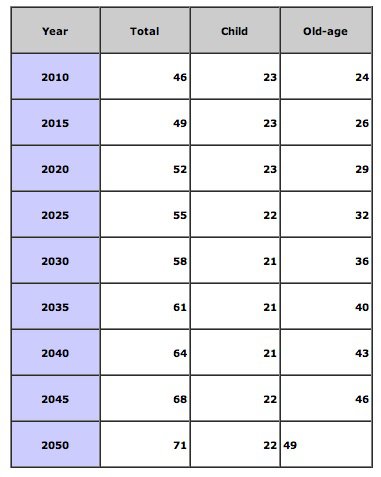
Europe's Population Dependency Ratios

The elderly portion of Europe's population will rise from 24% to 49% of the total, an insupportable burden. Who would want to buy 40-year European bonds?

This helps us to answer the question: why Greece? First of all, corruption pervades Greek society to the point that to purge it would destroy the social fabric: all political and social relations are premised on corruption. But it is also the case that the population profile of Greece is much worse than the European average. By 2050, the elderly dependency ratio will rise to a frightening 59%, and the Greek state will be hard pressed to meet its obligations under any foreseeable circumstances.

Greek Dependency Ratios, Constant-fertility Scenario


Greek Dependency Rates

At every inflection point of the financial crash, governments stepped in and announced that they had solved the problem. The crisis began in July 2007; central banks stepped into provide liquidity in August, and the Fed cut interest rates in mid-September . The consensus then held that the crisis was over and that bank stocks were cheap. Then came the Bear, Stearns failure in March 2008, in which the remnants of the firm were sold to J.P. Morgan. Financials briefly soared, and the analyst consensus was that bank stocks were cheap—just before Lehman Brothers' failure in August 2008. The Bush administration announced a $700 billion bank bailout in September 2008, and financials rallied, before crashing again in early 2009, amidst rumors of a general bank nationalization. More bailouts followed, and this time, an extended rally.

Each bailout requires more leverage, and puts at risk a larger and larger compass of the financial system. The central banks with their combined muscle crushed all the short positions in the market this morning. But time is against them; and now that the market has had a peek behind the curtain, things will never be the same.


David P. Goldman is senior editor of First Things.

Comments:

5.10.2010 | 11:20am
Peak Oil and other resource limits - both energy and non-energy - will put paid to the current structure of the world economy and financial system long before an excess of elderly members in European societies do. The physical basis for world economic growth no longer exists, and the gargantuan indebtedness that is itself an expression of this at this time can do nothing but collapse into system-wide default and deflation. This process already started three years ago, but we are as yet still in the early stages. The next two to three years should see developments in these regards that are far more devastating than anything we have seen now. Nothing can stop this process at that point, because adding to the debt-burden as the Europeans have just done only buys a very little time before the inevitable crash at the expense of making thec crash itself worse.
5.10.2010 | 11:27am
Mr. Goldman, may I please ask two related questions?

In your opinion, how would this financial crisis be different if the EU did not exist, if the European countries had remained completely independent nations?

In your opinion, is it fair to say that the EU is yet another failed experiment of the elite, socialist Left?
5.10.2010 | 12:28pm
Michael says:
I was surprised to see Mr. Goldman's name mentioned in a Barron's article a few days ago. http://online.barrons.com/article/SB127294729055586423.html?mod=googlenews_barrons

I was unaware FT had such well respected financial experts on it's editorial staff. http://www.cnbc.com/id/36693573/David_Goldman_s_Profile

As I understand it the "fix" the US government put in place for the banks was much less a bailout and more of an accounting change. They used to require asset values be counted at current market rates. This was known as market-to-market. When this was suspended, Banks could all just agree they were worth more. This is the definition of smoke and mirrors. Low interest rates allowed them to make hugh profits which they continue to sock away in to Treasuries because they know they would still be considered bankrupt if they had to price their assets at current market terms.

I agree that the bailouts, including the most recent one from the ECB, just kick the can down the road. The deficit spending is generally sustainable if there is a growing economy which will get harder as populations age. They hope enough growth return to make their debt look manageable.

Deficit spending is largely a product of "social justice" initiatives. It seems that these initiatives have saddled productive sectors of society with taxes in order to support unproductive sectors. It seems that these productive businesses are now beginning to buckle under the weight of these taxes. How can we continue to justify the costs of these large social justice programs? Can these programs be considered charity?
5.10.2010 | 12:46pm
Krakow says:
If the financial system implodes then all debt will be meaningless while military, natural resources and other such assets will be prominent? In the long run would the US benefit from a financial system implosion?
5.10.2010 | 1:01pm
Ed Snyder says:
What I'd like to know is: How do the economic powers of the world find the money for a bailout package when their governments are themselves up to their eyeballs in debt? (And, oh, by the way, part of that one trillion is being paid for by us Yanks via the IMF.)

Here in Italy, I used to like to crack wise that the Euro is Monopoly money. Now? It's all Monopoly money, baby.
5.10.2010 | 1:09pm
Krakow says:
Should John Maynard Keynes have foreseen that Nixon or some other US President would unilaterally cancel the direct convertibility of the United States dollar to gold?
5.10.2010 | 1:18pm
Diane says:
no, Michael, these programs cannot be considered charity. Charity is provided out of love grounded in truth and a test for truth is: Could I multiply this through all of humanity and, when fully accomplished, have increased vitality?

We are seeing the answer to that question reveal itself. Deficit spending, inflation, expenditures of "trust" funds, unfunded liabilities and guarantees, cap and trade, value-added taxes - all of it is taxation, the full cost of which is only revealed when the holder of the debt surrenders his trust that there is any value behind it. That trust is deservedly eroding at every level and throughout the world as more and more people demonstrate they have no willingness to repay it because they have become accustomed to considering every obligation someone else's burden.
5.10.2010 | 1:25pm
Brian says:
The church (i.e., all Christians) need to be prepared to take back its proper role as the steward of caring for the poor, once the government can no longer afford to do so. The church should have been doing it all along. The time to prepare is now.
5.10.2010 | 2:32pm
Bob G says:
A very insightful article, yet it leaves a lot out.

For a devastating critique of Keynes, see Hunter Lewis’s book Where Keynes Went Wrong. Keynes is useless in our times.

The world's greatest expert on financial crises is Carmen M. Reinhart, who recently published a study of such crises over the last 800 years: This Time is Different; Eight Centuries of Financial Folly. The 2008 crash followed the pattern perfectly. She opines that the bailout of Greece only kicked the can down the road. All of history says that Greece is bound to default. Folks, it's over in Europe, except for the shouting. I don't believe it will take 40 years for the truth to out. At most it will be five. Big trouble ahead in the U.S. too. These, in fact, are the “good old days,” before the effects of Obama's spending start to take hold.
5.10.2010 | 2:35pm
Invest in ammunition and canned Spam.
5.10.2010 | 2:40pm
Ellen says:
Mr Alleyn asks an interesting question, whether tethering together countries from the lesser and more developed parts of Europe has, in effect, helped to cause the current crisis, which may well get worse. If the EU didn't exist, Greece would never have been allowed to borrow all that money on such good terms to inflate the standard of living of a country that shares more in common with the nonproductive Middle Eastern societies than with the industrious nations of northern and Western Europe.

Right now, a small and economically unimportant country like Greece is threatening to bring down the world financial system (yet again). In the case of AIG, at least they were able to replace the corrupt and incompetent people at the top of that company and of the financial services division with better people who are quickly reviving the company (it seems). In the case of Greece, as Mr. Goldman has pointed out, you can't do that since the whole society is saturated with corruption and incompetence; people depend on it for their livelihood and social standing.

Greece is a geriatric hopeless case, and the best case scenario would be, as someone has commented, to turn the whole country into a Spenglerian theme park. Let the Germans run the admissions to the theme park and use the proceeds to pay off the Greek debt over the next 30 years, at which point most Greeks will no longer be around, based on actuarial tables.
5.10.2010 | 4:15pm
Mr. Alleyn,

If the EC did not exist, Greece and the other weaker members would not have had access to the kind of credit that got them into trouble in the first place. Lenders bought Greek (and Spanish and Portuguese debt) under the presumption, not yet falsified, that the EC never would let them go under. The major EC countries have around half their GDP in government spending, vs. around 30% until Obama came along (it's now 36% and with Obamacare will rise above 40%). "By their fruits shall ye know them" -- I would say the evidence is consistent with your statement regarding the EC and the socialist left.
5.10.2010 | 6:58pm
Brendan says:
In my view the big players in the market know that a massive crash is inevitable at this point. They are lobbying like mad for the governments to tip in another round of bailouts and stimulas spending just to to delay it a few more months (maybe until the next round of bonuses). However, they are set to pull the lever on the ejector seat at the first sign of the market crashing.

That's what happened on 6 May: the market got the jitters and 1000 points were ripped from the Dow Jones. Next time, when the crisis is real, the drop will be further and permanent.
type the text above in the box below

Links

Blogs

Find Us

Contact