
Under God:
Religion and American Politics
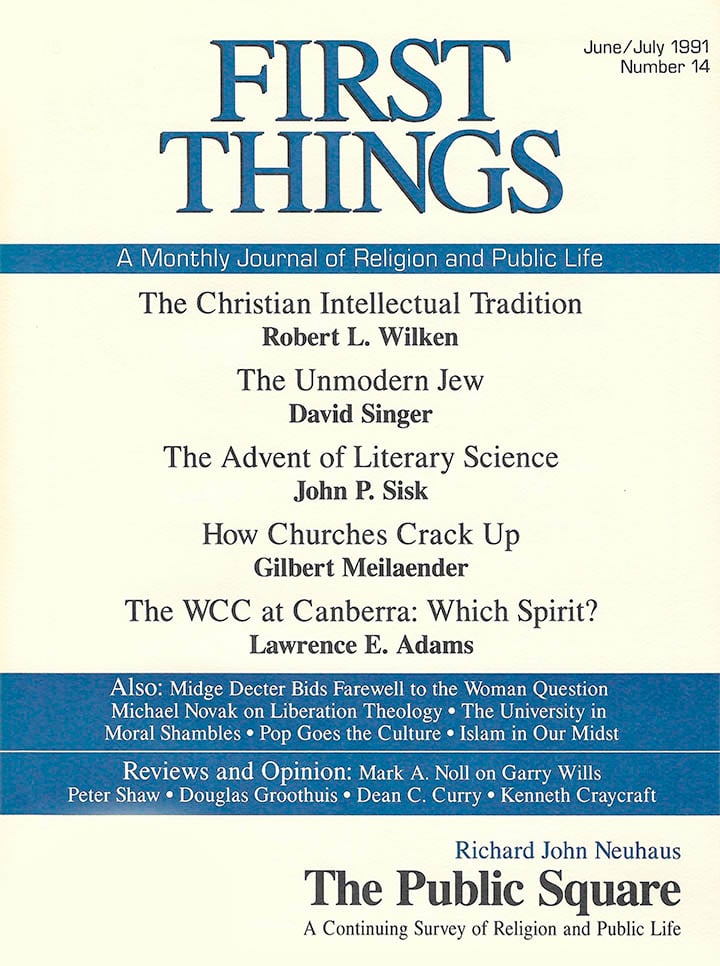
by garry wills
simon and schuster, 445 pages, $24.95
Garry Wills is an indefatigable iconoclast, and the icons that have felt the sting of his wit are as diverse in time as in form. They include ideas like the facile notion of Lockean hegemony in the Revolutionary period or unreflective confidence in the Catholic Church after Vatican II. Even more, Wills has pursued personalities—the domineering lusts of the Kennedys, the psychological quirks of Richard Nixon, the genial vapidity of Ronald Reagan.
With this book, he turns on one of the most persistent bits of modern conventional wisdom—the assumption that the political influence of religion will (or should) inevitably decline as American society becomes more “modern.” Not so, argues Wills in a work marked more by thematic coherence than a tidy procession of arguments. The political power of religion is, in fact, increasing as the United States enters its third century. Furthermore, and in the face of implicit assumptions from all points on the political compass, the history of the United States shows that the beneficial influence of religion grows when it is divorced from the machinery of government.
Wills makes these basic points in a wide-ranging series of essays growing out of his work as a reporter during the 1988 presidential campaign. The book’s eight essays are organized loosely around the religious backgrounds of candidates (Gary Hart, Pat Robertson, Jesse Jackson), the political implications of dogmas held by Protestant evangelicals (premillennial eschatology and anti-evolutionism), and contested issues in recent public life (pornography, abortion, and the separation of church and state).
The operative words are “wide-ranging” and “loosely,” for Wills’ muse carries him far and wide. As an example, the essay featuring Jesse Jackson includes also a historical overview of black millenarianism, a profile of Atlanta’s Andrew Young, an assessment of Abraham Lincoln’s faith in relation to the traditional beliefs of black Americans, a refinement of historian Jon Butler’s recent contention that slavery amounted to a “spiritual holocaust,” and an evaluation of the struggle for power in the Southern Christian Leadership Conference after the assassination of Martin Luther King, Jr. And all spinning around a close-up look at Jesse Jackson, the person, the seminarian, the campaigner, the orator, and the minister.
This kind of pyrotechnic virtuosity would be irritating if Wills were not so consistently thought-provoking. In this instance, he catches very nicely the ambiguities of a middle-class Andrew Young having to learn about civil rights from the television set. He makes a telling historical contrast between Julia Ward Howe’s exultant use of imagery from the Apocalypse of St. John and Lincoln’s sober preference for the “suffering servant” passages in Isaiah and Luke. He shows that blacks, who were brutally stripped of their indigenous religions, nonetheless discovered truths of unanticipated liberation in the slaveholders’ faith. And he makes a spirited defense of Jesse Jackson’s behavior after the death of Dr. King.
For my money, the section on Jackson would have been even better if Wills had directed the same gimlet eye at Jackson that he used in scrutinizing the campaigns of Hart, Robertson, Dukakis, and (in passing) Bush. Disappointment in this matter notwithstanding. Wills materially advances the book’s thesis with a sensitive depiction of Jackson’s base in black religious practice and a description of the unexpectedly strong showings he made in a few white areas where his persona as a man of God emerged.
Other sections of the book are equally rewarding. A splendid discussion of William Jennings Bryan, the Scopes Trial, and the general struggle by evangelicals against evolution is richly insightful on the Scopes circus of 1925 as well as on the deeper meanings of antievolutionism then and since. For Wills, all the old truisms are bunk. Clarence Darrow and H. L. Mencken, purported defenders of scientific enlightenment and highbrow culture, are successfully portrayed as manipulative social Darwinists. Bryan, in Wills’ forgiving eye, appears at “the Monkey Trial” not as a doddering old Puritan, but as “the most important evangelical politician of the century,” as a perceptive champion of the common people, and as one who understood only too well how the scientific pretensions of the better sort can lead to the degradation of the masses. Wills thinks that, by contrast, later anti-evolutionists, because they shifted the focus of their concern from the social impact of evolution to technical defenses of biblical details, have both forfeited a vibrant Christian tradition and condemned themselves to intellectual irrelevance.
Equally challenging is Wills’ painstaking unpacking of the process that transformed Gary Hartpence, Church of the Nazarene seminarian and inheritor of strict fundamentalist morality, into Gary Hart, the obtuse candidate who never could get it through his head that Americans are more offended by arguments for amorality than the commission of immoralities. The same could be said for his treatment of Thomas Jefferson as a sincere (if exceedingly idiosyncratic) Christian; of Pat Robertson as a curiously logical combination of high-born Southern gentry and down-home, born-again pentecostalism; of Francis Schaeffer as the fundamentalist leader who, often through misguided learning, nonetheless restored a public conscience to white evangelicals; of the laudable impulses but questionable tactics of those who attempt to preserve public morals through censoring pornography; of how details concerning end-times prophecy have become political meat and drink to some conservative evangelicals; of how leftist opposition to anti-pornography legislation flies in the face of liberal instincts to control the marketplace; and how rightist support for the same laws violates conservative professions to favor a free market.
Any reader with the least interest in Wills’ topics will find much about which to quibble and much as well with which to disagree heartily. For my tastes, there is too much authorial pretense, as Wills, for example, unfurls his learning to show how Col. Robert Thieme missed a couple of Greek accents during a sermon/lecture or how Tocqueville implied subtle ironies through prepositions that his translators obscured. Wills also makes a few simple mistakes: Denmark never had a Calvinist state church, neither William Jennings Bryan nor anyone else ever posed a clash between Augustinianism and Lutheranism, Calvin’s own predestinarianism emphatically did not extend to finding the right spouse, and the theonomist Rousas John Rushdoony does not inhabit the same realm as “name it and claim it” pentecostals.
Of several debatable assessments, I found most dubious Wills’ assault upon the double-track approach taken by the Roman Catholic Church to questions of public morality. He correctly notes that the Catholic Church has spoken by divine right to its own members and argued with natural reason in public. But then in bashing left and right—against Mario Cuomo for giving so little credence to the in-house morality of his own Catholic Church as he defends a tolerance for abortion in public and against the Catholic bishops for attempting to impose their “obsolete” beliefs about abortion on the general public”the discussion is muddled.
Easy as it may be to trip up both the bishops or the governor, confusion over abortion does not in the least vitiate the basic wisdom of the Catholic Church’s parallel modes of moral reasoning. Confusion precisely in these two realms has wreaked great havoc in American public life, whether from crusading evangelicals eager to impose a particular interpretation of Scripture on the general populace or from crusading secularists eager to prevent the legitimate expression of moral reasoning from a religious group. Some strategy of parallel discourse is absolutely essential for believers who also wish to be contributing citizens in a pluralistic society.
Whatever difficulties Roman Catholics may have with abortion or other specific issues, their strategies of moral argument are an inspiration for all who struggle toward a way of being both faithful to their religious beliefs and active in society.
To its great credit, Under God stimulates a wide range of such engaged responses. On some of his judgments, Wills may be wrong. Most often, however, he sets the record straight, blows away obfuscation, restores sanity to the tangled web of politics and religion, and, above all, sustains his thesis: Religion does play, and always has played, a major role in American politics. American politics would be a desperate venture if religion did not play such a role. The real question is not whether religion should play a role, but what kind of religion and how skillful the playing.

YOU MIGHT ALSO LIKE
The Church of Ratzinger (ft. Sam Zeno Conedera)
In this episode, Sam Zeno Conedera joins R. R. Reno on The Editor’s Desk to talk about…
Pelvic Theology, Pelvic Justice
In a recent New York Times guest essay, Catholic writer David Gibson praised Pope Leo for moving…
Can These Bones Live?
The Saturday after Easter, on a cloudless morning, I fell and shattered my left elbow while taking…
