
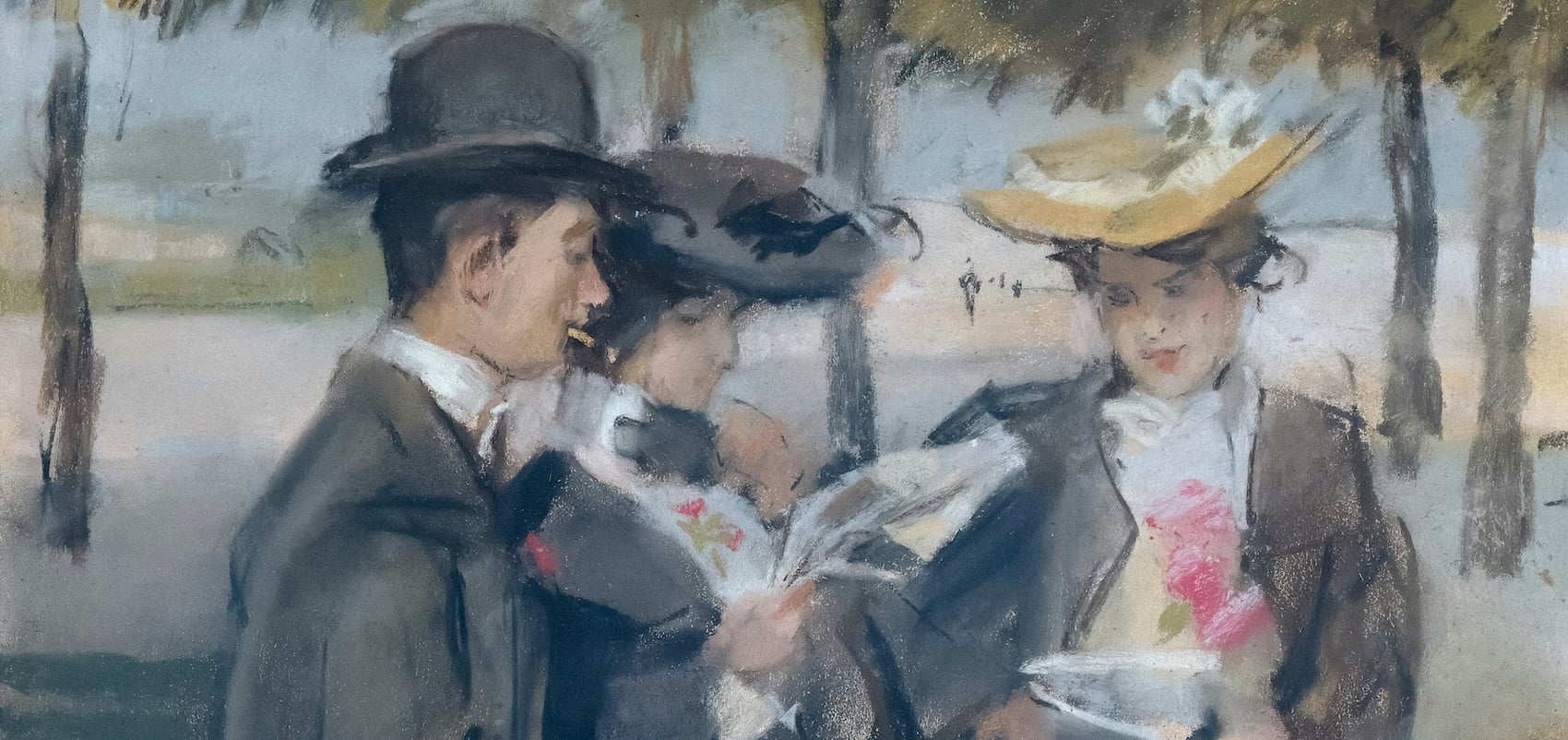
For quite a few years now, academic philosophers and sociologists, as well as popular social commentators who get paid to pronounce on such matters, have been telling us that people have been abandoning their formal personas in favor of the whims and behavior of their individual selves. The point of all the ink seems to be that public ritual behavior has given way to personal freedom, and that while we all used to have two personas, a public one and a private one, we now only have a private one which has gone public. Richard Sennett’s The Fall of Public Man appeared in 1977, followed by Christopher Lasch’s The Culture of Narcissism in 1979, and then the deluge. The publishing climax may well have come in 2000 with Robert Putnam’s Bowling Alone, in which Putnam argued that individuals were increasingly disconnected from one another and social structures.
While not putting an emphasis on dress itself, most commentators who have discussed the relationship between the public and private person have made reference to both dress and manners when discussing the abandonment of the formal public self. And perhaps nowhere can the loss of public self be so readily seen as in the clothes we wear. One commentator remarked, “A ‘gentleman’ no longer tipped his symbolic hat to a ‘lady’ to show the conventional respect due her sex; he no longer had a hat to tip.” And no one doubts that the hat is gone, as well as the suit, the tie, and the polished leather oxford. The word I’m searching for is casualization. There’s been, in the past couple of decades, a Great Casualization of the business wardrobe. The suits and white dress shirts and discreet ties that most businessmen wore for a hundred years and more started to disappear after the 1970s. When this casual business trend began in earnest in the following decade, fashion writers started referring to it as “the third wardrobe”—an alternative to both the tailored business clothes and athletic-inspired clothing that had traditionally comprised a man’s wardrobe for much of the twentieth century. Today, traditionally tailored clothing—suits, sports coats, and their accompanying accessories—might legitimately be considered the third wardrobe, a luxury wardrobe worn for dressy occasions by many, and daily by those in positions of real power in society.
To complicate things even more, there has been the gradual gentrification of the proletarian wardrobe since mid-century: the work-wear of what used to be known as “blue-collar” workers, clothes that included blue chambray and denim work shirts and trousers (jeans), civilian uniforms of various types (postal workers, garage mechanics, etc.), farm and range clothing, and active field-and-stream outdoor sports clothing. Prole gear has firmly joined military clothes and athletic sportswear to make up the bulk of men’s wardrobes today. The fashion garment of the moment, for example, is the olive green military field jacket issued to soldiers during the Vietnam conflict, complete with cinch-waist cords, epaulets, bellows pockets, and concealed hood. You can buy one from the original military suppliers for less than $200, or from an Italian designer collection for over $1,000. But perhaps the most telling clue to this prole luxe gear category is that humblest of blue cotton work shirts itself, which used to be the staple of the steelworker and ranch hand’s daily wardrobe, and sold for around $3 to $5 forty years ago in Army and Navy stores across the country, and is now found to be the mainstay of international designer collections and boutique offerings, selling for anywhere from $100 to $500. The hip Wallace & Barnes label has a little chambray number for $118; Drakes of London, a favored haberdashery with the young and well-dressed, offers a blue denim shirt priced at around $200; and the super-chic Saint Laurent’s washed vintage blue denim shirt is a mere $950, but it’s advertised as being “oversized,” so presumably you get more shirt for your money.
How is it that we have gone from wearing suits and ties to the office to wearing T-shirts, baseball caps, and a variety of military garments and ranch hand wardrobes? Everyone who’s ever perused photos of baseball games (or almost any other crowded venue for that matter) in an old Life magazine from the mid-twentieth century finds it remarkable that the majority of men in the crowd are wearing white shirts and ties, and business hats (a category of menswear now extinct). The metamorphosis over such a relatively short time to polo shirts and cargo shorts on most of the crowd is a bit staggering, almost as though we were looking at two different species. The history, the sociology, the psychology of dress all seem to come rushing in to confound my thoughts. But then I’m not alone.
Let’s start with the history. The man’s tailored wardrobe—which has been with us virtually unchanged in form since just after the Civil War—has been under attack for half a century now. While the twentieth century can legitimately be thought of as the century of the suit, the high point of that garment seems to have come earlier rather than later. Some would say the oft-heralded demise of the suit and its accompanying accoutrements has been occasioned by the long trend towards comfort in clothing enhanced by breakthroughs in the science of fabrics. And there’s no doubt of the truth in this theory, particularly when you stop to consider that we live now in such a climate-controlled world that some people have not actually experienced the great outdoors except in moving from one Disneyland ride to another. Even the tailored wardrobe itself shows this trend towards comfort. Traditional business clothes—the heavily starched shirt, the thick, scratchy woolen suit, the almost bulletproof overcoat—weighed more than twice as much at the beginning of the twentieth century as they did at the end of it. Heavy, stiff, scratchy wool gave way to lighter, airier, and smoother fabrics, so that today a man’s suit can easily weigh in at a few ounces, rather than the ten to twenty pounds it would have in the early 1900s.
Then too, there’s the eminently sensible argument that the jettisoning of the tailored wardrobe is merely a part of the larger and ongoing “democratization” of dress that started to standardize the wardrobe with the beginning of the Industrial Revolution, and whereby we may all eventually be encased in the same synthetic coverall and molded plastic footwear. Still others will tell you the degeneration of the trad wardrobe is all part of the “me” generation’s retreat from social consciousness and public style, part and parcel of a general lack of empathy, manners, and responsibility. More ancient members of the community can often be overheard muttering that we will eventually descend into anarchy, barbarism, and loincloths.
But what does the sartorial history from mid-century really show? First, that the 1950s was a long decade, stretching, it can reasonably be argued, from 1944 to 1964. In 1944, with the Allied armies gaining strength and victories, the U.S. Congress passed the Servicemen’s Readjustment Act to provide help for demobilized servicemen. It was the largest civilian aid act ever attempted by government, and would provide the largest range of benefits for returning veterans ever imagined. It’s difficult to overstate the importance and influence of this legislation. These government benefits included low-cost mortgages and business loans, unemployment compensation, and cash payments for higher education to every veteran who qualified. In addition to the private housing building boom, it’s estimated that one result was that enrollment in U.S. colleges and universities increased ten-fold in the ten years following the end of the war.
The G. I. Bill, as it came to be known, ushered in a new age of prosperity for many lower- and middle-class families. The sons of steelworkers, mill hands, teachers, clerks, and farmers could go to college, start a business, buy a small house and car. A telling indication of this new prosperity could easily be seen by looking at what young people wore. Ivy League clothes—the soft-shouldered, buttoned-down, saddle-shoed, gray flannel wardrobe—were by 1950 not limited to the Eastern establishment elite who had owned the style and worn the clothes for more than half a century, but were adopted by youth from Boston to Brownsville to every land grant college in the Midwest. The Ivy look—the Eastern establishment elite look writ large—became a symbol of the new prosperity.
This American menswear revolution could be seen everywhere, on campus, in film and TV, and in every men’s fashion magazine. Think of all the young, often blonde movie stars such as Tab Hunter, Paul Newman, Anthony Perkins, George Hamilton, and Troy Donahue who catered to the new teenage audience. And then there was the influence of the music. To mention only one pregnant example, in 1955 jazz trumpeter Miles Davis stepped onstage at the Newport Jazz Festival wearing a seersucker jacket and club-collar shirt purchased at Charlie Davidson’s Andover Shop in Cambridge, Massachusetts, and set a trend for the look of jazz musicians for the next decade and beyond. The look spread to Europe and Asia. Both W. David Marx (in his study Ametora), and Masafumi Monden (in Japanese Fashion Cultures) meticulously chart this trend in Japan since 1945.
At the same time, American work gear such as denim jeans, ranch jackets, field-and-stream clothes, and a variety of Army and Navy store gear was becoming popular here and abroad. But by 1964 this Ivy look, so quintessentially American in its blending of the casual and the dressy (sack-cut suits and button-down shirts worn with penny loafers), was under attack from abroad. Sean Connery, Michael Caine, Terence Stamp, and other “angry young men” introduced Americans to the wasp-waisted jackets with deep side vents and flared, drainpipe trousers favored by the mods of Carnaby Street and the neo-Edwardians frequenting Savile Row. Meanwhile, the films of Federico Fellini and Vittorio De Sica helped Brioni, Emilio Pucci, and other Italian labels find an American market.
Then, in the summer of 1967, came a blow to the American tradition of the tailored wardrobe from which it can be said never to have recovered. In the summer of 1967, 100,000 young people rushed to San Francisco for what came to be called “the Summer of Love.” The party lasted all summer. They left at the end of August to return to their campuses wearing not khakis and madras sports jackets and penny loafers, but festooned in tie-dyed T-shirts, bell-bottom jeans, love beads, and sandals of indeterminate origin, having only stopped off at home to burn their Harris Tweed sports jackets and Brooks Brothers button-downs, and let their hair grow longer.
The final blow came two years later, when 400,000 young people crowded into an open field in upstate New York at Woodstock for a rock concert. That party only lasted for a few days, but it was enough to put the tombstone to the Ivy look on campus good and proper. Purposefully torn and distressed jeans, Indian cotton overshirts, and large beads became the rage first on campus and then everywhere else. Needless to say, necktie makers were seen weeping in the streets, and tailored clothing manufacturers took on a myriad of facial tics and bodily spasms. Those students (and their teachers) seen on campus wearing various elements of the old Ivy tailored wardrobe unironically were thought to be subversive, elitist, conservative, reactionary, and, cruelest of all, unhip. It didn’t even help if you liked folk music. The hippie versions of work gear and international prole clothing had triumphed on campus. As Philip Rieff (a strict sartorialist who wore waistcoats and bowler hats in protest against the casual spirit of the time) said, instead of a society that dressed in order to “identify up,” we dressed in order to “identify down.” Americans have a long and colorful history of “identifying down,” from the fictional heroes of James Fenimore Cooper to Western and gangster films, from Jacksonian buckskin to the work gear of Rebel Without a Cause and the military outfits of M.A.S.H.
In all its long history, this casual impulse had never been so predominant as it became in the wake of Woodstock—overtaking not just the rock arena but the boardroom as well. The first attempt to loosen the traditional business outfit of gray suit, white shirt, discreet tie, and black oxfords—call it “the full IBM,” for the corporation which most assiduously promoted that super-clean look—was the concept known as “casual Fridays,” which some thought was merely a disgruntled managerial sop to office workers which cost the company nothing, while others beamed and gurgled to think that they didn’t have to wear a tie one day a week. Then corporate giants, IBM included, instituted a casual dress code, along with law firms, brokerage houses, and other stable and sane business establishments quickly tumbling into the gaping trend. It was thought at the time to have huge benefits, though they never did materialize.
Sartorially speaking, and having gone through a period of depression and despair, the fashion business now attempted to make lucrative lemonade out of a cartload of decidedly mixed citrus by decreeing “the third wardrobe.” It had finally dawned on them that the changing business climate might present not a new age of barbarism, recreational-drug-filled citizens, and horrendously lost profits, but an opportunity. Fashion writers were rubbing together whatever it is fashion writers rub together and salivating to say that men were now free to dress more to their mood, their personalities, and (here comes that favorite word of the 70s) lifestyles. Not only were we now finally free of the stiff, heavy, starched, scratchy, dull, constricting, stuffed sausage business uniform that had prevailed since Victorian times, we were free to change our clothes to fit any occasion or mood, or for that matter, any persona we wished to assume at any given time. We could all be football players, guerrilla fighters, Indian chiefs, continental playboys, or recherché lords of the manor. History became a rather nice commodity to mine for ideas in this regard.
It was a historic turn. In the early years of the nineteenth century there had been what fashion historians have called the “Great Masculine Renunciation” in Western male dress, as men turned their collective backs on all the silks and satins, buckled shoes and powdered wigs of court dress, and assumed the Victorian black worsted suit and cotton shirt of bourgeois middle-class business attire and propriety. The theory, first popularized in 1930 by the psychologist J. C. Flügel, attempted to account for the radical shift that men made to more sober attire after 1800, and the shift is usually seen as an expression of the triumph of the middle class, enlarging democracy, and the Industrial Revolution. A more ornate and chivalric ideal was replaced by the modest masculinity of a bourgeois gentleman in a democratic society. A gentleman’s clothes became more sober and standardized, his manners more reserved and proper. The very idea of a “gentleman” seems stuck in the nineteenth century.
At the end of the twentieth century, dress underwent another great change; call it the “Tailored Renunciation” or the “Casual Revolution.” Underlying it is not the triumph of one class but rather the loss among all classes of a sense of occasion. By “occasion” I mean an event out of the ordinary, a function other than our daily lives, an experience for which we take special care and preparation, at which we act and speak and comport ourselves differently—events which could be called ritualistic in matters of propriety and appearance. There used to be many of these events, social rituals that filled our non-working lives: weddings and funerals, going to church, restaurants, parties, and theaters. Meeting important people of various stripes, people who had greater social standing than we did, was an occasion for our parents and grandparents to dress up, and that included going to the doctor’s office when you were sick, because the doctor was thought to be an important person worthy and deserving of that outward sign of respect. Respect for the event and those in attendance was what made the occasion special.
It can now be said that this sort of an outward sign or almost any of the older outward signs of ritual are considered pure snobbery. After all, wasn’t the Edwardian Age the last time the really rich could hope to think that showing off their wealth in public display gave the poor a nice bit of entertainment and ray of sunshine in their drab lives?
But then, if these outward signs are socially discouraged today, what makes an occasion special? And how do we know? Can an event be an occasion if there’s no attempt to outwardly manifest it? Ritualized behavior of one sort or another may be considered an outward sign of our inward disposition. But how complete can this be if it is not expressed in our appearance? We need not agree with Nicolás Gómez-Dávila’s claim that evening dress is the first step toward civilization to think that something has gone amiss. Is it possible to believe that when we now wear polo shirts, khakis, and hyper-designed athletic shoes to weddings, funerals, and graduations, it’s a sign that we have forgotten how to enjoy the events by which we measure life?
Actions produce reactions, and pendulums do swing. Around the turn into the new millennium, there began to be whiffs of nostalgia in the air. It had been so easy once upon a time, we mused. If you were a good accountant or lawyer, or worked in sales or almost any other non-blue-collar office job, you put on your dark business suit, white shirt, discreet tie, black oxfords and went to work. It was all rather simple and time-saving and free of nagging choices. You might have incorporated a few personal touches like a pocket square or fancy wristwatch. But you didn’t have to worry about whether to wear the tangerine-colored cashmere turtleneck with the fawn suede blouson or the cappuccino-colored, waxed cotton shooting jacket with the puce narrow-wale cords (choices for which there seemed to be no authoritative guidance). As long as things fitted decently and weren’t garish, you were safe. More than a few men have told me they no longer understand what’s appropriate for any occasion anymore, except maybe weight-training.
Perhaps this goes deeper than mere nostalgia for postwar prosperity and the convenience of settled expectations. Lord Chesterfield advised his son that it is preferable to take people as they are, rather than as they really are. But in an age in which so little is inappropriate, how is this to be accomplished? When all the world was a more defined stage, outward signs were both socially mandated and much more obvious. The doctor, lawyer, and Indian chief dressed the part, or perhaps it would be more accurate to say the part dressed them. With the lack of occasion and the freedom from any but financial restraint, today the social signals clothes send seem more numerous, more capricious, more interchangeable, more fluid and permeable, more complicated and ambiguous. Conceptions are “spun,” realities are “virtual,” and clothes are mere perceptions of fantasies. We choose the clothing we wear not for modesty or the differentiation of the sexes, nor for protection from the elements, nor to signal our place in the social structure, but for the roles we wish to play, unencumbered by any social considerations or occasion.
Clothes have always provided the most obvious indication of both dignity and definition. There was no question in anyone’s mind when Louis XIV walked into the room who was king. His yards of ermine and gold cloth made it easy. But today we see a man walking in midtown Manhattan wearing a pair of jeans, denim shirt and jacket, cowboy hat, and cowboy boots and have no idea what he may be. He may of course be a cowboy, but on 34th Street? All we are given to know is that he wants to be thought a cowboy. At least for today.
It is no accident that the casual ethic is embodied in this solitary figure of freedom. The sense of occasion he opposes was always communal—accessible at once to low and high. Occasions are shared public realities, rituals in which we recognize something other than private expression. C. S. Lewis thought about this idea of occasion in terms of solemnity. For Lewis, solemnity is a public joyous propriety in which we humbly give up our private selves to the ritual: “The modern habit of doing ceremonial things unceremoniously is no proof of humility.” Wearing one’s Sunday best, as much as kneeling, was a visible sign of a humble heart.
If Lewis is right that a sense of occasion encourages humility, we should not be surprised to find that a society that no longer wants to dress up also gives more leeway to the strong than it does support to the weak. Fifty years on from the Casual Revolution, the dream of wearing shorts forever has faded. Frustrated by the demands of individual expression, some have begun to yearn again for a shared and public happiness. Behind their desire lies a realization that was once universal: A society hospitable to the down and out will not be afraid to dress up.
Dear Reader,
Can I be direct with you?
War abroad. Socialists on the rise. AI upending human life. Endless uproar online. The modern attention economy doesn’t want readers — it wants users enslaved to the tyranny of the present.
First Things is the antidote: literary excellence, timeless truths, and a fixed point of reference in a culture that has lost its bearings.
But we can’t do it without readers like you.
Our goal: Raise $150,000 by November 1 to sustain First Things in the year ahead.
Your gift anchors readers in the permanent things.
Make your Fall Campaign gift now using the button below.
If you have any questions or would like more information, please contact Giovanni Del Piero, Director of the Editor’s Circle, at gdelpiero@firstthings.com or 212-627-1985.

YOU MIGHT ALSO LIKE
Why the Death Penalty Is a Sore Point for Papal Authority
Pope Leo XIV marked World Day Against the Death Penalty, observed on October 10, with the following…
The Myth of St. Francis
At the beginning of his 2020 encyclical, Fratelli Tutti, Pope Francis speaks of “an episode in the…
Job and Her
It is said that Job lost everything, but she has lost more. All her possessions—the money, the…
