

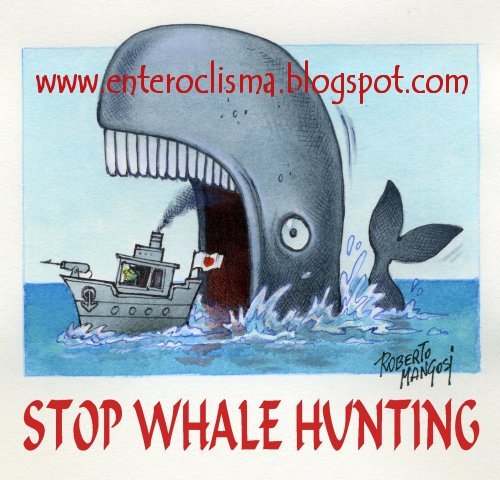
The anti human exceptionalists are–rather desperately, it seems to me–ever pretending that animals are like “us,” even as they say there is nothing special about being human anyway. And now, the effort to stop whaling has scientists in high anthropomorphic gear about pods of whales being “tribes” and alleged cetacean personhood. Latest example, New York Times science writer Natalie Angier, who argues that we should “Save a Whale, Save a Soul:”
After two years of transcontinental haggling, the commission had been expected to replace today’s hunting ban with limited hunting quotas. Supporters of the policy change had argued that by specifying how many whales of a given species could be sustainably harvested over a 10-year period, and by tightening or eliminating current loopholes through which whaling nations like Japan and Norway kill the marine mammals for “scientific” purposes, the new measure would effectively reduce the number of whales slaughtered each year.
Yet many biologists who study whales and dolphins view such a compromise as deeply flawed, and instead urge that negotiators redouble efforts to abolish commercial whaling and dolphin hunting entirely. As these scientists see it, the evidence is high and mounting that the cetacean order includes species second only to humans in mental, social and behavioral complexity, and that maybe we shouldn’t talk about what we’re harvesting or harpooning, but whom.
To show you where Angier is coming from, SHSers may recall that the last time I blogged about her writing, she ridiculously opined that plants are the most ethical life form on the planet because they live without killing. I guess she forgot that ethics requires rational analysis and the intentional creation of moral codes, activities in which only humans are capable of engaging. Oh, and what about those cruel venus flytraps? They digest their prey alive!
Here’s the thing: We don’t need to go through the mental contortion of making whales people too in order to support an international treaty banning commercial whaling. Human exceptionalism supports it based on our duty not to treat animals cruelly or cause animal suffering for little human benefit. The need for whale meat is very low and the cruelty of the killing method very high. That being so, it doesn’t matter that a pod of killer whales once seemed to play with dead salmon (discussed in Angier’s piece). As a matter of applying basic animal welfare principles, the arguments in favor of a commercial ban are clear and convincing.


June 27th, 2010 | 5:33 pm
[...] This post was mentioned on Twitter by Vince Humphreys, Wesley J. Smith. Wesley J. Smith said: Ban Whaling Based on Cruelty, Not Cetacean “Personhood” » Secondhand Smoke | A First Things Blog http://shar.es/m8lFg [...]
June 27th, 2010 | 6:10 pm
Wesley: You’re certianly right that whale hunting is cruel, and therefore should be banned. It’s cruel, because whales are conscious: they’re aware of their environment, they feel, etc. Consciousness is what gives them personhood.
Otherwise, one’s left with the incoherent notion that personhood is only possessed by humans, and dependant on having a human genetic code, or belonging to the human species.
Since whales feel, and experience emotions like we do,but are not as intelligent as we are, you seem to argue that personhood is based on intelligence, which seems arbitrary.
I hesitate to quibble with you over the definition of “personhood”, since you commendably support the banning of whaling.
Wesley J. Smith Reply:
June 27th, 2010 at 6:26 pm
Personhood is only possessed by humans, Bret. It is based on our unique inherent capacities as a species, which no other animal has. No whale, chimp, pig, dog, etc.–what used to be called the higher mammals–could even understand the concept. They are inherently incapable of doing so. That is to say, they are not moral agents. They are not rational. They do not think abstractly. They cannot conceive of moral codes, engineering, philosophy, religion, etc. They are not automatons. They feel pain. They experience emotions. They are not rocks, which is why we owe them duties. They owe us–and each other–nothing.
June 27th, 2010 | 6:25 pm
I must note, that if they really wanted to get serious about protecting whales and dolphins then the answer is actually create enforceable property rights around them.
That has worked wonderfully in Africa for protecting Elephants and Lions and other animals in preserves and gives the owners of the preserves a really strong incentive to deal with poachers.
As it currently stands the animals aren’t protected at all really.
If people had property rights to groups of the animals or areas they inhabit then greenpeace and other groups could stop whaling in those areas by purchasing the rights to them and then not using them. If anybody was to whale in that area then they would have a clear case of criminal misconduct that they could actually prosecute.
Of course such an approach would allow Japan and other places to whale in the areas they purchased, but I bet you’d save many more whales with such an approach.
Jason
June 27th, 2010 | 7:38 pm
Wesley: I certainly agree with you that only humans possess rationality, and the ability to engage in moral reasoning. But one must make the distinction between being able to engage in these things, and being justified in being a reciepient of these things. That is, you, and others who deny other animals personhood and therefore rights, have failed to provide a nonarbitrary basis for why ONLY beings who are capable of moral reasoning, should be considered persons.
We’ve covered this ground before, many times, but it bears repeating, and that is, babies, and mentally defective humans, who are not capable of exercising moral reasoning, are still considered (of course, rightly) persons, with rights.
Therefore, the denying of rights to conscious animals, is logically incoherent, and and constitutes a moral double standard.
Since you clearly believe that human babies, and mentally defective humans DO possess personhood, and consequently rights,why?
Wesley J. Smith Reply:
June 27th, 2010 at 7:54 pm
Bret: Let’s not go in circles. It is species based, not individually based. Otherwise, there is no way to protect universal human rights. It is what is inherent in us unless we are immature, injured, aged, or ill. And they have the same natures.
June 27th, 2010 | 9:30 pm
Wesley: Clearly we’ve hit an impasse on this issue. But you seem to slide between saying that the basis for personhood is moral agency, and that it’s merely being human. If it’s the latter, then you would have no problem accepting babies and the mentally defective. But, then you would have a problem accepting the hypothetical situation of extraterestrial beings, non-human, who displayed moral agency.
But we must also remember that “species” exist, because individuals exist. Clearly, you’re not going to be convinced. you believe you’re right. I respect that. But it begs the question why being a human and/or being a creature who can exercise moral agency, should be the basis for a being having personhood and rights. It’s hardly a self evident axiom.
But I think it’s impotant that you realize the need to protect whales from cruelty. Fortunately, regardless of one’s view regarding personhood, we all can agree on that.
Wesley J. Smith Reply:
June 27th, 2010 at 10:26 pm
Bret, I would have no trouble accepting an alien being as being exceptional. Vulcans, for example.
June 27th, 2010 | 10:56 pm
Wesley: But would Mr. Spock accept us?
Wesley J. Smith Reply:
June 27th, 2010 at 11:01 pm
Definitely. The Ferengi, not so much.
June 27th, 2010 | 11:35 pm
Wesley,
I think you’re irrationally creating anthropocentric definitions of personhood. Obviously dolphins or chimps do not understand human philosophy. They’ve been subjected millions of years of unique selective pressures resulting in their own evolutionary trajectory. Rather, we can use proxies of what makes humans human; morality, rational thought, culture, brain size and explore the animal kingdom for these qualities. With decades of dedicated studies, the emerging scientific picture is that cetaceans possess all of these proxies for what we believe makes us human. This means that they’re obviously not human, but they do possess qualities on par with being considered non-human persons.
Wesley J. Smith Reply:
June 27th, 2010 at 11:47 pm
Zac: Pot calling the kettle black. Thanks for jumping in.
June 28th, 2010 | 1:17 am
Wesley,
Now I’m confused. Since you are prepared to treat a race of Vulcans as persons it appears that your willingness to grant “personhood” and “rights” is not strictly based on human “exceptionalism” but on our possession of certain qualities (moral agency, most prominently).
Your claim that these new species would also be “exceptional” makes the word almost meaningless. If a billion such species were discovered would they all be exceptional? If species capable of moral agency outnumber their non-moral counterparts by a factor of a 1000 to 1 would they still be “exceptional”?
If on the other hand you make the straightforward claim “we are obliged to grant rights to individual members of any species capable of moral agency and treat such individuals as persons” (and drop the indefensible requirement that the species be somehow unique in its possession of this attribute) you are faced with the still unanswered (and perhaps unanswerable) question:
What reason do we have to use “moral agency” (rather than “self-consciousness”, for instance) as a criterion for “personhood”?
Wesley J. Smith Reply:
June 28th, 2010 at 10:11 am
Nothing to be confused about Raven. Human exceptionalism because only we in the known universe exhibit ALL of the inherent species attributes that give rise to rights and duties, which are flip sides of the same coin. Moral agency is an important one because it isn’t merely a physical attribute like eyesight. The alien sophistry is intended to somehow demonstrate that we are not exceptional through a hypothetical. But it doesn’t. Vulcans as depicted in Star Trek have all the attributes inherent in their species that make for rights/duties. And what does being aware of self have to do with morality at all? A fly, at least to some degree, is aware of itself otherwise it wouldn’t avoid the swatter. I have never thought self awareness was all that important to moral worth. It is very arbitrary in my view, selected for its value in destroying HE, not arrived at neutrally, as it were.
June 28th, 2010 | 3:42 am
I’d like to expand on the subject of “the intentional creation of moral codes”.
(I speculate that) Wesley believes in objective morality. That means: there’s an objective moral reality in the world which can be apprehended and written down as moral codes which gives us a guide to our lives. Human beings somehow “get” this, maybe trough intuition.
On the other hand, if there’s no objective morality in the universe, what Wesley means with “the intentional creation of moral codes” is that our moral codes are social contracts, like the rule “Do not use white socks with a tuxedo”.
This is very important question in ethics, it tests where you fundamentally base your ethical values. In my view the proponents of personhood theory (morality comes from being a person) seem to subscribe to the social construct of ethics, because they have to define “personhood” by a democratic consensus. That is a social construct.
Also basing the moral value on being rational or the ability to understand moral values brings big questions: if this is true, is it a moral duty to be as intelligent? Who determines which is the proper level for being intelligent (and therefore having moral value)? If I don’t know any of the various social contracts beforehand, is there any limits to my behavior?
My own view is that the value of human beings comes from being made in the image of God, therefore humans are uniquely valuable and worthy of love. This is maybe some form of Divine Command Theory.
Wesley J. Smith Reply:
June 28th, 2010 at 9:23 am
Markus: Very interesting. Indeed, if who matters becomes a matter of who has the power to decide–I disagree that personhood theorists would necessarily allow democracy to decide–it leads to tyranny. So, it seems to me that in the West we have agreed generally, secularists and religionists, that universal human equality and rights are core to a good life. Think UN Declaration on Human Rights. What is required for that to be fortified and protected? Human exceptionalism. So, if we value freedom for all, and not just those with the power to decide, HE is necessary. If we expand rights to the point that a squirrel has them, the concept of rights itself becomes less robust, like the value of currency in a wild inflation.
Singer et al, support tyranny. Animal rightists undercut that which keeps us free. Radical environmentalists accuse us of being the villains and would harm human thriving on the altar of some Edenic ideal.
We live in weird and dangerous times.
June 28th, 2010 | 7:56 am
“They [non-human animals] do not think abstractly.”
I think the scientists at Yerkes National Primate Research Center would disagree with you, since their decades of research have shown otherwise.
For more information about some of the research carried on at Yerkes go to: http://www.yerkes.emory.edu/developmental-and-cognitive-neuroscience
June 28th, 2010 | 2:08 pm
I’ll try and explain why I’m confused. (I also realise that you’ve probably covered this at length in other articles and books but please bear with me – I’m a bit late to this party).
You say “human exceptionalism” is important because “only we in the known universe exhibit ALL of the inherent species attributes that give rise to rights and duties”. There are two parts to this:
(1) we exhibit species attributes that give rise to rights and duties.
(2) we are the only creatures in the universe which do so.
Anyone who believes that human exceptionalism is the criterion for granting rights would also necessarily have to believe that both statements have to be true if humans are to possess rights.
If one is willing to concede (as you do, possibly in jest) that the discovery of another species possessing these [first statement] “attributes” would leave our rights unaffected even while rendering the second statement false then one is hardly using “exceptionalism” as the criterion for making this judgement.
In short, even if we concede that we are rights-bearing creatures because we possess certain qualities, how can our possession of those rights possibly depend on our being unique in this respect? Would we not be willing to admit any and all creatures who happened to demonstrate these abilities (even if none are presently apparent to us)? Shouldn’t that door be left open just in case, some time in the distant future, a plausible candidate walks through it?
Or is the concept of human exceptionalism just another way of saying to members of other species: “We’re not even going to seriously consider if you possess these attributes because we’ve made an a priori decision about who we’re admitting into the rights club. No non-humans allowed. Doesn’t matter what people say you can do or feel or experience. You’re not human. And that’s all that counts.”
June 28th, 2010 | 2:45 pm
My apologies, Wesley. It appears that when it comes to moral agency as a criterion for granting personhood and rights we’ve been having a verbal dispute rather than a strictly philosophical one.
You’ve previously drawn an important distinction between “animal rights” and “animal welfare” (which I have unfortunately ignored in most of my comments) and you have also indicated that when you refer to “rights” you are using the term in its non-colloquial sense. Rights bearing creatures are legal persons capable of being represented in courts of law. These rights automatically impose certain duties on the state etc
Taking these into consideration, your species-based criterion of “moral agency” is actually a quite useful one (and certainly better than an individual-based “self-awareness” criterion).
You are, it appears, on the right side of that argument.
However, my questions about “human exceptionalism” remain. (i.e human exceptionalism refers to a contingent fact about our moral status. How can it possibly be a relevant criterion?).
June 28th, 2010 | 8:53 pm
Unless one is an advocate of cartesian foundationalism, one must accept that any criteria or criterion we use as a basis for rights, is, to some degree at least, arbitrary. Many consider consciousness, to be an arbitrary criterion for granting rights, but others, myself included, would consider moral agency, to be at least equally arbitrary, indeed, more so.
Since we cannot, with complete philosophical certitude, come up with an airtight criterion, for granting a being rights, we must try to come up with a criterion that seems most connected, or relevant, to the wellbeing of the creature in question.
Reciprocracy, the ability to give back morally, to another creature who behaved morally toward me, seems very irrelavent. If x does y a favor, but y is incapable of returning it, we cannot logically infer that y was “undeserving” of the moral treatment of x. No one, to my knowledge, has philosophically demonstrated, in a logical fashion, the connection, syllogistically or otherwise, the connection between reciprocracy and rights.
Whether one is “given” rights or not, has direct bearing on one’s welfare, physically, and emotionally, and the only way these traits are realized, is through consciousness. Although this is not an “airtight” criterion for rights, (consciousness), it seems much more relevant to giving a being rights, than moral agency.
June 29th, 2010 | 12:26 am
Bret, you use an important phrase: “the well-being of the creature in question”. Wesley isn’t advocating that “moral agency” ought to be our basis for deciding if we “care” about animals or treat them morally. What he *is* saying is that if the creature is a moral agent we may then (and only then) express out concerns in terms of the creature’s “rights” – otherwise we express them in terms of the creature’s “welfare”. It’s a distinction I find myself inclined to accept.
All (“rights-granting”) criteria are to an extent arbitrary – but some are more useful than others and produce more acceptable consequences. “Consciousness” is an excellent reason to take an interest in an animal’s life and try and minimize its suffering but it’s an insufficient reason to grant a creature “personhood” in the full legal sense rather than in the rather airy and contested philosophical sense.
June 29th, 2010 | 8:58 am
Does anyone else find it totally absurd these days that we have to have in-depth arguments against giving more rights to animals than unborn humans or infants have? It’s like the Huns got a hold of a philosophy textbook and started developing arguments about whether it would be more moral to sack Rome on foot to avoid antagonizing their horses…
Still waiting for that orca to issue a press conference apology for killing the trainer and having a heartfelt healing moment with the trainer’s family on Oprah.
June 30th, 2010 | 7:20 pm
Raven: Any rights that we “give” or recognize (I believe the latter), must have a rational philosophical foundation. Unfortunately,the “animal welfare” position is really just a pragmatic, somewhat common sense approach to other creatures, that does not address the deep philosophical basis for the granting of rights. It’s adherents are well intentioned, and care about animals. But this “animal welfare” view is insufficient on a deep metaphysical level, to deal with what we know about animals, and their capacities.
If one relies on “moral agency” as one’s foundation for humans having rights, one encounters insurmountable problems. Babies, and the mentally deficient do not meet this criterion. Wesley answers this by asserting that, humans, all humans, have the “nature” or “capacity” or ”potential”, by virtue of being a member of the human race, to manifest moral agency, therefore, they’re included in the rights community. With respect to Wesley, who is, unquestionably, a decent, morally serious person, who has, and I’m sure will continue to do tremendous good, his assertion here is sophistory.
The beings in question(babies, mentally defective) do NOT have the moral agency property in question. Strictly speaking, we’re talking about their characteristics NOW, not at some future date.
And even though babies certainly will, one day, manifest this property of moral agency, the mentally defective will not. So, the mentally defective will never manifest this property (moral agency). They are LACKING in the NEUROBIOLOGICAL property that’s necessary for moral agency.
So here is where, in my judgment, Wesley, and others, are failing to make an essential distinction: one can be human, but still be missing the mental property that enables most humans to exercise moral agency.
June 30th, 2010 | 7:22 pm
Sorry, I think I inadvertantly put my email address on the last post. Please take it off before posting it. Thanks!
Wesley J. Smith Reply:
June 30th, 2010 at 8:07 pm
I don’t see any emails on your posts. Which comment?
June 30th, 2010 | 8:20 pm
Simon: To address what you said most recently in the “sea lion sues” section, you made reference to “epiphenomenalism”. In fairness, this view, essentially, that thoughts, intentions, morality, indeed all of mental life, can be “reduced” to mere neuronal phenemena, is not widely accepted in the neuroscientific community.
Even its most zealous defenders,(Pat and Paul Churchland, professors of philosophy) have backed away from it now.
To the best of my knowledge, the currently predominant view in neuroscience, is, that yes, the brain, is the cause of all mental pheneomena, BUT, mental phenomena still exist.
I think you’re refering to, what’s strictly called eliminative materialism.
June 30th, 2010 | 8:22 pm
Wesley : I accidently included it on my name section. No big deal. Thanks.
June 30th, 2010 | 9:03 pm
[...] writer goes into the anthropomorphic thing, accusing others of giving personhood to, in this case, marine mammals. Now to his credit, he is [...]
July 1st, 2010 | 1:38 am
simon: your statement on one of the other posts (when a sea lion sues), quoting an individual who said that evolution would be laughed out of court, should be addressed. I understand your concerns about evolution. But nearly every evolutionary biologist, who I’m aware of, believes that evolution, by way of natural selection, is the best explanation for life’s diversity. Biological evolution has different standards of evidence, than a court of law has. Phillip Johnson, tried this before, with his 1991 book “Darwin on Trial”, and the late biologist, Stephen Jay Gould, writing a review of it, in Scientific America, poited out the different rules of evidence, for a scientific theory, as opposed to the evidentery rules, in a court of law.
The fact that most biologists accept the veracity of evolution, cannot be blithely dismissed. It cannot be attributrd to some conspiritorial theory. The evidence is there.
Now, the evidence is NOT there, to support the extrapolation, that there’s no God, or need for God. Francis Collins, in his excellent book, The Language of God, points this out well.
As one examines evoloution in depth, one realizes, that the best expanation for evolution, is the exisrence of God. At this point, one enters the territory of theology.
July 1st, 2010 | 6:30 am
Wesley: In your response to Raven, you pointed out that the vulcans have all the traits necessary for rights/duties.
But you’re failing to take into account, the fact that human morality is more emotional than it is rational. Dr.Spock would NOT do very well, morally, by human standards. Ironically, he might get along very well with the hyperational Peter Singer, who believes that emotion should be completely out of the picture, when making moral assessments. The problem, and this is part of the human perdicament, is when we take emotion entirely out of our moral assessments, we end up being chillingly inhumane.
This is a conundrum, in that we want emotion out of our moral calculations, to be more objective. And this is true, to some degree. But only to some degree.
My guess is, Spock would be disasterous in terms of making moral decesions, for humans.His lack of emotion, would prevent him from seeing the subtle emotional, and social nuances, that are essential for proper moral assessment.
The reason that consciousness is relavent to rights, is it’s directly connected to the moral life, in that the well being of the creature matters to it, precisely due to its consciousness. There’s a very good reason that I’m not arguing for “tree rights” or “rock rights”, they’re unconscious, and any way they’re treated, is completely irrelavant to them. But if you’re conscious, your life “belongs ”to you, because what happens to you, has the greatest affect on you. Destroying a rock, harms no one, because the rock isn’t “anyone”. But harming or helping a cat, for example, has the greatest consequence for the cat, for bad or good, because the conscious cat is directly, in an unmediated way affected.
But one of my hope’s is to show the absurdity of morality being a result of pure objective reason. No, it’s a complex amalgam of emotion:sympathy, empathy, and reason. But the reason is the iceing on the cake.
By the way, a fly, simply does not have sufficient neuro complexity to be aware of anything. It’s behavior is a result of purely reflexive activity. Your dog, your cat, a monkey, to give just a few examples, has been shown, neuroscientifically, to be conscious, and capable of suffering.
Wesley J. Smith Reply:
July 1st, 2010 at 9:24 am
Bret: Vulcans have emotions. They just learn to keep them under rigid control. But the issue of aliens is a misdirection to get us off of human exceptionalism.
July 1st, 2010 | 6:54 am
Raven: I think you might be misinterpreting Wesley, regarding the distiction he makes between rights and welfare. He certainly believes that sentient animals should be treated humanely. That’s where his advocacy of animal welfare is prominent. But, if any welfare for the animals interferes with his understanding of human exceptionalism, then, the welfare takes a back seat. If animals had rights, then their welfare could not be infringed upon, any more than Janes welfare could supercede john’s.(if they’re both human).
So, Wesley believes that animals can be killed, if it’s determined that the animal’s death,would benefit a human. Whereas, no human could be killed, even if it helps the other human. but, we should do everything we can to kill the animal humanely. This example highlights Wesley’s views, regarding the distiction, between animal welfare and rights. I hope this fairly represents his views.
So, I think you may have had it right originally, unless you thought that Wesley did not support animal welfare, which he certainly does.
July 1st, 2010 | 6:27 pm
Bret: I fully realise the implications of Wesley’s position (animals which fall short of moral agency may be used as instruments in the furtherance of human goals) and (dare I say it?) I largely agree. This is consistent with my earlier position and I’ll briefly try to explain how.
I believe that all conscious animals are “morally considerable” http://bit.ly/7mVcqz (they are capable of being wronged by and of making moral claims on us). This is what I really meant when I spoke earlier (in my loose and inaccurate way) of granting animals “rights”. A decision to kill a sentient being or cause it suffering should never be taken lightly but to claim that an animal with just the faintest glimmerings of conscious awareness has the same right to life and liberty as a fully rational human being is to take things a step too far. (If for instance I had to choose between saving one two year old child and saving all the cats in Rhode Island, I would choose the child every time).
This may sound “species-ist”, and it is – but I would argue that “speciesism” rests on much surer intellectual and moral foundations than racism (to which it is often compared). The neurobiological differences between different races is negligible (far greater variation occurs within races than between them) so we know, or we have very good reason to believe, that our mental experiences are extremely similar (a fact clearly obvious long before the advent of neurobiology). When it comes to non-human animals however, we are on much shakier ground. What is it like to be a dolphin or a dog or a macaque? Is there any such experience? Are we taking our anthropomorphism too far when we speculate about the nature of their internal lives? I made a statement earlier about erring on the side of caution (if an animal appears sentient we ought to treat it as if it actually is) and I am prepared to stand by that statement but I would also add that we should never allow this compassionate stance to lead to human suffering or death (we have a primary obligation to members of our own species, beings with whose internal states we are familiar, and we ought not to be ashamed of this).
Moral Agency as a criterion: If we claim (as I am now doing) that conscious awareness is an insufficient criterion for personhood or rights (socially useful constructs with strict legal and moral consequences) we then ask ourselves the question, what criterion ought we to use? Wesley suggests “moral agency” and while I consider this a better (species -based) criterion than mere consciousness I am more comfortable with a formulation like “the awareness of oneself as an actor in the world (as a being with a past, present and future, capable of making decisions)”.
You mention, with justification, the problem of “marginal humans”, those who will never meet our criteria for personhood (if those criteria are based on higher order mental properties like “moral agency” or “rationality”). On what basis, you ask, do we include these individuals in the rights community (while excluding presumably better qualified, or at least equally qualified, non-humans)?
My answer to this question is based on a perspective you do not share. You see, I believe that rights are extremely useful societal fictions which do not exist apart from the societies which grant them. If we were to decide that the bottle nosed dolphin (for whatever reasons) fully deserves all the rights and privileges accorded to the average human we would not have made a “discovery” or recognised something which existed prior to our decision. If the heavens saw fit to remove the human race from the surface of the earth those rights granted so magnanimously would evaporated as soon as the humans who bestowed them pass away. Even if we do eventually extend the banner of privileges and protections beyond humanity we would still have to remind ourselves that we grant rights because they represent something powerful, deep and enduring about human society and they help us create the sort of world we want to live in. Rights have absolutely no meaning apart from the context of the human culture which grants them (the introductory sentence of the Declaration of Independence notwithstanding).
We thus extend rights to marginal humans because the alternatives are unworkable. We have neither the emotional, spiritual nor (at this moment) the intellectual resources to make conclusive determinations about whether this or that child is mature enough to have an independent right to life, whether this or that man has been whittled down into sub-rationality by age . . . Decisions of this sort would inevitably corrode our humanity and would be clearly open to abuse. An individual-based criterion for personhood might work if the decision makers were omniscient and uniformly just but were it to be applied by Homo sapiens circa 2010, it would be an unmitigated disaster. At present birth is the clear (albeit arbitrary) line beyond which we say, this creature is a person, a member of the human community, deserving of all relevant rights and privileges until brain death supervenes or the Supreme Court decides otherwise (tongue in cheek).
Philosophically this is all very “iffy” and ad hoc (and my views on this subject are, quite obviously, still evolving) but I think that, pragmatically, even if we did end up granting suitably qualified animals “rights” it would be impossible to argue that these rights were as inviolable as ours. We would have to set up a hierarchy of rights-holders with ourselves at the top.
This sounds suspiciously like “human exceptionalism” – but I would like to say, without much conviction, that I pre-emptively deny the charge (that is a house I would rather leave with its tenants undisturbed, shaking the dust off my feet as I go). Although we are “exceptional” (or at least appear to be) this is merely a contingent fact about the world not something on which very much depends. If we were not exceptional (if future discoveries prove us not to be) our moral standing would be unaltered and our rights would remain. Allow me to propose the Corvine Variant of Human Exceptionalism (which differs from Wesleyan HE in that it accepts the theoretical possibility of admitting non-human animals which meet appropriate criteria into the Very Select Club of Rights-Holders and, further, holds that the special position we grant other humans in these considerations results not from our uniqueness itself but from (a) our possession of those specific qualities which, at the moment, appear to make us unique and (b) our fraternity i.e we have exceptional duties towards members of our own species in much the same way, I would argue, that a man has exceptional duties to members of his family or his close friends.
I have rambled on again and meandered badly (as I tend to while “multitasking”) but I hope at least some of what I’ve written makes sense.
Raven
July 2nd, 2010 | 2:19 am
Raven: Thanks for your, as always, intelligent, honest, and articulate response.
When you state that conscious animals should be given “moral consideration”, or when Wesley states that animals should be treated “compassionately”, unless you both correct me, I’m assuming that your criterion for granting this favorable treatment to them, is the fact that they’re conscious. So, you and Wesley, already agree with me that consciousness should be the criterion for granting a being some moral treatment. It’s my position, that you, and Wesley, are not taking the logic to its proper conclusion. the proper logical conclusion would be that conscious beings should have their rights recognized.
Of course, I don’t mean that other animals have the absolute same rights as humans. No, the conscious animals have rights that reflect, and are congruent with their natures. Therefore, granting them the right to vote, obviously, would be silly. Granting them the right to life, and a decent life, would be consistent with their natures.
My point above, that you, Wesley, and others, of the animal welfare position, have essentially “given away the store”, by accepting that consciousness should be the criterion for treating animals humanely. Why not assert that moral agency should be the criterion here, as you do with rights? Once you go down the road (not that I’m complaining, any decent person must, but, I submit it put you in a logical bind), you’re logically commited to giving them rights as well.
So as much as Wesley states that consciousness is irrelavant to rights, he still (implicitly, at least) considers it relavant to treating them humanely.
Essentially, then, I believe that the animal welfare postion commits one to accepting animal rights. Why do you, and Wesley consider a cat, for example, to be deserving of moral treatment, and not a clump of dirt? Because you both accept the criterion of consciousness as necessary for moral treatment. I say, you’re halfway there, just keep moving!
The whole criterion of “moral agency”, is, I believe, a sophism to keep all the power with human beings. If animals are granted rights, humans will experience inconviences. But humans will STILL have all the rights that they have always had (how could they not?), they (we) will just have to be less selfish, frankly.
With respect to your willingness to help one human, as opposed to 100 cats. This argument could easily be applied to humans. That is, a mother will naturally want to save her own child, if two children are drowning, and she can only save one. But that does not mean that she, or anyone else, does not recognize the rights of the other child. In other words, the fact that we would prefer to save a human, rather than another animal, is no more of a reason to dicount animal rights, than the fact that we would rather save are own children, rather than strangers, is an argument against human rights.
Certainly, morality is a work in progress. Indeed,I believe that it’s much, much, harder than anything else humans have encountered. At least with math, and science, all one must do is utilize a priori reasoning, and a priori and a posteriori reasoning, respectively. With morality, one must utilize all reasoning, plus, emotion, in a highly nuanced way. It’s probably the hardest subject around, which is fitting, since it’s the most important subject around.
My view, concerning the ontological status of morality is that it’s discovered, not invented, analogous to math and science. Otherwise, what coherent response do you have to the tyrant who has a radically different conception of rights than you do?
Our understanding of morality is in a highly rudimentary stage. How emotion, reason, empirical findings can be blended together, to give an objective account (as opposed to a mere creation on our part) of morality, is more difficult than finding the holy grail of physics, the “theory of everything”. We’re not even close.
But, are humans exceptional? Of course! No one could reasonably assert otherwise. no other animal has created and discovered what we have. It’s irrelavant to whether animals have rights. Just as it’s irrelavant that Enstien is more “exceptional” than a down’s syndrown sufferer. The down’s syndrown sufferer, still has just as many rights as a brilliant scientist. The latter’s “exceptionalism” is irrelavant. Does the “exceptional” scientist have anything to fear by granting less “gifted” humans rights? Of course not? You see where this analogy is going!
July 2nd, 2010 | 2:35 am
My point, Wesley, in bringing up “extraterrestials”,was/is that, on the one hand, you assert that “moral agency” is the criterion for granting a being rights. However, since there are obviously some humands incapable of this, you essentially, in so many words, give them access to the rights club by virue of their humanity. Which is it? It doesn’t do to saym well, they’re human, so they at least have the “potential”. We have countless examples of mentally deficient humans, who have gone through their whole lives without ever displying moral agency, so they’re NO DIFFERENT in this regard (lacking moral agency) than a conscious animal, but the latter has no rights, in your view, but the former does. If this does not constitute an incoherent notion, I don’t know what would.
An extraterrestrial, would be nonhuman. So, if we recognized his rights, according to you, he would have to have moral agency. But what if he’s lacking in the essential emotional component that’s necessary to be moral, but he’s robotically, if you will, understaning of moral reasoning?
July 2nd, 2010 | 5:48 am
One of the halmarks of a good scientific theory, is its potential to be falsified. In other words, it’s empty if no evidence or arguments can work against it.
The same applies to mere arguments. The assertion made by Wesley, and others, is that the reason that only humans have rights is our moral agency. Aside from the question begging component to this (since they provide no good arguments for why “moral agency” should be the criterion for rights. Here, they’re failing to accept the proper burden of proof), when humans, who cannot behave morally, are pointed out, they say, oh, but they’re human, so they get their rights this way. This is a cardinal sign that an argument is in deep trouble, when there’s this shifting.
Wesley states that it’s “sophistry” to bring up extraterrestrials. Not at all. Extraterrestrials are brought up, to highlight the “shifting” of the basis for rights that those who are against animal rights engage in. If moral agency is the basis for rights, then babies, and mentally defective people don’t have rights. This would allow those extraterrestrials, who possess moral agency to have rights, but, if it’s really the humanity, that gives one rights, the extraterrestrials, don’t have rights. Pick one or the other, you can’t have both.
July 3rd, 2010 | 3:33 am
You are, of course, right that admitting “consciousness” as a criterion for moral considerability makes any attempt to use some other attribute as a basis for “rights” rather difficult. Any admission that an animal may make moral claims on us seems to shade imperceptibly into (and may in fact be identical to) a claim that said animal possesses rights of some sort. It would also seem that if we admit that we ought to be concerned about an animal’s “welfare” we are also conceding that the animal has rights in the loose sense which it is presumably not able to exercise.
Considering this, using “higher order criterion” for personhood and rights might not seem philosophically consistent – but it is, I would argue, the pragmatic course of action. I have no problem with the logic of your argument – I just feel that these ideas are unworkable in the real world. We may realistically acknowledge that we have moral duties towards conscious animals but to grant these animals rights in the legal sense would be to subject our economic and legal systems to strains they are presently incapable of bearing. In your words, “if animals are granted rights, humans will experience inconveniences” . I feel this is an understatement. You say we need to be less selfish but I think it’s more self-preservation than selfishness. Forgive the melodramatic metaphor – but we are in a tiny life-boat with the drowning clawing at us from all sides. A little callousness is required.
My previous post was, more than anything else, an ad hoc defence of a position I feel we are compelled to take. I know it sounds like I’m saying “we cannot do the right thing here because it’s too difficult” (an argument that smacks of moral cowardice) but I honestly believe that placing our duties towards animals and our concern for their welfare within the framework of legally enforceable rights would be a dangerous thing indeed (especially if the circle of animals persons is broadened by our use of the relatively inclusive “consciousness criterion”). What’s wrong with simply strengthening animal welfare laws? l
And about the whole “moral agency” thing: as I indicated before, even though I consider MA a more pragmatic (rather than philosophically sound) species-based criterion for granting rights than basic awareness (and I must emphasis once again that I am talking about rights in the strict legal sense) I am more comfortable with the simpler criterion of “self-consciousness” (the perception of oneself as an actor in the environment, the presence of an “I”). I would argue that self-consciousness is a basic requirement for a right to life (only a creature with a sense of self can possibly care about its extinction – as distinct from its suffering).
On the ontological status of morality: My claim isn’t that morality is “invented” in the sense that we make up arbitrary rules out of thin air. What I do assert is that “morality” has no meaning if there are no moral creatures to call it forth. It represents nothing real about the world (nothing that may be described without the presence of moral agents). Contrast this with something “real” (colour, for instance): a rose may still be described as red (as reflecting light of a certain wavelength) even if there is no one there to see it. The Last Man on Earth, on the other hand will have no rights (in much the same way that he would have no money or prestige). If he were discovered by an intelligent alien race he might attempt to convince them that they ought to grant him rights but the claim that he already possesses those rights (irrespective of what they may decide) is not one which may be demonstrated. The “universality” of moral principles results from certain constants present in human society (we will always have the same general types of problems and hence the same general solution will be applicable).
So mine isn’t a theory of “what give us rights” at all. It’s just an attempt to find a pragmatic basis for granting them which also happens to be consistent with our moral intuitions and which won’t, if applied, cause too much damage.
July 3rd, 2010 | 5:58 pm
Raven: Thanks for your response. I want to commend you on your honesty. You seem to be someone who has given this considerable thought. Your respectful, non-condescending approach, toward those whom you disagree, is admirable. I’m of the view, and it seems that you are too, that people can be friends, or at least friendly,even though they disagree. that’s a reflection of maturity. Diasagreements are inevitable, disrespect, is not, as you’ve shown.this requires discipline, and courage, because these issues can threaten our world views. You’ve shown these traits. I respect how you were,willing to admit Wesley was right (although i think he was, and is wrong on this issue. But he’s also a man of integrity, to allow freedom of speech. He’s proven this, by allowing those, like myself, who he perhaps considers irritating, to speak).
I understand your position, and you make a good case for it. Certainly we have to not be naive. But I consider the plight of animals to be so important, that, for as long as I’m able, and people kind enough, like yourself, Wesley, and others, allow me to comment on their posts, I will speak out on it.
Certainly, if one’s views, regardless of how impeccibly logical,cannot be manifested in reality, they’re worthless.
July 3rd, 2010 | 6:13 pm
Raven: Any creature, that’s voiceless, i.e., other animals, depend on us to fight for their rights. We must couragously continue the battle. I fundamentally believe that humans AND animals can have rights, and have great lives. Admittedly, groups like PETA, ALF, etc., are considered the “voice” of animals, and they’ve given animal rights a bad name. If they’re the ONLY groups, vis a vis animal rights, people have heard of, I don’t blame anyone for being turned off.
But the people who I know, in this area, are kind, and are loving and kind to people as well.
Since the logic is entirely behind the animal rights movement, the key is persuading others, but in the meantime, we must act pragmatically, in order to get real benefits for animals.
Links
Blogs
Find Us
Contact