

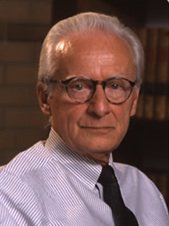
One of the marks of a virtuous character, according to Aristotle, is the performance of virtuous acts with ease and delight. On that basis, as well as others, Ralph McInerny was a remarkably virtuous man. One of Ralph’s most beautiful books is entitled The Very Rich Hours of Jacques Maritain: A Spiritual Life, the premise of which is that “we can find in the person of Jacques Maritain a model of the intellectual life in the pursuit of sanctity.” Those words certainly apply to Ralph, one of the great Catholic intellectuals of our time. What distinguished Ralph was not just his fidelity, his intelligence, and his astonishing productivity, but his gracious and ready wit. He possessed a knack for conversation with everyone—from philosophers and politicians, to the elderly and children. Unlike most gifted individuals, Ralph was never burdened by his gifts. He engaged in serious pursuits joyfully, almost playfully.
Ralph excelled in so many spheres and combined so many virtues in his person that it is difficult to know where to begin in recounting his noteworthy achievements. He was a philosopher (author of more than two dozen scholarly books, he gave the prestigious Gifford Lectures in 1999–2000), a translator (he translated the texts of Aquinas for Penguin Classics), a critically acclaimed and popular novelist (author of a number of mystery series, including the popular Father Dowling series that became a television series), a public intellectual (he appeared on William F. Buckley's Firing Line, and was a member of President George W. Bush's Committee on the Arts and Humanities), a journalist (with Michael Novak, he founded Crisis, a journal of lay Catholic opinion), and a published poet. In the midst of all this activity, Ralph was remarkably generous with his time and his help, especially for his students, in whose families he expressed an avid interest.
In recent years after the death of his beloved wife Connie, with whom he had seven children, his thoughts turned increasingly to age and death. In a wonderful and deeply autobiographical volume of poems, The Soul of Wit, he reflected at length on death. He said often that since Connie died, he felt posthumous. They were indeed a perfect match. As a graduate student, I met Connie when Ralph introduced her by saying, “Have you met my first wife?” With a wit as quick as Ralph’s, she had no trouble keeping up. Even or especially when occupied with thoughts of easeful death, Ralph’s humor emerged. He liked to tell the story about a hospital visit to see a failing Jean Oesterle, his Notre Dame colleague, a convert to the faith, and a translator of Aquinas. Hesitantly, he asked, “Jean, do you know who I am?” She retorted, “Don’t you know?”
Ralph had an indiscriminate love of puns; he seemed to enjoy bad puns more than good ones—a thesis that would seem to be confirmed by a perusal of the titles of his mystery novels (On This Rockne, Irish Gilt, Law and Ardor, Rest in Pieces, or The Book of Kills). An appreciation for the nuances and richness of ordinary language informed not only his humor but also his practice of philosophy. His most important philosophical text was Aquinas and Analogy, a study of the way Thomas Aquinas, following Aristotle, teased out of the complexity of ordinary language unities of meaning. He rejected the idea that Thomas Aquinas provided us with a philosophical system intended to compete with other systems. Instead, Thomas was asking in a more precise way questions every human being asks; he is interested in the human good, not the good of professional philosophers or intellectuals. In keeping with this working assumption, Ralph wrote both for elite groups of scholars and for intrigued laymen. With the latter group in mind, he penned A First Glance at Thomas Aquinas: A Handbook for Peeping Thomists. His distinctive approach to Thomas Aquinas is most evident in his supple account of natural law (see Ethica Thomistica, for example), and in his defense of natural theology in the text of his Gifford Lectures, published as Characters in Search of Their Author, the thesis of which Ralph states thus: “For us it is all but inevitable that, however momentarily, we feel ourselves to be part of a vast cosmic drama and our thoughts turn to the author, not merely of our roles, but of our existence. Natural theology is one version of that quest.” Ralph’s philosophical work flourished at the University of Notre Dame, to which he moved in 1955, after receiving his doctorate at Laval under the great Thomist Charles DeKoninck and teaching for one year at Creighton. His first office at Notre Dame was in the administration building, the Golden Dome. When he and a colleague became intrigued by the presence of an old safe, they opened it, and, amid the clutter, discovered a draft of a novel written by Knute Rockne. At Notre Dame, he held an endowed chair as the Michael P. Grace Professor of Medieval Studies; he was also director of the Maritain Center and of the Medieval Institute.
Early on at Notre Dame, he began, in addition to his teaching and philosophical work, to write fiction. The story of how he made the transition from wanting to be a writer to becoming one is illuminating. After a time in which he haphazardly polished off and sent out short stories for publication, only to receive rejection letters, he decided that he would write daily over the next year. If nothing were accepted for publication, he would take that as a sign it was not meant to be. So, every evening, after he had put his children to bed, he would repair to his unfinished basement and stand, not sit, before his typewriter pecking away from 10 p.m. to 2 a.m. On the wall in front of him, he had posted these words in bold, “No One Owes You a Reading.” He eventually published some short stories and then had a breakthrough in 1969 with The Priest, a work that became a bestseller. He wrote more than eighty novels and received the Bouchercon Lifetime Achievement Award for mystery writing.
Ralph’s life and career will always be enmeshed with the university he loved, Our Lady’s University. He was of course deeply chagrined at the direction of the University. The concerns about Notre Dame’s Catholic identity have become very public in the past few years with the administration’s decisions to elevate the tawdry Vagina Monologues to the status of great art and to award an honorary doctorate of laws to a pro-abortion president. Before all that, Ralph objected to the premature firing of Coach Tyrone Willingham, in an New York Times op-ed piece “The Firing Irish,” and to the unseemly image of a president and priest chasing down potential coaches on airport tarmacs in the dead of night. Even prior to that, Ralph objected to hiring practices that focused exclusively on “academic” criteria and rendered irrelevant knowledge of, and sympathy for, the Catholic faith and intellectual tradition. For Ralph, the accelerating abandonment of things Catholic at Notre Dame was the direct result of a craven quest for success understood in conventional, and often quite secular, terms.
It is common to say that Notre Dame’s motto is “God, Country, Notre Dame,” but Ralph was quick to remind us that the official motto is “vita, dulcedo et spes”—words meaning “life, sweetness, and hope” from the Latin Marian prayer, Salve Regina. How fitting that Ralph’s last book, published just months ago, is Dante and the Blessed Virgin. Again, what he said of Jacques Maritain is equally true of Ralph. Teacher of teachers, he was a “model of the Christian philosopher, of the Thomist, both by what he taught and what he was.”
Thomas S. Hibbs is Distinguished Professor of Ethics and dean of the honors college at Baylor University.
Comments:
As a boss, he was a great inspiration because he went to Mass every lunch but didn't make his staff go or pry into anyone's spirituality. He taught, but he didn't harangue. He believed he was witnessing a miracle at Mass and that was that. His office was fun-- I think there's something about a boss who wears jeans and refuses to take himself seriously.
Chris Kaczor’s tribute on the First Things blod recreates the entire, living scene of the Maritain Center. Dr. McInerny really was kind without being indulgent, and treated us all to the best opportunities, repeated lunches at the University Club and Great Wall (which I forgot until I read Chris's article), unlimited coffee and true indulgence with the company telephone which I irresponsibly wore out with long distance phone calls to and from beaux. But everyone did that, whether it was a certain student calling some guy he needed to talk to in Rome, or the famed Latin translator Jean Oesterle calling her nieces, or other, meeker folks who would seek honest pretences to use the phone. We were all treated to endless junkets and Catholic conferences and fed a lot of great banquet food. It was really a great world! In fact, it was a junket with a purpose-- the purpose of knowing God and enjoying life. I appreciate it so much more in retrospect when I see how well everyone was treated. When Jean was too old to edit properly, we cooked up a subterfuge where she edited one set of proofs, I edited the other, and she never found out. Nobody lied there, nobody lied then, everyone really was honest because with him at the helm and Alice keeping everyone honest, there was no need, and no tolerance for, con artists. It was so important to know there was goodness in the world. (And no, Xeroxing an extra set of proofs for his benefactress, the 85 year old widow of the man who brought him to Notre Dame, is not a lie—it is a kindness. It is great respect. If you can’t tell the difference, please see St. Thomas’s Prima Secunda on ethics.)
I think the most important things I learned from him were these:
1. If you want something done, ask a busy person.
2. If something's too hard you might not be good at it.
3. He taught me, as he put it, "I could make a magazine ex nihilo," aka, self-confidence. This confidence goes to work with me every day.
4. When you are around a writer you are his material.
5. The most complicated intellectual tasks are simple if you pray and attend daily Mass.
6. Young years are formative. Ralph McInerny was who he was because he was a minor seminarian and cared about real things since childhood.
7. Never truly embarrass anyone, ever, especially someone who is dependent on you. (To be distinguished from Irish needling.)
8. If something doesn't exist, and it should exist, you need to create it.
9. If people aren't happy they won't accomplish anything.
10. Without a sense of humor life is miserable but humor makes everyone happy.
11. Take the help to lunch, give them bonuses, free books, and unlimited coffee.
12. Thomism is clear, and most other systems produce wooly-headed thinking.
13. Philosophy is not enough.
14. Don't waste your time reading dissertations or senior theses. Speed read them.
15. Philosophy and Catholic learning are for everyone, and McInerny's summer camp was a great place to get up to speed on Basics of Catholicism.
16. If you're bored, stuck, or otherwise can't do your work, take a book off the shelf and start reading it.
17. The letter of Vatican II is one thing, the so-called "spirit of Vatican II" is not the Holy Spirit.
18. Someone who trusts grad students and kids to work on his books and magazines has a lot of humility and does not take himself too seriously.
19. Never walk into the office looking grumpy. He never did this once.
20. The best way to learn a language is to take the Bible and try to figure out familiar passages in the new language.
Last but not least, if you need to end a conversation gracefully, take out your hearing aid and start playing with it as if it is broken.
His autobiography was entitled, “I Alone Have Escaped to Tell You.” Rev. Marvin O’Connell referenced this phrase, pointing out that in the Old Testament Book of Job, when the devil began to try Job and take away all his family, his cattle, his possessions, each time, there would be devastation, but one witness would escape, recount the story to Job, and say, “I alone have escaped to tell you.” Ralph McInerny inhabited a bygone world, but he alone escaped to tell us. He told us the truth of Catholic philosophy and theology, and he taught us with his example and classy leadership and kindness. Someday, as in the story of Job, this patrimony and this world of Christian gentility will be restored twofold. Miracles still happen. Ralph McInerny, rest in peace, until that day.
I continued reading him and following his projects afterwards, even reviewing some of his books, and I could never list the ways I've been influenced by him or the ways I've doubtless passed that influence along to my own students. But one incalculably consequential effect was my wife's and my decision to send our own children to Thomas Aquinas College when we could have sent them free of tuition to the university where I teach. Dr. McInerny was a great supporter of TAC, and inadvertently provided us with sufficient reason to take the plunge. We've never regretted doing so.
For a man who was a homo ecclesiasticus, it would be also fitting for us to pray the Office of the Dead today.
ad Jesum per Maria,
Taylor Marshall
PS: Dr. Hibbs, an excellent presentation of an excellent man. Thank you.
It was not hard to love Ralph McInerny. He was simultaneously suave, sophisticated, urbane, relaxed, welcoming, and down-to-earth. He was tremendously and effortlessly charming. Others have written about his prodigious scholarly and popular output. I am one of the few who thinks she knows how he did it. I am convinced his mind was working full steam on several tracks at the same time; it was churning out puns and witticisms constantly; it was working on the latest novel; it was solving complex philosophical problems, processing profound and sometimes poetic thoughts, and it was fully focused on whomever he was talking with – all at the same time. Now how you do that?! I don’t know but I think that was what he was capable of doing. To the question, “is the light on when the refrigerator door is closed”, the answer, if Ralph is the refrigerator, is “Yes – and there are several ice makers doing their job at all times as well.”
For many summers he ran both a summer workshop for accomplished and for up and coming Thomists and a workshop on Basic Catholicism for those who simply couldn’t find any reliable presentations of fundamental Catholicism anywhere. (Isn’t it wonderful that those days are over? In part thanks to Ralph and his solace and training of many.) Summer after summer he sat in the front row in rapt attention for talks he had heard countless times or talks he could have given much much better. Always full of compliments to the speakers; always spectacularly accessible to the attendees. And we would find that at the end of the week, he had somehow found time to write another book. That multi-tracked mind!
It would be easy to exhaust one’s supply of positive adjectives in describing Ralph. I suspect that all who write tributes to him will mention his kindness, much of it sub tabula. I remember watching Ralph ask a poor young scholar at a conference if she would be at the banquet; she made some lame excuse (which I did not recognize as lame) for an inability to attend. Not long after we parted, I saw a conference organizer approach her with an “extra” ticket for the event. I knew Ralph had purchased one for her. For years he attended to the widowed Jean Oesterle like she was his mother; he helped find her scholarly projects that kept her going; gave her an office nearby and doted on her with his daily friendship.
He was marvelous to me during my trials at Notre Dame. He befriended me when I was a raw recruit in the fight for the good and true and never acted like he was the “great man” supporting the clueless newbie; he always treated me as an equal though I knew I was privileged to have him as a mentor and friend. His “mentoring” was of the most subtle kind; in fact, I learned most simply by being in his company and observing him deal with people, by watching him hatch new improbable schemes and seeing them materialize seemingly over night. I remember his wife Connie and I agreeing that there aren’t that many people who wake up each morning with a new grand idea for saving Western Civilization or of putting an end to dissent in the Church and there are fewer who make most of them happen, but Ralph was that kind of guy.
When I was denied tenure at Notre Dame, he was prepared to spearhead an effort to challenge the decision and even went to meet a lawyer with me. I admit I didn’t know whether his foremost motive was to support me or to gather material for some impending novel. And he wasn’t nice only to those who occupied the same ecclesial camp as himself; he was notorious for championing anyone who he thought got a raw deal, among them a prominent feminist whom he used to debate about the possibility of women becoming priests. When she was denied tenure, he battled for her. Ralph never backed away from a fight, yet never was pugnacious or belligerent; he was always the gentleman, always fair, always gracious. Indeed, he was manifestly fairer to his opponents than they were to him, both his opponents in the scholarly world and those in the academy. I doubt that anyone could accuse Ralph of underhanded behavior. Still, he was never hesitant to use his resources to advance the causes and people he believed in but, again, always transparently and fairly. When Notre Dame started becoming friendly to the political maneuvering of the gay/lesbian lobby, he arranged for a series of speakers on campus who defended Church teaching. It infuriated many, but Ralph doggedly reverenced the Church and its authority more than he reverenced the trendy irreverent climbers at Notre Dame.
I remember Ralph coming to the University of Dallas when I taught there and of a wonderful quodlibetal (“ask whatever you like”) session where he fielded questions with the finesse of Roger Federer; he made it all look so easy. That’s when I realized that those who are in the top 1% of intelligent people can easily make those who are in the top 2% look like fools if they want to. Ralph didn’t want to but you knew there was power behind that charm that could blast anyone away, had he chosen to do so. Ralph didn’t want to flatten anyone. He just wanted to lay out the truth so carefully and clearly that rejecting it would seem simply foolish. He made the world seem a more intelligible and friendlier place. He conveyed the attitude that a lot of it does make sense if you just use your mind to think about it – and embrace and trust the Catholic faith. His clarity and certainty about truth did not tend toward dogmatic closure on questions. The truth we know is just a stepping stone to further knowledge, knowledge cloaked in beauty and wonder and those privileged to have minds trained to discover it, were obliged to do so and pass that knowledge on to others, with an equal combination of humility and determination. Ralph’s humility and determination inspired others to take on the same approach to the search for understanding.
Connie was the perfect wife for Ralph. At home, they entertained beautifully together; it was a true delight to be invited to events on Portage Avenue attended by many of the old guard at Notre Dame; the intimate and warm friendships were a comfort to all; the conversations were erudite and hilarious and captivating.
I count Ralph among those who stood by me and shaped me. I know there are countless others who have been the beneficiaries of his goodness. I know his children must feel infinitely blessed to have had him and Connie as their parents; his colleagues and friends at Notre Dame must feel infinitely blessed to have had him as colleague and friend. We were all infinitely blessed to have had Ralph in our lives; we pray now that he is enjoying truly infinite blessings in the arms of the Truth he loved and defended so well.
It was an honor and joy to work with him over the years at Ignatius Press. We greatly enjoyed it when he came by for a visit to the Press while speaking in the Bay Area. An example of his humility is one time after a talk in the Bay Area, apparently he didn't have a hotel room and it was quite late, and since he had a key to the Press building he just came by and slept right on my office floor.
He also graciously agreed to be on our Board of Advisors for an independent Catholic school we have in Napa, Ca, Trinity Grammar & Prep (now Kolbe Academy - Trinity Prep), and gave us helpful advice over the years.
He was one of a kind.
Anthony J. Ryan
The concluding phrase should be on his tombstone.
The memorials here are wonderful.
The worst aspect of his death is that Notre Dame has lost a crucial anchor. I doubt ND recognized what it had in him--I heard a high ND chair-holder mock him. He was far better than most of them.
Let's see what kind of obsequies ND arranges. That may tell us much, if we really want to know. Maybe he can somehow do in death what he failed to do in life.
I still remember the magnificent class period in which he defined for us God’s name – ipsum esse subsistens, in the Latin. I can also remember the class in which he taught us what for St. Thomas distinguishes philosophy from theology. If a thinker presents us with a theory that returns its assertions, at the end of the day, to a concept that is in the public domain and explainable to everyone, then he is a philosopher. Theology, by contrast, is for St. Thomas a discursive field in which the founding principles are based on faith, and are proved by appealing to faith as interpreted by the deliverances of reason.
Of Professor McInerny I think that it can truly be said that the angels are now welcoming him into eternal glory.
Jeremy Neill


Last year while I was a visiting faculty member at Notre Dame, I was in line for confession at the Basilica of the Sacred Heart. After several minutes in line, it was my turn. The door opened to the confessional and out walked Ralph McInerny. He gave me a gentle look as if to say hello, seeming to realize that in that sacred space an ordinary exchange of pleasantries would have been profane. Several days later while I was working in my office in the Center for Ethics & Culture, I walked to the printer to pick up a manuscript. There was Ralph in the hallway, talking it up with Alasdaire MacIntyre. As though I were watching history in the making, I gingerly hovered around the conversation, nodding my head now and again, pretending I were remotely qualified to interject anything in the dialogue between these two giants. After Ralph said goodbye to me and Alasdaire he proceeded down the hallway toward the elevator. As if, on cue, he looked over his shoulder at me, smiled in my direction, waved his right hand, and loudly said, "See you at confession!"