
A month or so ago I found myself hovering at the edges of a long, rambling, repetitive intra-Orthodox theological debate over the question of universal salvation, and specifically the question of whether there exists any genuine ecclesial doctrine hostile to the idea. It is an issue that arises in Eastern Christian circles with some frequency, for a number of reasons, some of them reaching back to the first five centuries of the Church, some only as far back as the middle of the nineteenth century in Russia. Not that there really is much of an argument to be had on the matter. Orthodoxy’s entire dogmatic deposit resides in the canons of the seven ecumenical councils—everything else in Orthodox tradition, be it ever so venerable, beautiful, or spiritually nourishing, can possess at most the authority of accepted custom, licit conjecture, or fruitful practice—and the consensus of the most conscientious and historically literate Orthodox theologians and scholars over the past several decades (Evdokimov, Bulgakov, Clément, Turincev, Ware, Alfeyev, to name a few) is that universalism as such, as a permissible theologoumenon or plausible hope, has never been condemned by the Church. Doctrine is silent on the matter. So live and let live.
But there are those who find this an intolerable state of affairs, sometimes because of an earnest if misguided devotion to what they believe Scripture or tradition demands, sometimes because the idea of the eternal torment of the derelict appeals to some unpleasantly obvious emotional pathologies on their parts. And the fiercest on this score seem to be certain converts from Evangelicalism who bristle at the thought that Orthodox tradition might be more diverse, indeterminate, and speculatively daring than what they signed on for. And so the argument went on, repeating a familiar pattern. Those who were keen to defend the gates of hell against every assault of hope cited the small handful of New Testament verses seeming to threaten everlasting damnation; those on the other side responded that none of those pericopes, when correctly interpreted and translated, says what the “infernalists” imagine, and then cited the (far more numerous) passages proclaiming universal rescue. The eternal-damnation party invoked various “binding” authorities, such as the 1583 edition of the Synodikon; the total-reconciliation party pointed out (quite correctly) that Orthodox dogma is the province only of the Seven Councils, not of some hoary collection of canonical pronouncements and para-canonical opinions. The hellions made vague appeals to “holy tradition”; the empyrealists (knowing that “holy tradition” can mean anything from unshaven priests to crypto-gnostic superstitions about departed souls rising through “aerial tollhouses” supervised by devils) were unimpressed.
I expect my own sympathies are showing, however. In fact, I found the debate boring, except at the one juncture where it infuriated me. It should not have done, since I knew it was coming, but it touched upon an old sore point with me, and it was voiced by two of the disputants. And it is the one argument that the membership of the Hellfire Club (as I came fondly to think of that merry band) believes unassailable: Did not the Fifth Ecumenical Council, in 553, name Origen of Alexandria (a.d. 185–254) a heretic, and condemn “Origenism,” and thus the very idea of universal salvation?
In point of fact, no—absolutely not.
I
t is true that something remembered by tradition as “Origenism” was condemned by someone in the sixth century, and that Origen was maligned as a heretic in the process; and it is also true that for well more than a millennium both those decisions were associated with the Council of 553 by what was simply accepted as the official record. But, embarrassingly, we now know, and have known for quite some time, that the record was falsified. And this is a considerable problem not only for Orthodoxy, but for the Catholic Church as well, inasmuch as the authority of the ecumenical councils must in some way be intimately—if obscurely—bound to some notion of the indefectibility of the Church’s transmission of the faith. (And, frankly, the prejudices of ecclesial fundamentalists are as impervious to historical fact as are the naivetes of young-earth creationists to science.)
But, really, it is the most shameful episode in the history of Christian doctrine. For one thing, to have declared any man a heretic three centuries after dying in the peace of the Church, in respect of doctrinal determinations not reached during his life, was a gross violation of all legitimate canonical order; but in Origen’s case it was especially loathsome. After Paul, there is no single Christian figure to whom the whole tradition is more indebted. It was Origen who taught the Church how to read Scripture as a living mirror of Christ, who evolved the principles of later trinitarian theology and Christology, who majestically set the standard for Christian apologetics, who produced the first and richest expositions of contemplative spirituality, and who—simply said—laid the foundation of the whole edifice of developed Christian thought. Moreover, he was not only a man of extraordinary personal holiness, piety, and charity, but a martyr as well: Brutally tortured during the Decian persecution at the age of sixty-six, he never recovered, but slowly withered away over a period of three years. He was, in short, among the greatest of the Church Fathers and the most illustrious of the saints, and yet, disgracefully, official church tradition—East and West—commemorates him as neither.
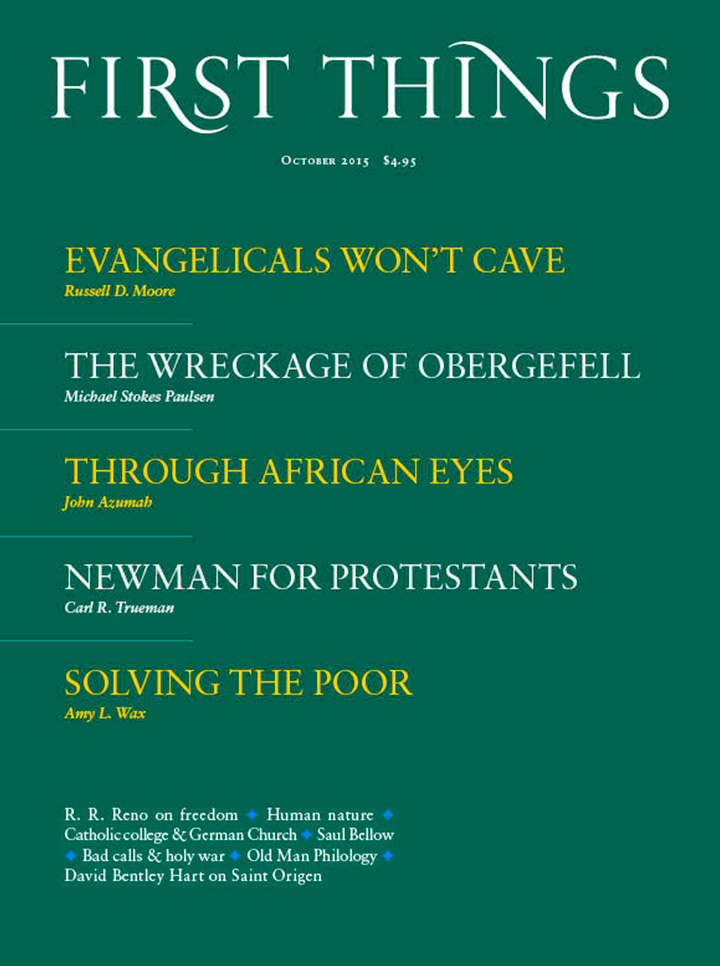
I cannot really say what irks me more, though: that it happened or that, in fact, it really never did. The oldest records of the council (which was convened to deal solely with certain Antiochian theologians) make it clear that those fifteen anathemas were never even discussed by the assembled bishops, let alone ratified, published, or promulgated. And since the late nineteenth century various scholars have convincingly established that neither Origen nor “Origenism” was ever the subject of any condemnation pronounced by the “holy fathers” in 553. The best modern critical edition of the Seven Councils—Norman Tanner’s—simply omits the anathemas as spurious interpolations.
As for where they came from, the evidence suggests they were prepared beforehand by the vicious and insidiously stupid Emperor Justinian, who liked to play theologian, who saw the Church as a pillar of imperial unity, and who took implacable umbrage at dissident theologies. A decade earlier, he had sent ten similar anathemas of Origen (or what he imagined Origen to have taught) to Patriarch Menas; and on the council’s eve he apparently submitted the fifteen anathemas of 553 to a lesser synod of bishops, in hope of securing some kind of ecclesial approbation for them. Or they may instead have been proposed at a synod as much as nine years before. Whatever the case, it was only well after the Fifth Ecumenical Council’s close that they were attached to its canons, and Origen’s name inserted into its list of condemned heretics. In this way the anathemas “went on the books,” where they remain: peremptory, garbed in immemorial authority, and false as hell.
I
n themselves, the fifteen anathemas are an odd relic of disputes of which we can now glimpse only the shadows. Few of them are even remotely reminiscent of Origen’s actual ideas, except in almost comically distorted form, and he in fact is never named in any of them. Perhaps some of the ideas denounced vaguely echo aspects of the thought of Stephen bar Sudhaile (late fifth century); others have a faintly “gnostic” or “orphic” hue; still others might have been concocted by Aristophanes and Edward Lear during a long night’s assault on a distillery; but they all emanate from schools that have left no other historical traces. Even if the anathemas had actually been approved by the council, they no more constitute a serious condemnation of Origen than they do a recipe for brioche.
And I am not entirely certain why anti-universalists cling to them so pertinaciously, since they do not even really condemn universalism as such at all. The first anathema speaks of the idea of a “monstrous restoration” (apokatastasis), but only the version of that idea that logically follows from a particular “fabulous” account of the soul’s preexistence. And the succeeding anathemas fill in the details of the tale: an undifferentiated substantial unity of all rational natures at the beginning and then, identically, at the end; the spherical shape of resurrected bodies (Christ’s included); christological speculations that more parody than promote Origen’s beliefs; caricatures of Origen’s views of angels and demons; and so on.
In any event, I stopped following the debate when I was sent a link to a fatuous screed by some converso polemicist who not only defended the fifteen anathemas, but insisted on praising “St Justinian’s” rebukes of “Origen.” Admittedly, technically he was within his rights. East or West, all Christians are burdened with the absurdities of Christian imperial history. But any conception of orthodoxy that obliges one to grant the title of “saint” to a murderous thug like Justinian while denying it to a man as holy as Origen is obviously—indeed ludicrously—self-refuting. And one does not defend tradition well by making it appear not only atrociously unjust, but utterly ridiculous.
Dear Reader,
Can I be direct with you?
War abroad. Socialists on the rise. AI upending human life. Endless uproar online. The modern attention economy doesn’t want readers — it wants users enslaved to the tyranny of the present.
First Things is the antidote: literary excellence, timeless truths, and a fixed point of reference in a culture that has lost its bearings.
But we can’t do it without readers like you.
Our goal: Raise $150,000 by November 1 to sustain First Things in the year ahead.
Your gift anchors readers in the permanent things.
Make your Fall Campaign gift now using the button below.
If you have any questions or would like more information, please contact Giovanni Del Piero, Director of the Editor’s Circle, at gdelpiero@firstthings.com or 212-627-1985.

YOU MIGHT ALSO LIKE
Why the Death Penalty Is a Sore Point for Papal Authority
Pope Leo XIV marked World Day Against the Death Penalty, observed on October 10, with the following…
The Myth of St. Francis
At the beginning of his 2020 encyclical, Fratelli Tutti, Pope Francis speaks of “an episode in the…
Job and Her
It is said that Job lost everything, but she has lost more. All her possessions—the money, the…
