
Every generation, it seems, has its paradigm-defining Supreme Court case: a decision (or series of decisions) that determines the jurisprudential ethos and frames the judicial, political, and academic debate for the next quarter century or so. A landmark case of this sort also marks an ending, substantially revising the judicial ethos of the earlier paradigm-defining, debate-framing case.
In the early twentieth century, it was Lochner v. New York (1905), the case that gave its name to an era of “substantive due process” judicial activism directed against government economic regulation. That approach gave way in the mid-1930s to New Deal–era cases repudiating Lochner and deferring broadly to legislative choices. That paradigm in turn yielded to Brown v. Board of Education in 1954, the defining case of the Warren Court. Brown marked the arrival of a certain form of judicial activism. Its obviously just result erased long-standing erroneous precedent and upended entrenched social practices with dispatch—a pattern followed in many other Warren Court decisions in the years following. Brown was right as a matter of original meaning, yet the Court’s reasoning did not rely on legal text and history, which the Court found ambiguous. Instead, it drew on sociological studies and the Court’s sense of justice.
Roe v. Wade (1973), the most famous and controversial case of the past fifty years, marked the end—in many ways the apotheosis—of the Brown paradigm and the onset of renewed doubts about judicial activism. Roe was an outgrowth of the Warren Court era’s activism, but it was a reckless and extreme outgrowth. Unlike Brown, Roe had no foundation in constitutional text, history, or structure, resting purely on social policy and tenuous extrapolation from earlier precedent that itself possessed the thinnest of ties to text, history, and structure. Roe defined the jurisprudential debates of the 1970s, 80s, and 90s. To its critics, Roe was (and continues to be) the prime illustration of judicial activism run amok, a fundamentally illegitimate and lawless decision of enormous consequence—creating a constitutional right of some human beings to kill other human beings, for all intents and purposes for any reason they choose. To its champions, Roe was (and continues to be) the altar before which every knee should bend—a test case of commitment to women’s rights and to a particular substantive vision of the Constitution. Generational debates have enduring echoes. The role of Roe in confirmation battles gave us the Court we have today.
In 1992, the paradigm shifted again, slightly, with Planned Parenthood v. Casey. A 5–4 majority reaffirmed Roe—not because the Court thought the decision correct, but rather on the theory that, right or wrong, Roe should be adhered to as a matter of stare decisis, the judicial doctrine that prior decisions should be followed. Casey defined an era of pseudo-restraint. The Court became somewhat more reluctant (usually) to make up new constitutional rights, but it was also unwilling to roll back its earlier invention of a right to abortion. In truth, the Court’s invocation of stare decisis was opportunistic fraud. The Court adhered to precedent, except when it didn’t. It overruled two abortion decisions in Casey. And it overruled Bowers v. Hardwick (1986), which had declined to create a new constitutional right to homosexual conduct, in Lawrence v. Texas (2003), on the grounds that it now thought Bowers wrong. The Casey paradigm remained one of judicial activism, but a two-steps-forward-one-step-back, disguised, disingenuous activism. As many suspected at the time, Lawrence proved an intermediate step on the way to a new paradigm—a halfway house between pseudo-restraint and unabashed judicial activism.
On June 26, 2015, the paradigm shifted yet again, decisively, with the Supreme Court’s decision in Obergefell v. Hodges, creating by a 5–4 vote a national right to same-sex marriage overriding the marriage laws of every state. The decision deliberately disclaimed the propriety of judicial restraint or caution. Instead, it rested on the premise that a majority of the Court, unconstrained by the original meaning of the words of the text, has the power to update the Constitution to reflect its sense of justice, liberty, and right.
Obergefell completes a stunning social transformation in the millennia-old institution of marriage and seeks to locate and entrench that transformation, however implausibly, in the U.S. Constitution—by virtue of a provision adopted in 1868 to ensure that state governments act in accordance with the rule of law and fair procedures for applying it. The decision will frame for the indefinite future the national debate not just over marriage but over law—the rule of law, the role of courts, the freedom to dissent. Obergefell figures to become the paradigm case of our age, framing the debate over one of the most divisive social issues in generations, over judicial power, and over religious freedom. Obergefell was more than the case of the year. It may be the case of the next several decades.
Other than that, Mrs. Lincoln? While it may have been defined by a singular notable decision, it was not a one-case term. The Court decided cases involving the First Amendment, statutory interpretation, religious freedom, nondiscrimination law, the death penalty, police searches and seizures, election redistricting, and the Constitution’s foreign affairs powers. Some of these decisions were of real consequence. Many of them the Court got wrong, too—it was in general a worse year than usual. But nobody will remember any of the other cases in twenty years. Instead, we’ll all still be talking about Obergefell.
Obergefell is enormously consequential, but it was really no surprise. Nearly everybody predicted that the Court would create a national constitutional right to same-sex marriage; that it would do so by a vote of 5–4; that Justice Anthony Kennedy would write the majority opinion; that the Court would purport to ground its decision in either the due process or equal protection clause of the Fourteenth Amendment (or perhaps a mixture of both); that it would rely in part on its decisions two and twelve years ago, respectively, in United States v. Windsor (2013)and Lawrence v. Texas (2003); that the Court’s reasoning would be confusing, convoluted, and unconvincing, composed of vacuous pseudo-sophisticated aphorisms; and that no one in the majority would much care about the opinion as a matter of legal craft—it was a result to be reached, and nothing more.
It almost goes without saying that the Court’s conclusion—that the Fourteenth Amendment provides an affirmative right to same-sex marriage, and that all state marriage laws have been unconstitutional for 150 years—is legally absurd. It has no basis in the text, structure, logic, or history of the Constitution, and is contrary to all evidence of historical understandings at the time the amendment was adopted. The decision lacks support even in the Court’s own precedents. Despite throwaway citations to Windsor and Lawrence, nothing in those cases gets you anywhere near the neighborhood of an affirmative right to same-sex marriage, overriding the laws of the states; considerable language in both cases points to exactly the opposite conclusion. The four dissents—Chief Justice John Roberts’s lead dissent is the most thorough—devastate the majority opinion on each of these points. The outcome has no legal basis. Roberts aptly dubbed it “an act of will, not legal judgment.”
What, then, was the majority’s reasoning? Justice Kennedy’s majority opinion rests on the long-discredited (but stubbornly resilient) legal doctrine of substantive due process. The drafters of the Fourteenth Amendment, Kennedy wrote, “did not presume to know the extent of freedom in all of its dimensions” and so they entrusted to “future generations” (translation: five justices) the power to protect “the right of all persons to enjoy liberty” as “we learn its meaning” on the fly.
“Substantive due process” of course makes complete textual hash of the due process clause of the Fourteenth Amendment, which reads: “No state shall . . . deprive any person of life, liberty, or property without due process of law.” The provision concerns legal regularity. It requires that government act in accordance with the rule of law rather than arbitrary power. It is about fair procedures. It forbids deprivations of life, liberty, or property without due process of law. It does not say that government may not deprive persons of “liberty”—period, full stop. All it says is that government must duly enact a law for there to be a law, and must ensure a fair process to individuals accused of violating the law. The requirement of due process does not limit the substance of what laws legislatures may enact. The doctrine of substantive due process is utter gibberish.
Worse than that, the notion of substantive due process contradicts the core principle of due process itself. In judicial hands, it becomes a doctrine of arbitrary judicial discretion—of making up the law as you go along, as judges supposedly “learn its meaning.” This violates the due process clause’s mandate that officials act in accordance with the prior rule of law and do not exercise arbitrary power.
The landmark precedents employing this incoherent doctrine are all horrid: Dred Scott v. Sandford (1857) created a substantive due process right to expand slavery into federal territories, saying that any law that deprived a man of his slave property could “hardly be dignified” by the name “due process of law.” Lochner v. New York (1905) resurrected the doctrine to invalidate social welfare and economic regulatory laws, in the name of “liberty” under the due process clause. Lochner reigned for years before being killed and buried in the 1930s and 40s. But the monster rose again in the late 1960s and 1970s to create new substantive due process rights to sexual liberty, held to include (in Roe) the right to kill unborn children gestating in a mother’s womb.
The Obergefell Court’s reliance on substantive due process is thus historically familiar. But it is still remarkable. The majority rested the right to same-sex marriage on the least plausible basis in the Constitution one can imagine. Why? What about the other constitutional arguments?
To the surprise of some, the Court declined to embrace a traditional equal protection clause argument that traditional man-woman marriage invidiously discriminates on the basis of an immaterial personal characteristic. There was a certain candor in this. The Court seemed to realize that the idea of equal protection cannot get you all the way to a substantive right to same-sex marriage. The core of “equal protection of the laws” is the idea that government may not treat people differently for no other reason than discrimination on the basis of a personal characteristic not relevant to the law being applied. The law cannot be different for some than for others, unless there’s a good and legitimate reason. Simply put, everybody must be equally subject to the same legal rule.
The argument for same-sex marriage reverses this principle. Gays and lesbians were not subjected to a different rule because of their sexuality; they were subject to the same marriage rules as everybody else. Traditional marriage—marriage as the union of a man and woman—is not a jiggered, gerrymandered institution designed to discriminate on the basis of sexual orientation. It is based on biological difference and sexual complementarity. The “marriage equality” argument was not an argument for equal protection, but instead an argument that we need to change the institution itself, in order to accommodate same-sex couples. We need to change the rule from biological complementarity to any-two-will-do.
That’s substantive due process reasoning—the creation of a new substantive-right rule—not equal protection of the laws, which is about equal treatment in accordance with the law. So, in the end, the majority invoked equal protection notions only to furnish what it called “synergy” for its substantive due process holding. In effect, the majority said there is a “substantive” equal protection clause, too, overlapping the substantive due process argument.
It was, then, the substance of marriage that the majority sought to define. The majority identified “four principles” of marriage that it thought should extend to same-sex couples: (1) “the right to personal choice” flowing from “the concept of individual autonomy”; (2) marriage’s “importance to the committed individuals”; (3) the fact that marriage “safeguards children and families” and is related to procreation and child-rearing; and (4) the idea that marriage “is the keystone of our social order” as described by Tocqueville. (I am not making this last point up in the slightest, I promise.)
Quite aside from being invented abstractions rather than constitutional language (and contestable abstractions about marriage as well), the dissents aptly noted that the same principles might as easily—indeed, much more plausibly—support a constitutional right to polygamous marriage. “It is striking how much of the majority’s reasoning would apply with equal force to the claim of a fundamental right to plural marriage,” wrote Roberts. “Indeed, from the standpoint of history and tradition, a leap from opposite-sex marriage to same-sex marriage is much greater than one from a two-person union to plural unions, which have deep roots in some cultures around the world. If the majority is willing to take the big leap, it is hard to see how it can say no to the shorter one.”
Hard, indeed. That does not mean that the Court necessarily will take that next step, at least not immediately. (Roberts was quick to deny that he was embracing automatic legal equivalence.) If not, however, it is only because substantive due process means never having to say you’re sorry: Just make up the result you like, drape it in some empty rhetoric, and retreat from it the next time if so inclined. It’s nice if there’s some semblance of consistency, but there’s nothing to require it. As Roberts put it: “If an unvarying social institution enduring over all recorded history cannot inhibit judicial policymaking, what can?”
Amore serious problem is the fate of religious liberty in Obergefell’s wake. Put starkly: If same-sex marriage is, as the Court has now said, a fundamental constitutional liberty, those who resist it are like segregationists resisting Brown v. Board of Education—forces of evil to be extirpated. Civil rights laws provide the bulldozer for eliminating such views. Already, at many levels of government, there are laws protecting against sexual orientation discrimination and marital status discrimination. Obergefell gives these laws added oomph by assigning them the status of constitutional freedoms that can only be abridged for the sake of a “compelling state interest”—which the decision denies exists.
Homosexual rights advocates are rapidly pressing for more. Their goal is to stigmatize, delegitimize, and quickly extinguish opposition to the new norm, especially dissent grounded in religious conviction. They avowedly seek to run traditional religious views off the field. For them, to tolerate any remnants or enclaves of dissent is intolerable, for it might be taken to suggest that there is legitimate room for disagreement.
Churches, synagogues, and mosques; religious ministries and social service agencies; religious schools and colleges; and private businesses owned by religious individuals, families, or groups (bakers, florists, photographers, and the like) are vulnerable to anti-discrimination lawsuits if, as a matter of religious conviction, they decline to recognize, participate in, or provide services in support of same-sex marriages. Suits will be brought—many already have been—seeking fines or direct judicial orders to engage in conduct inconsistent with faith. At the oral argument in Obergefell,the Obama administration’s solicitor general conceded that the tax-exempt status of religious colleges that adhere to traditional biblical views of marriage would be at issue if same-sex marriage were to become a constitutional right.
The Obergefell majority recognized all of this. Late in the opinion, Kennedy offered some tepid words of supposed reassurance:
Finally, it must be emphasized that religions, and those who adhere to religious doctrines, may continue to advocate with utmost, sincere conviction that, by divine precepts, same-sex marriage should not be condoned. The First Amendment ensures that religious organizations and persons are given proper protection as they seek to teach the principles that are so fulfilling and so central to their lives and faiths, and to their own deep aspirations to continue the family structure they have long revered.
The narrowness of these expressions was not lost on the dissenters. Chief Justice Roberts sarcastically noted that the majority “graciously suggests” a freedom of religion “to ‘advocate’ and ‘teach’” but omits what the First Amendment guarantees: “the freedom to ‘exercise’ religion.” Justice Clarence Thomas decried the majority’s “weak gesture toward religious liberty,” insisting that religious freedom “is about more” than just the right to teach. Rather, it embraces “freedom of action in matters of religion generally.” Justice Samuel Alito warned that the decision “will be used to vilify Americans who are unwilling to assent to the new orthodoxy” and that the majority’s comparisons with racial discrimination “will be exploited by those who are determined to stamp out every vestige of dissent.” Justice Antonin Scalia joined each of the three other dissents.
The fate of religious liberty is the most important consequence of the Obergefell decision. Same-sex marriage was already arriving by legislative action. Many religious believers found that regrettable, but in much the same way they regret moral or social decline generally: It is bad, but so what? The world is bad. Same-sex marriage may be an affront, but not a direct impairment of their own personal freedom. Being compelled by government to act contrary to one’s fundamental faith convictions is another matter entirely. It is of overwhelming importance that men and women of good faith be permitted to act in accordance with religious conscience.
No summary of the four Obergefell dissents would be adequate; one simply must read them all, front to back. They are remarkable, powerful, memorable. And they are singular in one striking respect: All four dissents go beyond refuting the majority opinion; they condemn it as illegitimate. The Court is not just wrong, but has become a renegade institution that needs to be reined in by democratic forces outside of itself.
Roberts calls the decision “an act of will, not legal judgment,” a decision so fundamentally wrong that it calls into question the legitimacy of the Court. Scalia’s dissent refers to “this Court’s threat to American democracy.” Thomas calls the decision “at odds not only with the Constitution, but with the principles upon which our Nation was built.” Alito says the decision shows “the deep and perhaps irremediable corruption of our legal culture’s conception of constitutional interpretation.”
These are strong words. The dissenters appear to go so far as to urge political and public resistance to the majority’s decision. Check this Court, they seem to say. Things have really gone off the rails.
Scalia is the most explicit: Where judges act in excess of their legitimate power, their hubris invites political leaders—state as well as federal—to bring the Court back into line by refusing to execute its lawless judgments. Quoting Alexander Hamilton’s famous Federalist 78, Scalia concludes:
Hubris is sometimes defined as o’erweening pride; and pride, we know, goeth before a fall. The Judiciary is the “least dangerous” of the federal branches because it has “neither Force nor Will, but merely judgment; and must ultimately depend upon the aid of the executive arm” and the States, “even for the efficacy of its judgments.” With each decision of ours that takes from the People a question properly left to them—with each decision that is unabashedly based not on law, but on the “reasoned judgment” of a bare majority of this Court—we move one step closer to being reminded of our impotence.
Take the step, Scalia is imploring. Remind us. Bring on the fall.
Justice Alito’s dissent is more dispirited, but has the same implications: “If a bare majority of Justices can invent a new right and impose that right on the rest of the country, the only real limit on what future majorities will be able to do is their own sense of what those with political power and cultural influence are willing to tolerate.” Solemn calls for judicial restraint are not enough: “Today’s decision shows that decades of attempts to restrain this Court’s abuse of its authority have failed.” Something more needs to be done.
The four dissenters have issued a call to arms. They are challenging the legitimacy of the Court as an institution. They are calling for action to be taken to restrain or repudiate the Court itself. This is truly extraordinary. Whether such action will be taken, or what form it might take, remains to be seen. But one thing seems clear: Obergefell v. Hodges has framed the constitutional debate not only over marriage and the fundamental structure of American society, but over the judicial role and its legitimate exercise, probably for a generation or more. For better or worse—for richer or poorer—the Court has married same-sex unions to the Constitution, and to an unabashedly activist and historically indefensible conception of judicial power.
Given the fireworks over Obergefell, it is hard to get too excited about the rest of the Court’s term. The higher-profile cases followed a common pattern: judicial activism in service of the liberal bloc’s preferred agenda, coupled with indifference to the words and meaning of the Constitution (or of Congress’s actual enactments in statutory interpretation cases). Often, Kennedy joined the four hard-left liberals. Occasionally, one of the four conservatives succumbed and joined them. Every now and then the liberal four fell one vote short, with Kennedy siding with the conservatives.
In Arizona State Legislature v. Arizona Independent Redistricting Commission, the Court, by the same 5–4 alignment as Obergefell, held that a state ballot initiative can remove a federal constitutional power from a state legislature. The Constitution provides that the “Times, Places and Manner of holding Elections for Senators and Representatives shall be prescribed in each State by the Legislature thereof.” Simple enough. The voters of Arizona, however, by ballot initiative removed the power to draw election districts from the legislature and vested it in an independent political commission. In an opinion by Justice Ruth Ginsburg, the Court held that “Legislature” did not necessarily refer to, well, the state’s actual legislature, because that would frustrate popular democratic liberal reform. The majority’s result cannot be squared with the language of the Constitution. As Chief Justice Roberts’s powerful dissent demonstrates, everytime the Constitution uses the word “Legislature” it actually means legislature. The majority’s decision, like that in Obergefell, was simply result-driven.
Zivotofsky v. Kerry was a curious but important decision. The specific issue was small: Could Congress constitutionally require the State Department to put the word “Israel” on passports of U.S. citizens born in Jerusalem? The constitutional stakes were large: Who possesses the constitutional power over foreign affairs? Both the Bush and Obama administrations have sought to avoid diplomatic controversy over the question of sovereignty over Jerusalem by having passports say simply “Jerusalem,” dodging the issue entirely. Both administrations declined to enforce a statute that required putting “Jerusalem, Israel” on passports, on the grounds that it interfered with the president’s power over foreign affairs.
Kennedy wrote the majority opinion, joined by the four liberals. It sided with the executive branch—correctly, I think—but for convoluted, policy-driven reasons. The statute, Justice Kennedy wrote, interfered with the power of the president to recognize foreign governments. The opinion deliberately did not say, but explicitly denied, that the president possesses the general constitutional foreign affairs power. Where, one wonders, does the power to recognize foreign governments come from?
The correct answer is that the president possesses a general power to conduct foreign affairs as an aspect of the original meaning of “the executive Power” vested by Article II, except where that power is either reassigned to Congress (such as declaring war) or shared with the Senate (making treaties). Other than that, Congress cannot use its ordinary legislative powers to interfere with the president’s power over foreign affairs. It follows that Congress cannot make the president identify Jerusalem as part of Israel on U.S. passports when the president deems such a declaration contrary to the foreign policy interests of the United States. Only Justice Clarence Thomas, concurring separately, got the analysis right.
The three dissenters insisted, strangely, that an act of Congress could interfere with the executive foreign affairs power. It was odd to see the conservative wing of the Court (except for Thomas) rejecting presidential autonomy in foreign affairs and embracing congressional meddling. It was odder still to see the liberal wing embracing unilateral presidential power, even in a muddy, hedged, policy-driven opinion.
The Court went a dismal one-for-three on First Amendment free speech cases. In an obscure but doctrinally important case, Reed v. Town of Gilbert, the Court invalidated a town’s sign regulation ordinance that treated private signs differently based on the sign’s message. The case became the occasion for a ringing reaffirmation of the principle that government may not prohibit, restrict, or regulate expression based on its content or message. This principle is at the core of the First Amendment, and the majority opinion of Justice Thomas systematically demolishes all the bad arguments bureaucrats typically make in defense of controlling speech they do not like. Reed was the singular constitutional bright spot of the term.
But then, the same day, the Court decided Walker v. Texas Division, Sons of Confederate Veterans, featuring a bad opinion by Justice Stephen Breyer upholding Texas’s censorship of a proposed specialty license plate design featuring a Confederate battle flag emblem. The Court’s theory was that the speech on license plates is the government’s own speech, which it could censor however it wishes. In reality, Texas allows some 350 license plate designs formulated by private groups to promote their causes or views—and to give the state revenue. Texas was essentially selling mobile billboard space, not espousing the state’s views. (An Oklahoma Sooners specialty plate can hardly be speech of the state of Texas.) A state board routinely approved proposed designs and slogans of all different kinds, until the “Sons of Confederate Veterans” came along. The proposed plate offended a segment of the public, which lobbied the state board to reject it. The Texas board acceded to the request for censorship, and denied the application because of popular disapproval of its message.
The 5–4 majority of the Court upheld the censorship because it disapproved of the proposed plate’s message—Clarence Thomas this time joining the liberal bloc. Thomas has done this sort of thing before. Usually excellent on First Amendment issues, he seems to have a blind spot for racist speech, the Klan, cross-burning, and Confederate symbolism. The decision clanks against the principles of the free speech clause. If government may censor whatever it owns, touches, manages, sells, curates, promotes, or operates, then the scope of freedom of speech depends on the scope of government’s assertions of power. Given the extensive penetration of government into all aspects of life today, that is not a happy prospect. One hopes that Walker merely creates a “license plate exception” or “Confederate flag exception” to the First Amendment, rather than a general hole.
The Court’s third free speech case, Williams-Yulee v. Florida Bar, also is best read as a narrow exception to usual free speech principles. In an opinion by Chief Justice Roberts, the Court upheld a state’s ban on candidates for elected judgeships personally soliciting campaign funds. If the principle were applied to elections generally, it would be horrid, as Justice Scalia’s dissent powerfully proved. The decision is wrong but (one hopes) limited.
The Court added to its incoherent Fourth Amendment decisions, holding in City of Los Angeles v. Patel that a city ordinance authorizing police to review motel guest registries violated the prohibition against unreasonable searches. In Rodriguez v. United States, the Court found it unreasonable to detain the driver and occupant of a vehicle for an additional seven minutes for the arrival of a backup officer before lawfully using a drug-sniffing dog to walk around the vehicle. (The dog sniffed out a stash of methamphetamine.) The dissenters had it right: seven minutes? Really?
It’s nice when the Court gets something right. In Horne v. Department of Agriculture, the Court held (8–1) that the takings clause of the Constitution applies to government appropriation of personal property as well as real property. Property apparently means property!
In Glossip v. Gross, the Court turned back, 5–4, an Eighth Amendment “cruel and unusual punishment” challenge to the use of a particular drug protocol for execution by lethal injection. Kennedy joined Alito’s sensible, disciplined majority opinion for the conservatives. What made headlines was Justice Breyer’s forty-one-page dissent suggesting the Court revisit the question of whether the death penalty itself is unconstitutional, prompting vehement and effective rebuttals from Justice Scalia and Justice Thomas.
King v. Burwell was the worst of the Court’s statutory decisions. Chief Justice Roberts wrote for a majority of six, joined by the four hard-core liberals and soft-core Kennedy. The narrow question was whether “an Exchange established by a State,” under the Affordable Care Act, includes an exchange not established by a state, but by the federal government. Roberts said it did, in an opinion bringing to mind the old joke that only lawyers and painters can turn black to white. On this imaginative rewriting depended billions of dollars of federal subsidies in dozens of states.
Roberts’s reasoning: True, the most natural meaning of the legislation’s language was exactly what it said. But the Affordable Care Act would not work well if subsidies were not available in states that chose not to establish their own exchanges. Congress messed up by not anticipating that so many states would refuse to play along with Obamacare. So it was necessary to fix the statute to match what Congress might have meant to enact had it thought things through more carefully.
This is from Lawyers’ Tricks 101, and it’s embarrassing to see Roberts playing this game. And what on earth for? One reading of Roberts’s vote is that he has an overwhelming preference for sustaining government action and leaving the status quo undisturbed—a philosophy of judicial restraint of a certain sort, reminiscent of his old boss, the late Chief Justice William Rehnquist. A less charitable reading, offered by Justice Scalia in dissent, is that Roberts bends the rules to sustain Obamacare, which Scalia renamed “SCOTUScare.” At all events, Scalia’s dissent eats Roberts’s majority opinion for lunch.
Statutory interpretation cases are usually thought less important. If the Court gets a statute’s interpretation wrong, Congress can (in theory) fix it by modifying the statute. Still, it is important for the Court to read statutes correctly the first time for the same reason that it is important to read the Constitution correctly: They are the law, and faithful statutory interpretation is essential to the rule of law. More than that, as Scalia points out, when the Court misinterprets or rewrites a statute, it raises a constitutional problem related to the separation of powers. Judicial rewriting of statutes violates Article I of the Constitution, which vests all “legislative Powers herein granted” in Congress, not the Court. Judicial rewriting of statutes is not just wrong; it is unconstitutional.
Another case of rewriting the law saw the same alignment of votes as in Obergefell. In Texas Department of Housing and Community Affairs v. Inclusive Communities Project, Justice Kennedy’s 5–4 majority opinion wrote into the Fair Housing Act new liability predicated on the racially disparate impact of a government policy rather than identifiable acts of discrimination. The Court had done a similar thing to Title VII of the Civil Rights Act, making disparate impact an element of employment discrimination. Apparently Kennedy and company thought it good to do so in another statute, too.
The Court got some statutory interpretation cases right. Some of these vindicated rights to religious freedom and nondiscrimination. The Court held, unanimously, that the Religious Land Use and Institutionalized Persons Act and the Religious Freedom Restoration Act protected a Muslim prison inmate’s right to wear a beard (Holt v. Hobbs). The Court held, 8–1, that protection against private employment discrimination on the basis of religion—part of Title VII of the Civil Rights Act of 1964—extends to a Muslim woman refused employment by Abercrombie & Fitch because her apparel didn’t match the retailer’s desired “look” (EEOC v. Abercrombie & Fitch). And, by a vote of 5–4 (Kennedy joining the conservatives), it set aside the Obama administration’s EPA mercury emission rules for not having taken into account industry costs before issuing the regulations, as required by statute (Michigan v. EPA).
There were more cases, interesting to lawyers and perhaps to a few real people, concerning the confrontation clause, habeas corpus, statutory interpretation, and res judicata. But the world will little note nor long remember what the Court said in those cases—or for that matter in very many of the others decided this past term. But we will remember and debate for a generation what the Court did in Obergefell.
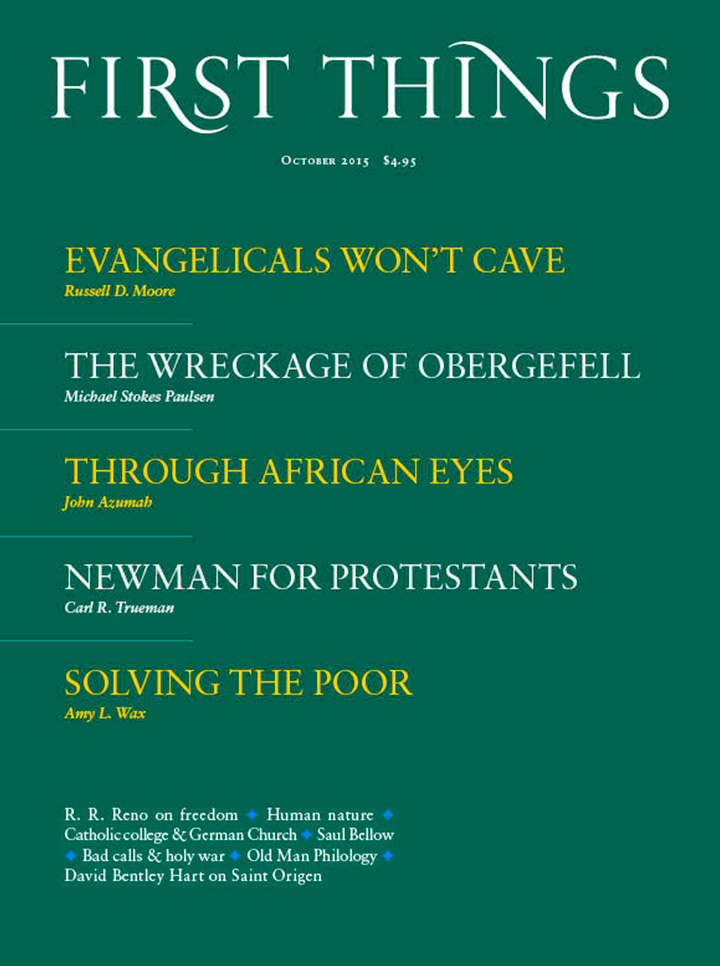
Michael Stokes Paulsen is Distinguished University Chair and Professor at the University of
St. Thomas School of Law.
YOU MIGHT ALSO LIKE
Equipping the Church for the IVF Era
When Anna, a pianist at her local church, began to show the unmistakable signs of pregnancy, her…
The Fourth Watch
In this episode, James F. Keating joins R. R. Reno on The Editor’s Desk to talk about…
Christianity Is Not a Tool
On today’s episode, writer Kelly Chapman joins Virginia and Germán. According to the discourse, it’s fashionable to…
