
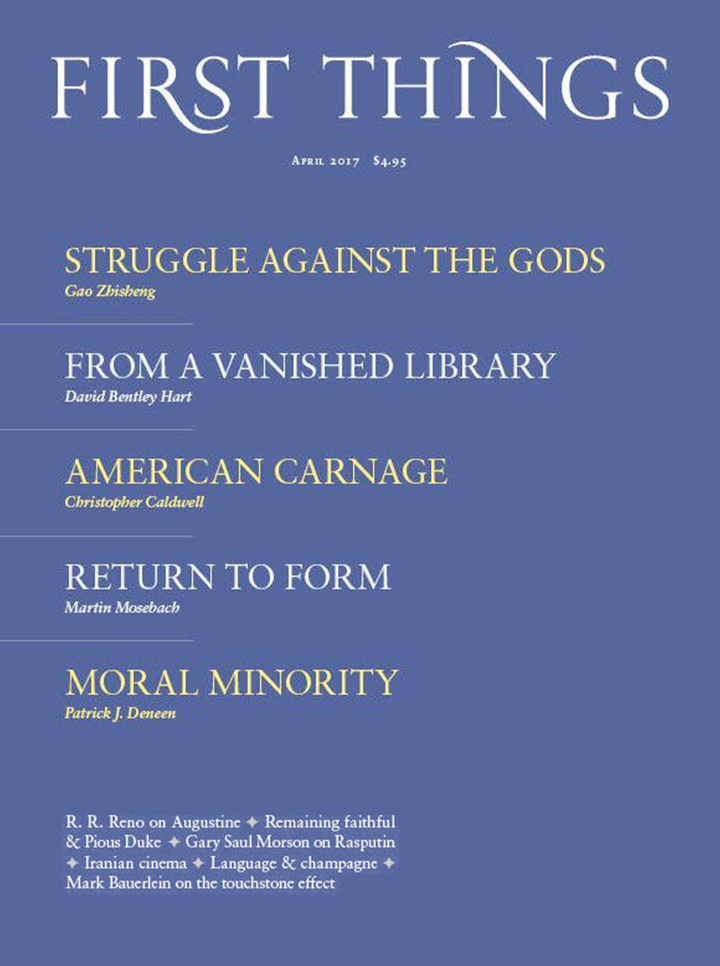
The library in question is not the Great Library of Alexandria, but it is every bit as much a thing of the past, existing now as scarcely a memory—almost legendary, positively Edenic. I think it had been my ambition throughout much of my life to accumulate a collection of books in the ideal, grandly compendious style of the personal libraries assembled by the most literate of prosperous Victorian gentlemen. I knew I would never be able to amass the literally hundreds of thousands of volumes that Gladstone and Disraeli each left behind when they departed this life, but at its apogee my library was around 20,000 volumes, which in our day, and within the practical material constraints pressing on me, was a fairly estimable hoard. Some of the books were rare and beautiful, many were ordinary, a great many superfluous, but I clung to all of them like a miser guarding the heaps of gold coins kept in his vault.
And somehow I had deceived myself that my particular kind of greed was more pardonable than that of men who fill their sprawling garages with antique motor cars or drape themselves in the costliest lines of designer suits. Surely, I told myself, a great personal library is an almost spiritual achievement, a kind of generous hospitality to the world at large, an open heart inviting in all the mysteries and beauties of art and culture and wisdom, a sort of noble annex of honorable knowledge that one has attached to one’s own soul and mind. But, of course, owning a complete set of Ruskin bound in gleaming green hand-tooled leather, for instance, or a complete collection of Max Beerbohm or Saint-John Perse or Vladimir Nabokov or Saul Bellow or S. J. Perelman or Patrick White first editions, or a nearly complete collection of Lafcadio Hearn’s most beautifully designed books, or six different editions of Gibbon, or twenty-three different editions of the Alice books is as much a sensuous indulgence and carnal extravagance as an Italian sports car or a mistress with expensive tastes.
And to what end? Probably just to revel in the gasps of surprise that the sight of the collection fully displayed might very occasionally evince from a new visitor to one’s home. That may be the pettiest motive possible in this life for an exaggerated acquisitive habit. If, as Paul tells us in 1 Corinthians, those whose works will have merited no reward at the end of days will have to be saved “as though by fire” when the damnable works they did leave behind are consumed, the insatiable bibliophile may prove to have chosen a particularly combustible vice to indulge.
In any event, it is all gone now, except for a few jagged fragments. In 2014, a natural catastrophe of an insidiously furtive and unanticipated kind overtook both me and my library, and ultimately (though in agonizingly protracted stages) the latter had to be liquidated. The bereavement of losing nearly forty years of accumulated texts, however, was not nearly as great as I thought it would be (allowing for the possibility that I am still in a state of shock). It turns out that all those texts are still out there to be read, and that many of them I did not need anyway. I found the books of theology the easiest to part with, since many of them are very dull; I am never going to read Barth’s Church Dogmatics again, for instance, and did not really enjoy it very much the first time. And all those yellowing Vintage paperbacks of the authors who were considered especially significant when I was in high school or college—Camus, Faulkner, Sartre, Mann, Gide, and so on—dissipated like a pale morning fog without any profound sense of desolation descending on me. Even the loss of many volumes of a rarer and more recherché nature somehow left me more or less emotionally intact (does anyone really need all five volumes of Osbert Sitwell’s memoirs?). The books published abroad in various European and Asian languages, ancient and modern, were somehow harder to part with in many cases, and I suspect that was because they had subtly served my vanity more than the volumes in English, but their loss too did not destroy me.
I learned from the experience, in the end, that all vanity is vanity, all lust is lust, and all excess is excess, no matter what the objects of one’s desire. The aesthetics of bound volumes is unique and exquisite; but there are more important things. I love Robert Louis Stevenson. I think there was no greater prose stylist in English in the nineteenth century, no better storyteller, and no better travel writer. It astonishes me that he has often been held in higher esteem by judicious foreigners (like Borges) than by British or American readers. And I especially loved reading his work from the complete twenty-six-volume set I had owned since boyhood, with its evocative dull red covers and rough-cut pages and illustrations shielded by translucent slips of rice-paper. But, now that those volumes are gone, I find that the texts have lost none of their power to delight when I read them in the Delphi Classics eBook edition of his collected works (about $2.00 for the whole thing) on a Kindle device. And I no longer have to drag the ponderous burden of the bound set about the earth, along with all the other volumes in my library, like Jacob Marley’s chains.
Even so, I am going to indulge in a little nostalgia for that vanished library, which was a happy retreat for many years. A friend recently asked me for a reading list of roughly twenty-five volumes, and this immediately struck me as an ideal way to take one last stroll around the grounds before locking the gates on that particular estate of memory. So here is my catalogue of suggestions for reading on a very long trip—maybe a convalescent’s journey down to the seaside to take the purging air, or some other trip suitably Edwardian in nature and extent. All are books I especially love, or at least revere, though none may seem like an immediately obvious choice (because, really, no one needs to be told to read Homer or Dante or Shakespeare or Milton or Tolstoy or Proust or Rilke). Honestly, they are all quite marvelous in their diverse ways. So, in no particular order:
• J. A. Baker, The Peregrine and The Hill of Summer: Two works that contain some of the most sublime, beautiful, and hauntingly ominous prose written in the twentieth century: bleak, austere, asperous, cold, and yet overflowing with a lyricism unlike any other. The latter volume was out of print entirely until it was reissued in the most recent edition of the former. Both should be read in small portions at a time, the former especially, as the sheer intensity of the language is almost unendurable over long periods.
• Sadegh Hedayat, The Blind Owl: The greatest work of modern Iranian literature, by a writer whose devotion to Poe inspired at least one work far greater than anything of which Poe was capable. It is the only first-person novel written from the perspective of a mad narrator that is truly, wholly, and terrifyingly convincing as a portrait of deep psychosis. One recovers from the book gradually, and does so best in a quiet upstairs room from which the babble of a nearby mountain stream can just be heard.
• “Lady Sarashina,” As I Crossed a Bridge of Dreams: Actually the work of an anonymous eleventh-century Japanese noblewoman, this is one of the most delicate specimens of classical Japanese literature (which already surpasses almost all other literatures in delicacy). It tells of temple pilgrimages and shimmering landscapes and private melancholy and mystical dreams.
• John Cowper Powys, A Glastonbury Romance: The best of Powys’s insane, gigantic, Romantic, mystical, pagan, Nietzschean, pantheist novels; rude, indelicate, and occasionally febrile; and yet wholly British and domestic, in a “long-walk-in-the-afternoon-followed-by-tea-and-toast-in-the-cottage” sort of way.
• Ẓahir-ud-Din Muḥammad Babur, The Baburnama: This oddly absorbing, thoroughly exotic, and occasionally brutal (in merry Mongol horde fashion) memoir of Babur (1483–1530)—lineal descendent of Timur Lang, sometime ruler of Samarkand and other stretches of Central Asia, and founder of the Mughal Empire in India—is also a work of intense introspection, political and social philosophy, historical reflection, natural history, and startlingly lovely detail. The passages on northern India are sometimes stupefying in their richness.
• Patrick Leigh Fermor, The Violins of Saint-Jacques: No one in the twentieth century wrote more magnificent English, or prose of a purer purple; but, while his travel memoirs are now more widely appreciated than ever, his only novel (or novella, really) tends to be overlooked—a deftly constructed, economically proportioned, perfectly satisfying little tale about the small twilight world of a fictional French Caribbean island on its last day.
• Robert Walser, Jakob von Gunten: Perhaps this is an obvious recommendation after all, since Walser’s star seems to be rising again, so suffice it to say that this may be his most ingeniously attractive work, a kind of dreaming, drifting journey through the sensibility of a protagonist like no other in modern fiction.
• Georges Rodenbach, Bruges-la-Morte: The best and most hypnotic of the Belgian author’s works, and proof that there can be such a thing as great Flemish literature; a novel of pure atmosphere, physical and psychic: soft shadows, mutely gleaming canals, mist-gray buildings, grief, illusion, displaced desire, murder . . .
• The Ramakien: You have, of course, read the “official” Sanskrit version of the Ramayana, and you may even be aware of certain of the heteroclite Indian dialect versions, but the Indo-Chinese revisions of the stories of the great Indian epics rival the originals in their fantastic flights, and this Thai iteration of the Ramayana is positively tropical in the lushness of its mythic invention. As far as the iron law of dharma goes . . . well, it is quite extraordinary how liberal classical Thai culture’s moral expectations of its gods could be.
• Longus, Daphnis and Chloe: The most delightful of the extant “novels” of late antiquity, captivatingly absurd and tender; not really an especially esoteric recommendation, perhaps, but nevertheless a book that very few persons today seem to have read.
• Frederick Rolfe, Hubert’s Arthur: The best known of the books of the mad, fragile, and ultimately degenerate “Baron Corvo” is Hadrian the Seventh, and even that has had far fewer readers than A. J. A. Symons’s book about the man himself, but this, his last and posthumously published novel, contains all the “Corvine” virtues and vices—the opulent lyricism, the ghastly neuroses, the anfractuous invention, the weird nostalgias—in particular abundance.
• Sigizmund Krzhizhanovsky, Memories of the Future: The most mercurially gifted of the “Odessa School” writers, Krzhizhanovsky is at last emerging from the shadows to which Soviet censorship condemned him for decades, and these seven stories are among the most attractive specimens of his bizarre, whimsical, frightening, kindly, and endlessly fertile imagination. They are usually described as “surreal,” or “fantastic,” or “Kafkaesque,” but are best not described at all.
• Pu Songling, Strange Tales from a Chinese Studio: Anyone who loves Chinese ghost stories and tales of Taoist magic and supernatural fables—anyone, that is, with a soul—should know this, the classic collection of a great many of the best of them. Pu (1640–1715) belonged to the ranks of the gentlemen-scholars (shi dafu) who constituted the civil administration of China for centuries, but was apparently too bored by his career ever to prepare for and pass the second level of imperial examinations; instead he devoted his energies to the stories he loved, thus becoming not only a benefactor to future generations, but also a moral exemplar for them to emulate.
• Murasaki Shikibu, The Diary of Lady Murasaki: Needless to say, The Tale of Genji is the greatest literary achievement of the glorious Heian period of Japanese high culture, and one of the greatest novels ever written, and so I win no points for needless obscurity here, but having recommended Lady Sarashina’s journal above, I would be remiss in failing to recommend Lady Murasaki’s equally (but very differently) lovely collection of vignettes and meditations and acute observations (and gossip).
• A. W. Kinglake, Eothen: Again, perhaps not a sufficiently arcane recommendation for this list, but nearly so. Published in 1844 and recounting a journey in the Middle East made a decade before, it is a masterpiece of the wry and elliptically self-mocking English travel memoir; only Eric Newby improved on the model in any respect.
• Gyula Krúdy, The Adventures of Sindbad: Not the Sinbad of the Arabian Nights, but a seducer and lover and aesthete of love, three centuries old at least, but indefatigable, a ghostly figure haunting the fading world of the Austro-Hungarian Empire.
• The Kebra Nagast: The fourteenth-century Ethiopian epic of the “Solomonic Dynasty,” the Queen of Sheba’s embassy, the translation of the Ark of the Covenant to Ethiopia, and the “first conversion” of Amharic culture; one should read it because one should.
• Imekanu (Matsu Kannari), Kutune Shirka: An “epic” of the Ainu, first committed to writing by an Ainu woman missionary and poet; like Finland’s Kalevala or Mali’s Sundiata, it is at once a genuinely old work of oral poetry and a genuinely modern work of literary reconstruction. It is probably a little dull, really, but it has such a rough, savage, and alien feel to it that one thinks it quite exciting (and it may truly be so, if you are fascinated by seal-hunting); in any case, the only English version is Arthur Waley’s violently condensed rendering, which is so short that you can read it in less than an hour and still ever thereafter have the right casually to mention that you are quite familiar with the Kutune Shirka.
• Walter Savage Landor, Imaginary Conversations: There are five series of these, admittedly, so here you may wish to find a good volume of selections for your journey. Landor’s poetry and prose have never enjoyed the popularity they deserve, and he has long been overshadowed by contemporaries who were not in any real way his superiors. The Conversations are brilliant, inventive, witty, and often even profound.
• Nguyen Du, The Tale of Kieu: The single greatest work of Vietnamese literature. First published in the early decades of the nineteenth century, it is a long narrative poem about a young woman of great beauty and culture, her misfortunes, and the burdens of karma; a work of genuinely moving brilliance, grim and sad at many points, but also somehow radiant. In English, it is best read in the translation of Huynh Sanh Thong.
• Jan Potocki, The Manuscript Found in Saragossa: The supreme masterpiece of “tales told in a wayside inn” genre; disorienting, mesmerizing, weird, fantastic, beautiful, mysterious, droll, and exquisitely complicated.
• Kalidasa, Śakuntala (Abhijñānaśākuntalam): As Kalidasa was “Sanskrit’s Shakespeare” (though older than the Bard by around a millennium), and as this is his masterpiece, and as it was the German translation of this play that first inspired in Goethe the concept of “world literature,” one really should read it at least once. And it is charming, after all, at once a fairy tale of love won, stolen, and regained, and also a religious allegory (or so tradition says); and Gustav Holst loved it. . . .
• José Maria de Eça de Queirós, The City and the Mountains: Perhaps not an obscure book or author at all, but generally overlooked in the Anglophone world; a wisely humorous and lovely paean to the Portuguese countryside, and the final great work of a majestically talented novelist.
• Joaquim Maria Machado de Assis, The Posthumous Memoirs of Brás Cubas: Speaking of books in Portuguese, one might as well add one by the towering genius of Brazilian letters, who did everything that would be attempted by “surrealist” or “magical realist” or absurdist writers a century later, and did it all much better; The Posthumous Memoirs is as fantastic and exuberant and hilarious as any of his works, and is also surely the best novel written in the voice of a deceased narrator.
• Ferdowsi (Abu’l-Qasim Ferdowsi Tusi), Shahnameh: The great national epic of Persia, written at the turn of the eleventh century, a masterpiece of verse narrative, and allegedly the longest poem in existence written by a single, historically identifiable author. Persian mythology, in many respects, has a “Titanic” rather than “Olympian” feel, oddly similar in some respects to Celtic, and if you read it, you will know what Matthew Arnold was going on about in “Sohrab and Rustum.”
• Antal Szerb, Journey by Moonlight: The book’s Hungarian title, Utas és holdvilág, is more accurately rendered as Traveler and Moonlight, but I am going by the most recent translation. Like Bruno Schulz, Szerb was a delightful and brilliantly original genius, with a touch of the angelic in his imagination, who was murdered by the Nazis. Of the three novels he completed, this is the finest—and is, in fact, an almost perfect novel by any standard.
• Edwin Muir, The Complete Poems: As far as I can tell, Muir is the least-read great poet in English of the twentieth century; he is mostly remembered, it seems, for his translations of Kafka (which are immeasurably better than anyone else’s).
• W. H. Mallock, The New Republic: It defies reason that a professional economist should have written one of the most brilliant satires of the nineteenth century (it appeared in 1877); a conversation novel, in the manner of Thomas Love Peacock, and just about as ingenious as any of his; a grand and ungracious burlesque of the Oxonian intellectuals and writers of the time, many of them Mallock’s friends.
• Victor Segalen, Stèles: Segalen—physician, poet, novelist, Sinologist, aesthetic theorist, among other things—was admired by Borges and Simon Leys (who took his nom de guerre, I believe, from Segalen’s novel René Leys), and has long had a small but unflagging following. This book of prose poems—composed in Chinese and French—is written in the “genre” of Chinese imperial proclamations graven on great stone steles; it achieves a haunting grandeur at times, like Saint-John Perse’s Anabasis in some ways, but more remote, sublime, and mysterious.
• Kamo-no-Chōmei, Hojoki: One of the most essential and shortest of Japanese classics, written by a monk who—having seen Kyoto devastated by earthquake and fire early in the twelfth century—retreated to the mountains to dwell alone in a simple hut and contemplate the transience of all things; quiet, shimmering, and evanescent as dew, melancholy as autumn twilight, it is best read just before going to sleep or dying.
I had better stop here. Twenty-five was the number suggested, and I have breezed past that, and I see that the next item on the list I quickly scribbled on the back of an envelope is Chateaubriand’s Mémoires d’Outre-Tombe, which suggests that I was beginning to lose all sense of proportion. I should have included Sei Shōnagon’s The Pillow Book, I suppose, to go along with the diaries of the Ladies Sarashina and Murasaki. Then again, lists of this sort are meant to be arbitrary, ideally even somewhat perversely so. And, of course, no journey goes on forever.
David Bentley Hart is a fellow of the Notre Dame Institute for Advanced Study. This essay is adapted from his new book, The Dream-Child’s Progress and Other Essays (Angelico Press).

YOU MIGHT ALSO LIKE
The Fraying Fabric of the Church of England
St. Paul’s Cathedral has come up with a novel way to fill the pews: It is becoming…
Talkin’ God and Football
Paul Finebaum is known as “the mouth of the South,” but he does a lot of listening.…
Letters—October 2026
I’m grateful for Stephan Pax Leonard’s essay on his conversion to Orthodoxy (“Why I Became Orthodox,” June/July…
