
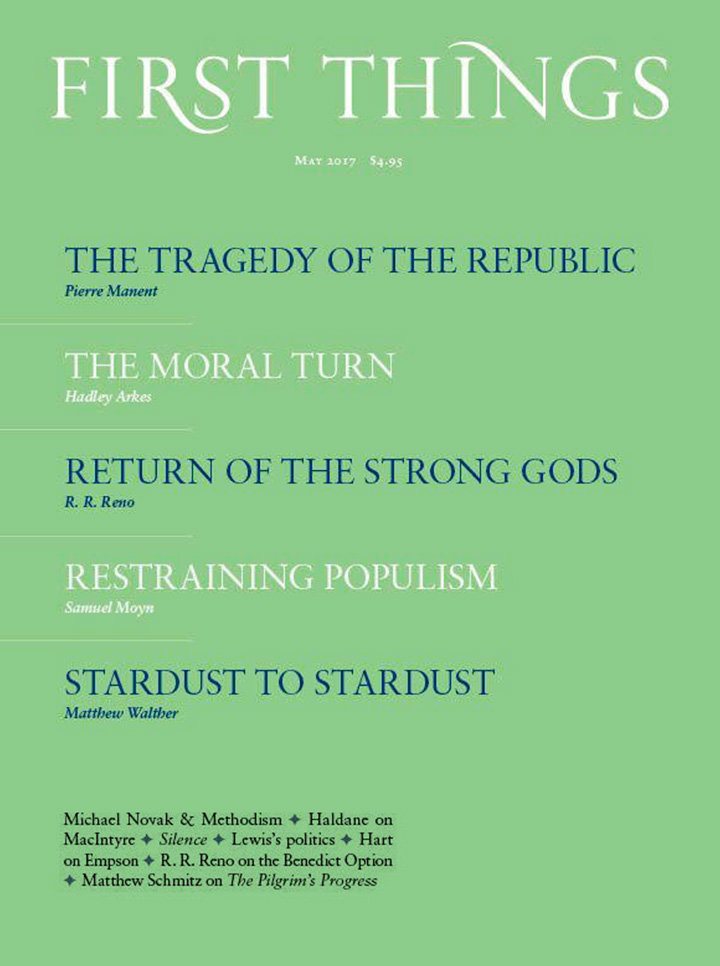
There’s something very right about Rod Dreher’s call to action in The Benedict Option: A Strategy for Christians in a Post-Christian Nation. He urges us to ask if we have “compromised too much with the world” and suggests ways to renew the integrity of our religious communities. Yet there’s also something wrong. A rhetoric of crisis runs through The Benedict Option. The dire picture of our present challenges is likely to confuse Christians rather than help us discern the way forward.
Dreher is a journalist who has perfected the art of blogging. On the American Conservative website, he gathers material from a wide range of sources, quoting them liberally while interposing sharp comments and observations of his own. Reader comments are integrated into his commentary in an authentic give-and-take. The upshot is something unique on the web: an ongoing seminar led by a kinetic, engaged teacher who brings urgency and enthusiasm to his subject.
Arresting images and memorable monikers are Dreher’s strong suit. In the early 2000s, he recognized that young conservatives are less and less likely to be middle-American Rotarians. They don’t like Big Box stores and chain restaurants. Many share with progressives an interest in organic lettuce, free-range chicken, and locally produced cheese. He pulled together these and other threads in Crunchy Cons, published in 2006.
Dreher was on to something, and “crunchy con” entered our lexicon, a testimony to Dreher’s talent for minting a memorable phrase. The same is true for “Benedict Option,” which Dreher draws from the much-quoted ending of Alasdair MacIntyre’s After Virtue that foresees a new Dark Age and our need for a “another—doubtless very different—St. Benedict.” It’s impossible to keep up with the debates about the Benedict Option. That’s not just because Dreher has pressed its adoption with unflagging regularity for a number of years (so much so that James K. A. Smith has characterized Dreher’s project as an ongoing campaign to promote brand recognition—BenOp™). We all sense that the social context for Christian faith and practice is changing in America, and in the West more broadly, and we know we need to decide what it means to be the Church today.
In his account of our circumstances, however, Dreher goes wrong. He makes astute observations about particular challenges, including an important warning about our captivity to the screens we seem always to have in our hands (on this spiritual threat, see Patricia Snow, “Look at Me,” May 2016). The problem is that he gathers them up and frames them as an apocalyptic threat to the very survival of Christianity. The millennial generation is abandoning Christianity, and “if the demographic trends continue, our churches will soon be empty.” Those who remain are uncatechized and captive to a paper-thin, pseudo-Christian deism in which the cardinal virtue is being “nice.” The sexual revolution is everywhere triumphant. Gay marriage is the law of the land. Florists and bakers are being persecuted. Religious liberty may soon be extinguished. “We’ve lost on every front,” and “nobody but the most deluded of the old-school Religious Right believes that this cultural revolution can be turned back.” At times, The Benedict Option can read like Breitbart with incense.
“The old-school Religious Right” receives rough treatment throughout. It’s ironic, therefore, that Dreher follows the Religious Right’s pattern of public engagement. “I have written The Benedict Option to wake up the church and to encourage it to act to strengthen itself, while there is still time.” Substitute “America” for “church,” and one has exactly the rationale for any number of books by religious and social conservatives over the last few decades. Before it’s too late! While there’s still time! The rhetorical structure of The Benedict Option requires imminent disaster. Thus it’s not surprising that Dreher is drawn to the flood as the fitting biblical image for our time. The storm is coming. There’s no escape but . . . the Benedict Option.
We need to beware of exaggerating our peril and misjudging our circumstances. We have not “lost on every front.” A commitment to the sanctity of life has risen gradually over the last generation. Recent studies show that millennials have less sex than their parents or grandparents did at their age—a sign, perhaps, that the sexual revolution isn’t moving from strength to strength. Gay marriage is a marginal phenomenon, and transgenderism, the latest stage of the LGBT movement, faces grassroots resistance by no means limited to religious conservatives. The Obama administration used executive orders and other techniques to impinge upon religious liberty, but when the core question was raised of whether religious communities have complete discretion in their choices of ministerial leadership, the Supreme Court was unanimously opposed to the administration’s efforts to diminish constitutional protection of religious freedom.
Our times are like every other historical epoch between Christ’s ascension into heaven and his return in glory: a complicated combination of good and bad trends. After World War II, the nations of Europe secularized to an unprecedented degree. Given America’s close ties to the Old World, this could not help but affect us. Although church attendance has not declined in any significant degree over the last three generations, our public culture has become more secular. During those same decades, however, Christianity grew at rapid rates in Africa and elsewhere in the world. By some accounts, Pentecostal Christianity is the most powerful force in Latin America, transforming the deepest currents of culture there. Even in the secular twenty-first-century West, the notion of a post-Christian culture obscures as much as it clarifies. Ancient Rome would not have anguished over countless migrants drowning in the Mediterranean.
Dreher says that the “Judeo-Christian culture of the West” is dying, superseded by a therapeutic culture of self-realization. That’s right at one level. But the vanguard institution of this new therapeutic culture—the university—is in crisis, not churches and synagogues. I have confidence that religious institutions, however constrained or impaired in the future, will be living, vital institutions for my grandchildren. I don’t believe the university will survive. The distinctive tradition of higher education that emerged in the Middle Ages is being absorbed into the corporate-bureaucratic structures of our society. By contrast, monasteries, missionary movements, and storefront churches are not. Yes, our religious communities are influenced by that therapeutic culture of self-realization, as Dreher points out. It provides the logic for too many sermons that preach the false gospel of self-acceptance. But we should not be blind to the fact that this false gospel weakens secular institutions much more than religious ones. People still join churches. They’ve stopped joining Masonic lodges, political parties, and bowling teams.
And then there’s the “radical individualism” that Dreher assumes is triumphant. That’s right, but only half-right. The populism that’s disrupting politics throughout the West takes its energy from nationalism. As I argue in “Return of the Strong Gods” in this issue, this powerful trend calls for the restoration of the sacred to public life. It is a rebellion against the “liquid modernity” that turns everything into raw material for us to use for our own purposes. The upsurge of populism won’t necessarily be good for Christianity. It may lead to a dangerous idolatry. But today’s populism reminds us that the trends of recent decades won’t continue forever. The wheel of history turns.
There’s a great deal of good advice in The Benedict Option about how to renew and deepen Christian identity. But I fear the book encourages some of our debilitating self-deceptions. One conceit of modernity is that it is a world-historical “flood” that transforms everything in unprecedented ways. But this is not true. We are not living in a singular age in which Christianity must become a counter-culture. The Sermon on the Mount frames a way of life that always has been a counter-culture. We are not unique in our need to separate from the world. “The world,” as the New Testament uses the term, is a regime governed by sin and death, a way of life that presumes self-interest to be fundamental and death final. Being a Christian has always meant dying to “the world” in this sense. In so doing, we become a light to the world, which in this instance means the created order that God wishes to redeem.
Dreher commends joy and love, but the rhetoric of crisis crowds them out—which is a shame, for they are the reliable bases for Christian witness, as I’m sure he knows and wishes to affirm. In many places in The Benedict Option, theological concepts and historical theories become pliable instruments for exhortation and tools for jarring readers out of their complacency. We need to be shaken awake, yet this approach can feed into a modern pattern one finds in a great deal of conservative Christianity in America, especially conservative Protestant Christianity. The domain of the intellect is mobilized and reshaped to meet this or that crisis. There’s no room for contemplation.
I don’t want to be taken as Pollyannaish. The struggles of 2017 are real, and they are daunting. But they are not uniquely perilous. For centuries, the Church grappled with a warrior culture that enflamed disordered desires for honor, sometimes compromising, often failing. And after it succeeded in Christianizing knighthood, the Church was almost immediately suborned by the dynasties that dominated Europe. Now we must fight the worship of Mammon and the sexual revolution—also with mixed results, sometimes being taken captive by them, sometimes unseating them as false idols. We need to be agile in our efforts to live faithfully in twenty-first-century America. Rod Dreher offers useful guidance. But when all is said and done, what will sustain us is simply the Christian Option.
Against the Idea of America
What is America? That wasn’t a question I anticipated when Riro Maniscalco convened a discussion with David Brooks and me at New York Encounter, the annual three-day Communion and Liberation feast of theological, philosophical, and artistic substance. But it came up naturally. This year’s theme was about the solidity of what is real. Political upheavals are raising the question of what it means to be a nation. What is at the center of our public life that is substantial and enduring?
In the course of the conversation, I rejected the notion that America is a propositional nation, or what David Brooks called a “creedal nation.” I know what he’s trying to say. Our country is not timeless, like China, nor are we simply the people of a certain place, as the Irish are the people of the Emerald Isle. There’s something intentional and purposeful about being an American. The Massachusetts Bay Colony was a religious venture; the colony of Virginia was a business enterprise. 1776 launched a revolution, followed by a “founding.” Our watchword is freedom, and we live under the sign of choice.
Over the last few years, however, I’ve become increasingly hostile to the notion that what makes an American an American is a set of political ideas. It strikes me as too abstract, too deracinated—and, quite frankly, an American self-deception. I venerate the Constitution and admire the wisdom of its authors. But I’m loyal to something more organic than a political philosophy or system of government. America is a community of memory and habit of mind. Perhaps that living reality can be thrown into shorthand, creedal form for the sake of catechizing the young and the newcomer. The Nicene Creed is not the object of Christian faith; rather, it adumbrates and evokes the sacred mystery. The same holds for our nation, which, though by no means divine, is a reality more mysterious than any formula or creed. We seek to bring our way of life into accord with specific principles. Our society has foundational documents. But we are not a “propositional” people. We are shaped by myths, stories, images, and rituals.
Our community of memory is a house with many mansions, but it is one house. As a young college student taking summer courses in Europe, feeling for the first time an uprooted homelessness in a world that, while filled with glorious architecture and lovely countryside, was not my own, I read James Baldwin’s Notes of a Native Son. He had gone to France in the hopes of escaping America’s racism. To a certain extent, he did. In the Europe of the 1950s, a black man was exotic, not tainted with the almost metaphysical defilement that America’s racist ideologies created. Yet Baldwin testifies to an anguished realization that the America he hated was inside him, tugging at his heart even as it pushed him to the back of the bus. Baldwin did not believe in an American creed. It had betrayed him, as it had betrayed his ancestors from the very moment they stepped on our shores. But he knew himself to be an American.
The American genius is capacious. It’s thin enough to bring recent immigrants into our way of life with shocking speed. There’s an alluring naturalness to the American character, as well as an easy-going attitude toward the natural inclinations of our fallen humanity: acquisitiveness, self-promotion, and get-aheadism. It’s easy to put on the American suit of clothes. Yet our national character is deep and strong enough to stamp people into an instantly recognizable shape, especially those who, though they look Sri Lankan or Vietnamese, are native born. Some of the best mid-twentieth-century American literature runs on the tensions between immigrant parents who remain formed by the old country and their Americanized children, who have gone native without much effort.
E pluribus unum: That’s the miracle of our country, and it’s made possible by an expansive, diverse, open form of life that is nevertheless distinctive, alluring, and absorptive—so much so that those from other cultures worry that they will be overrun by our mores, sensibilities, and ways of life. Tell someone in France or Japan or Uganda that America is a “multicultural nation,” and they’ll laugh. We have an aggressive, invasive monoculture that most of the world sees as imperialist.
Many have tried to explain the American genius. By my reckoning, our sometimes fervent, even heretical Christianity plays an important role. My European friends remind me that we’re a “young country.” They imagine that the atmosphere of freedom, lack of strong barriers, and relative ease with which we put on and take off roles and identities is possible because we have shallow historical roots. I’ve come to think otherwise. From the first Puritans to the revivals of the early 1800s, through spiritual movements that brought us Shakers, Transcendentalists, and Mormons, Americans have looked heavenward for their true homes. That gives life here a temporary quality. Like a cowboy on the range, we’re on the move, just passing through, accumulating fortunes and then squandering or giving them away. There’s no plausible scenario in which Citizen Kane could have depicted a European magnate. The American imagination prizes the naked wilderness, not just for its beauty, but also for its purity. The limitless horizon of the American West, empty of human habitation and undefiled, is a natural sign of our transcendent ambitions, fueled by a restless, often churchless Christianity.
Ta-Nehisi Coates shares James Baldwin’s sense of existential imprisonment in an American identity. He goes to Civil War battlefields that are alive with a history that reaches more deeply into him than it does most Americans of his generation. I have many reasons to enjoy a warmer, more affirmative relation to my Americanness than Coates does, which is why my patriotic emotions are strong. But I also feel uneasy, sometimes, in my easy-to-put-on American identity, for I don’t want it to tempt me toward heretical Christianity. (It’s this temptation that Stanley Hauerwas has fought against for many years.) But I can’t be what I’m not, so it’s a temptation I can’t escape. One can renounce creeds and disprove propositions. It’s something else—something more mysterious and powerful—that shapes us so profoundly that we can’t throw it off, even when we want to.
The Lordless Powers
Writing in the Weekend Review section of the Wall Street Journal, Tom Wainwright argues that building a wall and beefing up border patrol won’t deter illegal immigration. “Looking back over the past several decades, it is hard to see that the level of border security has made much of an impact. In fact, the main driver of fluctuation in the number of illegal immigrants has been the ups and downs of the U.S. economy.” The most likely consequence of Donald Trump’s promises will be to drive up the costs of “coyotes,” the guides hired by those who want to slip across the border. And “because illegal immigrants are largely insensitive to changes in the price of these services, their number is unlikely to diminish much.”
A year or two ago, I would have passed over this analysis as a useful exercise of sober realism. Now, I react differently. Wainwright’s conclusions fit a widespread pattern of analysis I’m coming to see as stultifying, and thus politically explosive. Musing about Trump in the American Interest, Tyler Cowen makes a passing assertion: The newly elected President can’t possibly restore manufacturing jobs to the Rust Belt or bring back 4 percent GDP growth. It’s a truism many have recounted to me in recent months. “The reality of the global economy is too powerful. Technology is transforming the workplace, and nobody can turn back the clock. The jobs aren’t coming back.” At best, Trump can give the declining American working class a symbolic victory here or there. But the larger trends will continue. There’s nothing we can do.
I’ve heard the same when it comes to the breakdown of marriage, the sexual revolution, and other degradations. The decline of intact households will take a toll on children, making them less likely to succeed in life and less able to form and sustain stable households when they become parents. Faced with rising rates of out-of-wedlock births, our society shuns moralism. We don’t want to “blame the victim.” So some propose a technocratic solution: long-acting and reversible contraceptives. Implanted into teenage girls, perhaps this technology can mitigate the collapse of stable households in poor communities by preventing births. That’s the most we can hope for. Cultural change is impossible.
Marijuana legalization evokes a similar pessimism. “Social attitudes are changing. The horse is out of the barn. There’s no going back.” We’ve heard no bold call to action to address the terrible increase in heroin overdose deaths. As Christopher Caldwell observed in the last issue (“American Carnage”), it’s widely held that we can’t arrest our way out of the drug crisis. Narlox, medical help, counseling—we’ll manage as best we can, largely without the hope that we can effect significant change.
I don’t wish to gainsay careful assessments of economic and social realities and the constraints they impose. Utopian politics has been a perennial danger in the modern era. And I don’t discount the value of good management of difficult, intractable problems. But there’s something wrong with our present public culture. It accepts a remarkable degree of political impotence. We assume that greater powers—the supposed laws of economics, brain science, socio-biology, and others—guide and govern human affairs at a deeper level than politics.
This presumption is theological. In the lectures given before his death, published posthumously as fragments for Volume IV, Part 4 of Church Dogmatics, Karl Barth observed that when man no longer accepts God’s authority, he is not in fact free. Instead, otherwise healthy aspects of the created order “become spirits with a life and activity of their own, lordless indwelling forces.” The modern secular West imagines that it no longer lives in a world of demons and occult powers. That is true only in a superficial sense, for into our supposedly rational and scientific culture “there thrust themselves, palpable for all their impalpability in every morning and evening newspaper in every corner of the globe, the great impersonal absolutes in their astonishing willfulness and autonomy, in their dynamic, which with such alien superiority dominates not only the masses but also human personalities, and not just the small ones but also the great.”
According to Barth, one of the lordless powers is a “demonism of politics.” This involves the transformation of a political philosophy or system into an unquestioned absolute that dictates the terms of public life. He had in mind the totalitarian ideologies of the twentieth century: Fascism, National Socialism, and Communism. In our less dire times, this “demonism” can hold sway as well. Conservatism or liberalism should be political orientations that command our loyalty because we believe the priorities they establish best promote the common good. But they can easily become lords over us, which causes us to serve “conservatism” or “liberalism,” not the common good.
Mammon is another lordless power, which Barth describes as “a very mobile demon,” as are ideologies, which he defines as the transformation of our rigorous and fitting use of concepts into all-explaining systems. These two interact powerfully in the present moment. The Wall Street Journal editorial page treats the “market” as an all-seeing, all-knowing deity that we must not anger. Our obeisance is buttressed by economic theories, the authority of which we largely accept as definitive. Here we find the source of the widespread conviction that today’s populism represents a futile protest against economic and technological inevitabilities.
Ideological “demons” also interact with “chthonic forces,” the instinctual powers that surge within our created natures. It is a rigidly held but false truism of our time that sexual desires have metaphysical standing. If they are unfulfilled, then they cry out for justice, like the blood of the murdered. Identity politics participates in the dominion of the primal given. Something inside us rages for recognition, taking command of public life, even to the point of dictating pronouns. Were someone innocent of political correctness to witness the desperate machinations of university administrators as they try to respond to the proliferating and often invisible “identities” that demand accommodation, he might well conclude that our society is possessed by demons, and not unreasonably so.
We are living in a strange historical moment. The culture of the twenty-first-century West lives at a greater remove from the perennial human desire to obey divine authority—a far greater remove—than any culture in human history. Yet we are the opposite of free. We see ourselves as deeply constrained, unable to respond to problems we’re convinced can’t be solved. Our public culture is characterized by limited horizons and a pessimism that finds countless reasons why nothing big or new or bold can be done. “Sustainability” is our default aspiration. In a world without divine authority, tomorrow can only be a recycled version of today.
This cannot go on much longer. Human beings are made for transcendence. Spiritually, we cannot endure a culture that offers only sustainability. This is another reason why, as I argue in “Return of the Strong Gods,” the populism abroad today wants to restore the sacred to public life. It wants freedom, which in public life means political leaders capable of changing the course of events. And as Barth shows, this freedom stems, paradoxically, from loyalty to something higher, something that commands the lordless powers that otherwise exercise their purposeless dominion over us.
WHILE WE’RE AT IT
Rabbi Shalom Carmy has been a longtime contributor well known to readers. This month, he launches a regular column as the First Things “Litvak at Large.” Rabbi Carmy is heir to a rigorous Lithuanian Jewish tradition of Talmud interpretation (Litvak is a Yiddishism for a Lithuanian Jew.) He’s also formed in the Modern Orthodox tradition of Torah Umadda (religious and secular learning) that combines classical rabbinic education with the great minds of the Western tradition. When I first met him many years ago, we had a long conversation about Alasdair MacIntyre, Karl Barth, and John Updike, among other things, while eating falafel sandwiches at a small place on Avenue H near the Q subway stop in Brooklyn. There were many more conversations. I’m glad they’ll continue in our pages each month.
♦ “I believe that diversity of all kinds results in better companies, better performance, better culture and better workplaces.” So says tech investor Fred Wilson in his personal credo, which he proclaimed to the world on the occasion of International Women’s Day. One hardly knows where to begin with this exercise in the “I believe because it is absurd” tradition. One wonders if Wilson strongly encourages tech start-ups to make sure that half their workforces have below-median IQs. Or if community college graduates are well-represented among the entrepreneurs he funds.
Diversity is one of today’s most prominent weasel words. It’s presented as a statement of fact. My workforce is diverse! But it’s actually ideological. The only kinds of diversity that count are those that reinforce liberalism’s claim to moral superiority, and thus sustain liberal elite dominance. That’s why the imperative of diversity invariably matters most when rich people are involved. More women on corporate boards! More blacks in C-suite positions! Meanwhile, the very same people chanting the liturgies of diversity send their children to private schools that are vigilantly homogeneous, filled with children of well-off, well-educated parents—just like them.
♦ After the election of Donald Trump, Yale history professor Timothy Snyder rushed out a short book, On Tyranny: Twenty Lessons from the Twentieth Century. He has written a great deal about the blood-saturated first half of the twentieth century. The book—a tract, really—claims to draw guidance from that history to help us face challenges today. Throughout, Snyder presents himself as the voice of political integrity speaking in corrupt times. In truth, he’s just an anti-Trump propagandist.
Lesson six: Be wary of paramilitaries. After sketching the history of central European private armies active between the World Wars, including the Nazi SA and SS that incited street violence and killed political adversaries, Snyder shifts to Trump. “What is novel is a president who wishes to maintain, while in office, a personal security force which during his campaign used force against dissenters.” He then describes a rally when Trump mocked protesters and his supporters chanted “USA.” In another place, he notes that Hitler used elections to attain power, and then suspended them. A throwaway line follows: “We can be sure that the elections of 2018, assuming they take place, will be a test of American traditions.” Apparently, what mass mobilization of the Civil War did not stop—there were elections in 1862 and 1864—the current president just might.
Lesson ten: Believe in truth. Here, Snyder associates Trump’s demotic exaggerations and sloganeering with Nazi totalitarianism, which sought to deprive people of the psychological room for dissent. Later in the book, Snyder wonders what it means that “the president’s enterprises have been financed by mysterious infusions of cash from entities in Russia and Kazakhstan.” It’s a tidbit of fake news, one of many sprinkled throughout this political tract, used to buttress his Trump-is-evil message. At one point, he warns against the culture of denunciation—in a book that employs the most potent tool of denunciation available to public intellectuals: the fake-historical analogy that allows you to say that someone is a Nazi or proto-Nazi.
Snyder cites Leszek Kolakowski in his epigraph: “In politics, being deceived is no excuse.” It’s ironic—or perhaps the right word is “pathetic”—that On Tyranny is such a transparent exercise in deception. There’s not a single reasoned objection to Trump’s claim that we need to rebalance our politics in the direction of national solidarity. He exhibits no interest in the reasons why the American electorate went for Trump. Snyder is an accomplished historian, but he has written a crude reductio ad Hitlerum that runs on exaggeration, innuendo, and fearmongering. That a professor at Yale is cynical enough—or self-deceived enough—to write such a book indicates how corrupted our intellectual culture has become. That corruption, not Donald Trump, poses the real long-term threat to our democratic culture.
♦ There are times when I want to scream. In 2015, Princeton economists Anne Case and Angus Deaton reported on the declining life expectancies of white working-class Americans over the last generation. Their recent Brookings Institution paper shows that the situation is worse than they first reported. Between 2000 and 2010, deaths by alcohol, drugs, and suicide rose dramatically. These are what Case and Deaton call “deaths by despair.” The drug crisis was only beginning in 2010, which in all likelihood means the situation has gotten still worse. (Christopher Caldwell describes the epidemic of drug overdose death in “American Carnage,” April 2017.)
Our elites are in a double denial. When Trump gave his inaugural address, commentators derided it as strangely “dark.” After all, unemployment is down; the stock market is up. Trump’s talk of “carnage” was thought to be another instance of his penchant for made-up reality and fake news. The opposite is the case. It’s the great and the good who are living in an alternative reality that conveniently confirms them in their conviction that they are expert and exemplary economic, political, and cultural leaders, thank you very much. Meanwhile, a substantial portion of the American population—the part that, along with black American descendants of slaves, is entirely dependent upon elite-defined American culture for its identity—is experiencing a decline as precipitous as that which afflicted Russia during the disastrous years immediately before and after the collapse of the Soviet Union.
The second dimension of denial comes in a refusal to consider that the cultural and political project of the last three generations is causing widespread social dysfunction among some of the most vulnerable members of society. Comparisons to blacks and Hispanics, as well as comparable populations in European countries, show that stagnant or declining incomes cannot explain the increases in mortality, especially the “deaths by despair.” Case and Deaton suggest it’s a result of “cumulative disadvantage” in many areas of life, including marriage, outcomes for children, and education. But they cannot resist circling back to economic factors as fundamental. Cumulative disadvantage is “triggered by progressively worsening labor market opportunities.” All of this ignores the obvious. Sexual liberation, the denial of any difference between men and women, drug legalization, Hollywood’s glamorous hedonism, easy consumer credit, and free-market ideology—we have been deregulating almost every aspect of life for more than half a century. In a world without guardrails, more and more people crash.
This latest report by Case and Deaton will be explained away, as their earlier one was. Some will say that the despair stems from a loss of “white male privilege,” implying that there’s a rough justice in the suffering of the white working class that can’t be helped if we care about racial justice. Others will weakly suggest that lack of access to health care explains rising mortality. Most will just ignore the facts, treating what are sure to be more Trump tweets as more important and newsworthy.
♦ Robert Mickens writing in the National Catholic Reporter: “Those who carry out vicious acts of terror in the name of the so-called Islamic State (which, despite its twisted claims, has nothing to do with God or religion) have become a major threat in our world.” Nothing to do with God or religion? Mickens represents a pure case of someone for whom spiritual dreams outweigh even the most obvious realities.
♦ The Holy Father was interviewed by Die Zeit, Germany’s major weekly. Asked about the political rebellions brewing in Europe, Pope Francis warned, “Populism is evil and ends badly, as the past century showed.” Ah, Peronism, it’s a wonderfully mobile outlook: I believe in the people, except when I don’t.
♦ A recent number of the Journal of Markets & Morality features an essay by Catholic University of America economics professor Catherine Pakaluk, “Dependence on God and Man: Toward a Catholic Constitution of Liberty.” At one point she makes the arresting observation that the progressive drive toward ever-greater equality has the paradoxical effect of undermining social unity. “Ironically, egalitarian policies are usually sold under the banner of solidarity. However, if inequality functions so as to create opportunities for love [as between the dependent child and superordinate mother, for example, or between the untutored student and knowledgeable teacher], then to eliminate the difference eliminates the opportunity.” Bonds of reciprocal care, gratitude, and responsibility develop across hierarchies, not within agglomerations of equal individuals. “Solidarity accompanies articulations of role and structure. An orchestra or sports team, with difference and specialization, shows an intensely high degree of solidarity.” We can say, therefore, that inequality is “a kind of gift that gives rise to the social glue required for unity.”
With this in mind, Pakaluk makes the provocative observation that our present political distempers do not arise from too little equality, but instead from the relentless application of egalitarian ideologies over the last three generations. “Equality does not create unity but only uniformity. Could we find here the kernel of the reason why, as Charles Murray has pointed out, we may now be facing the greatest class divisions ever experienced in the United States, and this after a half-century of policies aimed at the equalization of outcomes?”
♦ One has to admire the ingenuity of Noah Allison. As a doctoral student at the New School (a famously progressive institution in New York City) in the urban policy program, he took up the crucial topic of the way ethnic restaurants “reveal how cultural traditions help shape spaces within larger networks of sociocultural practices.” This led to a research project: survey the restaurants along Roosevelt Avenue, a major six-mile-long thoroughfare running across the northern part of the borough of Queens, one of the most diverse locales in America. He has identified 394 establishments serving twenty-five different ethnic cuisines. It’s the dream degree program: eating your way to a PhD.
♦ By the way, you can read his preliminary conclusions in the March 2017 issue of the Graduate Journal for Food Studies. My colleague Matthew Schmitz is unimpressed. He wants someone to launch the Graduate Journal for Bourbon Studies, by which he does not mean a journal about the descendants of King Henry IV of France.
♦ Jacobin, founded in 2010, is a Marxist quarterly that has gotten notice as the voice of youngish radicals. I took a subscription last year, wanting to know the thinking of the anti-establishment left. As a college student in the early 1980s, I was for a brief period the campus organizer of CISPES, the Committee in Solidarity with the People of El Salvador. I’ll leave it to the historians to determine whether CISPES was a front organization under Soviet control, but I can report that my participation in meetings put me in touch with hard-core communists. So I enjoy a certain nostalgic pleasure when I read the occasional essay that speaks of “objective conditions” and “a working-class vanguard.” But that was not my reaction to Connor Kilpatrick, whose anti-Trump rant “Steve Bannon’s Autobahn” opens the winter 2017 number.
Kilpatrick writes in the potty-mouthed style that one finds among many bloggers (and not just bloggers, but anti-Trump marchers as well, whose signs often feature angry obscenities that produce interesting paradoxes—“F—K Trump. No more Hate”). He recounts a parade of deplorables, associating Bannon with Rudolf Hess by way of John Birch Society president Larry McDonald and Texas oilman Clint Murchison, “who, rumor has it, funded the American Nazi Party.” Steve Bannon has criticized Silicon Valley billionaires and endorsed an economic nationalism oriented toward revitalizing the working class. This gives Kilpatrick pause, but he quickly reassures his readers that “without working class militancy,” nothing will be done for the working class. Trump says he wants to bring back manufacturing jobs, but what he’s really scheming to do is to drive down American pay to “developing-world wages.” In any event, it’s not really about economics. Bannon is in bed with the “white nationalists.” At root, Trump won on racism. Trumpism is a “Herrenvolk populism.”
So there you have it. Even the Marxists in America who want to restore class politics default to identity politics. Kilpatrick likes to denounce “weak-tea liberalism,” but his line of thought is really just the New York Times editorial page frosted with Marxist terminology.
♦ The Rev. Tim Keller has established a remarkable ministry in New York City. He is the author of many widely read books on theology and Christian discipleship. He’s arguably the most well-known Presbyterian in America. The venerable Princeton Theological Seminary selected him for this year’s Abraham Kuyper Prize—until it didn’t. Keller does not hold the “correct” views on women’s ordination or the sexual revolution, which makes him an enemy of “full inclusion,” as the patrons of narrow, punitive political correctness like to call their position. With the usual anti-Solomonic wisdom of our testicularly challenged (as a friend delicately puts it) academic leaders, Princeton Theological Seminary president Rev. Craig Barnes tried to keep everyone happy by allowing Keller to deliver the lecture at the annual Kuyper Center for Public Theology conference, where he now will not receive the Kuyper Prize.
♦ In the early sixteenth century, the Anglo-Scots border was infested by thieves. The archbishop of Glasgow took the matter into hand, denouncing the miscreants with a spirited vigor and comprehensiveness that’s a tonic in our therapeutic age.
I CURSE their head and all the hairs of their head; I CURSE their face, their eyes, their mouth, their nose, their tongue, their teeth, their skull, their shoulders, their breast, their heart, their stomach, their back, their womb, their arms, their legs, their hands, their feet, and every part of their body, from the top of their head to the sole of their feet, before and behind, within and without. I CURSE them going, and I CURSE them riding; I CURSE them standing, and I CURSE them sitting; I CURSE them eating, I CURSE them drinking; I CURSE them walking, I CURSE them sleeping; I CURSE them rising, I CURSE them lying; I CURSE them at home, I CURSE them from home; I CURSE them within the house, I CURSE them without the house; I CURSE their wives, their children and their servants (who) participate with them in their deeds.
♦ This month brings a passel of readers who want to form new ROFTERs groups—a great opportunity for readers to get together and discuss the latest issue of First Things.
Mark Thornewill of Frankfort, Kentucky, is organizing a group: markthornewill@gmail.com.
Charles Gilders of Longside, Texas, is putting out a call for fellow readers who want to meet: cchild6898@aol.com.
In West Palm Beach, Florida, Garry Collins is forming a ROFTERs group: garry.m.collins@gmail.com or 917-828-4963.
Adam Paternack of Columbus, Ohio, wants you to join his group, which has its own email address: firstthingscolumbus@gmail.com.
Bill Lang of Allenwood, New Jersey, plans to launch a ROFTERs group: earland@verizon.net or 932-682-5397.
Finally, my friends Audrey and David Schaengold are starting a ROFTERs group in Cincinnati. Childcare will be provided for meetings! david.schaengold@gmail.com.
Dear Reader,
Can I be direct with you?
War abroad. Socialists on the rise. AI upending human life. Endless uproar online. The modern attention economy doesn’t want readers — it wants users enslaved to the tyranny of the present.
First Things is the antidote: literary excellence, timeless truths, and a fixed point of reference in a culture that has lost its bearings.
But we can’t do it without readers like you.
Our goal: Raise $150,000 by November 1 to sustain First Things in the year ahead.
Your gift anchors readers in the permanent things.
Make your Fall Campaign gift now using the button below.
If you have any questions or would like more information, please contact Giovanni Del Piero, Director of the Editor’s Circle, at gdelpiero@firstthings.com or 212-627-1985.


YOU MIGHT ALSO LIKE
A Muslim Answer to Muslim Immigration
Modern America worships at the altar of youth and eagerly tracks in polls and market research its…
New Founders Wanted
It’s now 250 years since America declared her independence and embarked on the experiment of fashioning a…
Forget Odysseus. Aeneas Is the True American Hero.
Who is our Odysseus? Or more precisely, who is the most Odyssean hero of American film? Matt…
