
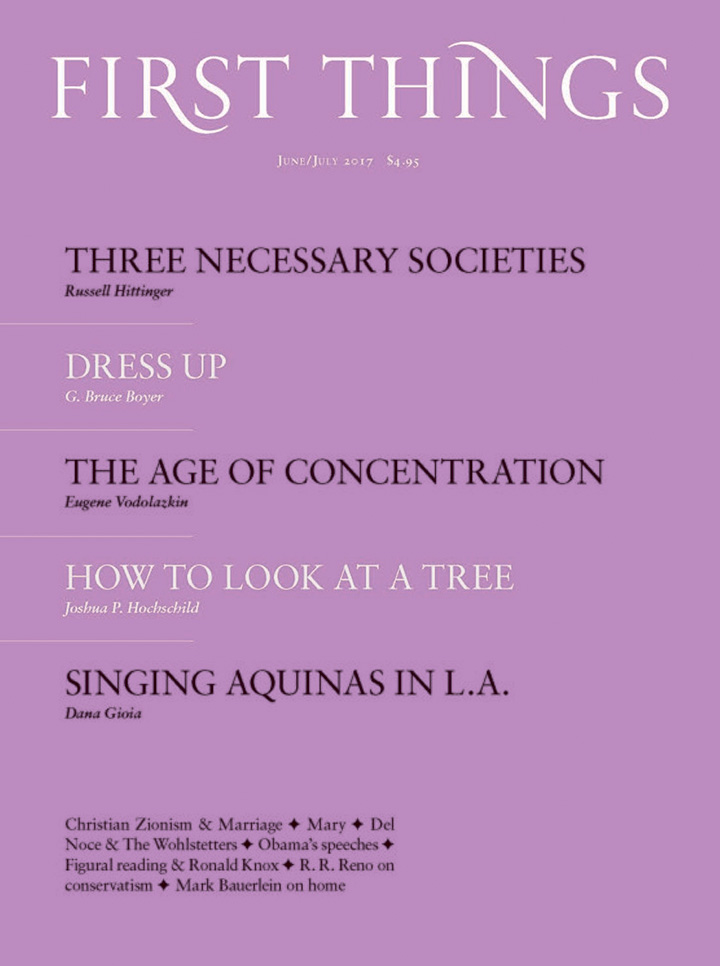
Many regard Russia as backward, lagging behind the West. This is not so. Our shared civilization is changing, and because of our raw experience of the twentieth century, my country is in some respects ahead of the West. I have described the coming epoch as a new medievalism (“The New Middle Ages,” August/September 2016). But it is too early to outline this new epoch in detail. We can only dimly see its outlines, which are best expressed as a turn toward inner strengthening and social reconsolidation. I call this “concentration.”
Communist materialism determined the order of Russia for more than seventy years; the phase of market-based materialism was traversed in much more rapid fashion. Both materialisms attained extreme manifestations but ultimately left the stage, or at least the proscenium. The whole world had time to admire the communist phase of our development, while the market phase passed without much notice. It is possible that the grotesque and farcical forms of Russian capitalism ultimately prevented this phenomenon from becoming an ideologically dominant conception in my society.
Not since the eighteenth century, when Russian culture switched its orientation from Byzantium to Western Europe, have we seen such a radical shift toward the West as occurred after the end of the Soviet Union. It was just as disruptive as it had been in the eighteenth century, marked by the appearance of previously unknown words and ideologemes, the phrases and thought patterns that are building blocks of ideological systems. One of these ideologemes was expressed in a statement that arose at the time. It conveyed a new, obligatory individualism: “That’s your problem.” In the conditions of Soviet collectivism, such an expression would have been absolutely impossible, but in the Russia of perestroika, people pronounced it enthusiastically, whether in an appropriate context or not. Sometimes the reason to pronounce it was even invented. The phrase was admired; it seemed so “Western.”
The relationship between Russia and the West at this time could be compared to a love story. At the beginning of the post-Soviet period, Russia was like a girl without a dowry who stood ready to marry the rich West on any terms. Though some might say this romantic abandon was little more than a crude desire to sell herself, it was in fact true love. Genuine though it was, her love turned out to be unrequited, and the girl was unceremoniously shown the door. The plot then developed, just as it should in a good story, in the direction of a radical transformation of the protagonists.
In the last quarter century Russia has passed from chaotic permissiveness—“That’s your problem”—to a tightly structured and harshly directed state based on the principle of traditionality, which is to say a self-conscious program of restoring tradition, not the organic perpetuation of an already traditional society. Sometimes this state has been out of kilter, as any growing organism is apt to be. Meanwhile an important part of the West, the European Union, has pushed forward to realize ideals of liberal universalism, although it is beginning to feel the ground shifting beneath it. The USA has also experienced great changes, as witnessed by the recent presidential campaign and its result. I will leave it to my friends in the E.U. and America to characterize those changes, but this I can say with confidence: All talk of a possible wedding has permanently ceased. The West in its contemporary form no longer suits Russia. This is that rare instance when the feelings of the West and Russia toward each other are mutual.
The contrast between Russia and the U.S. has reached a point that it did not seem to have attained even in Soviet times. The propaganda war waged by each side has taken on a form unprecedented in its harshness. At times, one fears that rashly pronounced words could turn into bullets. And all this is taking place with Russia no longer a communist country in ideological conflict with the West. An absurd situation? Yes, but only if one takes into account nothing other than economic and political factors. If one believes metaphysics is one of the movers of history, the situation is less surprising.
The antagonism between Russia and the United States is a sign of the era that is replacing the one we inherited. I call it the age of concentration, and put it in the same category as antiquity, the Middle Ages, the Renaissance, and modernity. In a formal sense, the age of concentration can be compared to the Renaissance, but with a significant difference: What is being resurrected is not antiquity but the Middle Ages. There are two levels of this restoration, one personal and the other social.
Ivan Krylov’s fable “The Quartet” tells the story of four happy beasts who decide to make music. As sometimes occurs with socially active people, they are not capable of playing their instruments. Several times they try sitting in different configurations, as if that might improve the quality of their music. Needless to say, this game of musical chairs does not work. The fable reminds us that the sum total cannot be changed simply by shifting its constituent parts, and that the work of a collective does not always lead to success. There are things that can only be attained by personal effort—in this case the ability to play a musical instrument. Applying the moral of the fable to the social and political sphere, one could say that without the personal discipline necessary to improve the quality of our “human material,” all social constructions will fail.
Our dispersed and untrained souls need to be shaped and formed, attaining focus or concentration. This will have to be realized first of all on the personal level, requiring the development of the ability of self-direction independent of the condition of society and the propaganda surrounding us. Personal concentration works against the dispersing influences that might otherwise gain control of our souls.
At the dawn of the computer era, I recall that a colleague asked me where the content of the Internet is stored. At first I did not even understand the question, but it eventually became clear that my colleague assumed the content was distributed over the net, simultaneously existing everywhere and nowhere. He was expressing an ideologeme, one that expresses the common opinion that things are dispersed into ethereal networks. Thus, when we speak of a rise in social tension in society, we tend to forget that this nervous energy is generated by concrete human souls. Of course these souls resonate with each other, but this nervous energy can be turned off only by each specific human being—in himself.
Speaking about personality in the Middle Ages in The End of Our Time, Nikolai Berdyaev gives what at first sight seems to be a contradictory definition. He argues that men in the Middle Ages, compared to men in the modern age, were less individualistic, yet had much stronger and more stable personalities. In fact there is no contradiction. The modern age has promoted the development of distinct personal qualities and encouraged us to see ourselves as individuals rather than roles, but has isolated us from the truths that supply us with energy and rivet the mind. These were of course religious truths—they represent vertical connections.
We live in a time when mass consciousness is being inculcated by education and media. It encourages horizontal connections. We think of ourselves in terms of relationships to other people. The individual becomes part of a mass. Celebrity marks an important instance. It is a status won by horizontal acclaim. The Middle Ages, by contrast, exalted sanctity, which flows from the vertical connection to God, not horizontal connections to others. This vertical connection provided the individual with autonomy, allowing him to evaluate events and relationships from the point of view of religious ethics. Today, the paradigmatic modern way of achieving independence from mass consciousness is one of social protest. But this is horizontal—the position “against.” The vertical connection provides a much stronger position. It puts one in position “above” and transcends the horizontal web of social relations.
I am convinced that political cataclysms are not only and not primarily the result of social and economic factors. Take the revolution of 1917. Russia has had worse years without any revolutions. Another example is political terrorism. It flourished as a social phenomenon in Russia during the reign of Alexander II, one of the most liberal czars, who was ultimately killed in a terrorist act. Let’s set aside the Russian context. Could the social and political circumstances in Europe in the years after 1910 explain the outbreak of the terrifying hostilities of World War I? The more salient factor was the rising aggressiveness on all sides before the war began. It is enough to read the poets of the time. The majority of them were anticipating war and looking forward to it. It is my belief that the search for the reasons for such catastrophes must begin in the sphere of the personal.
For this reason, and despite the complexity of the contemporary situation, I have grounds for optimism. I discern no aggressive spirit in contemporary Russian society (with a few rare exceptions). The furious malice that turned everything upside down in 1917 does not exist today. I don’t want to say that in Russia we have all come to like each other. But we have ceased to live with daggers drawn.
Feelings on the international level are also promising. Despite years of propaganda, no significant increase in xenophobia or isolationist tendencies is discernable in Russian society. Despite sanctions and the militant rhetoric used by both sides, there is no deep antagonism in Russia toward the West.
There is another aspect of the personal dimension, namely, the role of the national leader. The leadership of a country and its population are always connected in some way. This is as true for democratic as nondemocratic societies. In a democratic society, the relation between the population and its leadership is institutionalized and transparent, while in a nondemocratic one, it is hidden and complex, but that does not mean that it doesn’t exist. Even a despotic regime cannot arise without the existence of a social demand for its appearance.
Let us imagine that Stalin arrives in London and proposes to institute government-sponsored terror. His proposal would not attract Englishmen in the least. The dictatorship would be annulled without having begun. But in Russia, the dictatorship was realized in full. It would seem that there was a demand for it and that it solved certain problems. What problems? The hero of my novel The Aviator (it will appear in English this year, translated by Lisa Hayden) assumes that Stalin served as the instrument of a social aspiration to suicide. It is hard to understand how such an aspiration could arise. But why do groups of whales cast themselves out on beaches? The human mind contains irrational and frightening elements that can draw it into sinister depths. The bloody Stalinist terror is hard to understand in social and political categories alone. There is no way to explain it without metaphysics.
The important point for our purposes is the following: A national leader, any national leader, does not appear accidentally, and when he does, he is called on to solve specific problems. At the same time, it is obvious that the problems, say, Charles de Gaulle faced were very different from those François Hollande faced. The example of Hollande testifies to the fact that the generation of faceless leaders is on the way out. The majority of those who are in leadership today serve as the final paladins of a departing historical cycle.
What is coming will require a leader who is a reformer or even a revolutionary. As an epoch ends and a new one begins, such a leader is unlikely to exhibit the expected attributes of a responsible political actor. He comes to prominence because he manifests in the most vivid fashion the changes the majority has been waiting for. Perhaps this explains Donald Trump.
Individuals and phenomena that break the customary flow of events are by definition unexpected. Preliminary questionnaires designed to gauge their significance, popularity, and influence produce inaccurate results, because respondents to these questionnaires prefer to voice “commonly accepted” points of view that may not coincide with what they believe. Thus Brexit and Trump ran counter to both established opinion and the predictions of pollsters. Most prefer not to reveal that they support a completely new historical project, especially in the late stages of an epoch defined by mass consciousness and the priority of horizontal connectedness. The new epoch of concentration is coming unannounced.
When considering the social level of this new age, it is best to begin with the concept of utopia. The Greek word means “no place,” or “a place that does not exist.” When the term was coined in the sixteenth century, it existed only in the sphere of ideas and had no bloody trail following it. A very different relationship to the concept of utopia took shape in the modern age.
Antiquity usually conceived of time in cyclical terms, while time in the modern age is thought to progress in a linear fashion toward a determinate end. In the Middle Ages, time also had direction, but in a very special way: Old events are repeated on a new level. The Middle Ages compromised between antiquity and modernity, conceiving of time as a spiral. The modern age impatiently waits for the future, which it sees as the apex toward which to strive. The Middle Ages accepted the future, but related to it calmly. For the man of the Middle Ages, the highest moment of history is the incarnation of Jesus Christ, a point in time that has already passed, but which gets repeated again and again in the liturgy of the Church.
This accounts for one of the fundamental differences between the Middle Ages and the modern age: The Middle Ages did not know the idea of progress, while the modern age regards it as fundamental. That is why the Middle Ages did not give rise to utopias. At the very essence of a utopia is the idea of progressive movement toward a not-yet-achieved perfection.
It is wrong to think of utopias as harmless dreams. Combined with the idea of progress, utopian thought is a dream that motivates action. It establishes a goal so lofty that it cannot be reached. The more ideal it becomes, the greater the stubbornness with which it is pursued. There comes a time when blood is spilled. Oceans of blood.
One of the most terrifying attempts to realize a utopia was the communist experiment in Russia. A slogan inscribed on a sign in the Solovki gulag was a simple but exact expression of the essence of utopia: “With an iron hand we will drive humanity to happiness!” Relentless pursuit of the communist utopia determined life in Russia for a large part of the last century at the cost of millions of lives.
In the second half of the last century (truly a century of utopias) there arose another utopia, that of globalism, which at first seemed merely the ideological accompaniment to the development of transnational corporations. In some of its aspects this was indeed what it was. But as often happens with phenomena that are not sufficiently grounded in reality, the ideas associated with globalism—peace through trade, world citizenship, an “international community”—took on a life of their own. Strictly speaking, utopias, being myths, don’t really need grounds for existence. They are not produced by real circumstances but are born of ideas. At the same time, one cannot say that utopias are completely unrelated to reality. Unfortunately there is a link, but an unusual one: Although a utopia is not a product of reality, it begins to create reality on its own.
Where the Marxist utopia in Russia gave birth to terror, the globalist utopia in the West inspired “democratizing” wars and so-called “color revolutions.” This has been the subject of a great deal of discussion that I will not repeat. Leaving aside the damage inflicted on the countries subjected to “democratization”—a large number of direct and indirect victims, the replacement of traditional social structures by chaos—we can see the problems the globalist utopia creates in the West.
About twenty years ago a Dutch pastor with the face of Mr. Pickwick took me on a tour of Amsterdam. The theme of this remarkable tour was the word “tolerance.” The Dutch people are tolerant, he told me, and hence in Amsterdam, there are no ethnic or religious minorities, an achievement made possible by the fact that although a majority of residents are of Dutch descent, only around 25 percent call themselves Christian. His enumeration of the achievements of Dutch tolerance concluded with an account of the removal of a stanza about the help of God from the national anthem of the Netherlands. “As you can understand,” explained the pastor, “various people have various gods, and they can be offended that the anthem names only the Christian God. This is a triumph for tolerance, isn’t it?” Listening to him, I thought, if this is a triumph, what would catastrophe be like?
Legal and illegal flows of migrants have reached such proportions in recent decades that comparisons to the great migrations of peoples from the fourth to seventh centuries are not exaggerated. Such migration affected the local populations in ways that were not always beneficial. Notwithstanding the utopian dreams of today’s globalists, there is no reason to assume that present migrations will yield different results today.
Optimistic assumptions are standard components of utopian thinking, and they have until recently been voiced by many Western leaders and thinkers. Europe has been pictured as a huge kettle in which various ingredients are boiled and blended. In truth, however, some of what bubbles in the kettle has no intention of blending. That which does not want to dissolve or blend keeps coming to the surface. Of course, a man has the right not to dissolve if he so wishes. Some seek self-possession. This requires concentration, not dissolution. Because that is so, responsible rather than utopian thinking must urgently determine what sort of meal it is that Europe is trying to prepare.
Strictly speaking, that should have been thought through before the kettle was put on the fire, but this was not done. The utopian nature of globalism insists on the possibility of multiculturalism, which is to say people of different cultures living in the same place while maintaining their distinct identities. This can be done. Beirut is famous for its multicultural history. Yet it is difficult to sustain, as the recent history of Beirut reminds us. There are cultures that do not merge—like water and oil—and pouring them into a single vessel is a recipe for conflict.
When the chaos in a system (any system) approaches a critical point, the system needs at the very least to stop the process; otherwise it will cease to be a system. One of the important constituents of any system is the boundary separating it from other systems (and from chaos). It is not surprising that the process of restoring the integrity and functionality of systems must begin with deliberations concerning boundaries—an important element in the social process of concentration.
Western Europe, Russia, and the United States represent various branches of a single tree. The basic systemic feature of this civilization is Christianity, both as a religious practice and as a specific kind of culture. If European civilization is fated to survive, it will require a rediscovery of Christianity. And that will take place both on the level of nation-states and at a pan-European level.
What this will mean for the future is uncertain. The Christian world is losing strength, and its specific weight in the world as a whole is decreasing. In a very short time, the focal points of world importance will no longer be represented exclusively by European states, and this will lead to a regrouping of forces. Yesterday’s opponents, the West and Russia, may need to unite around a single focal point that will stand in opposition to a non-European focal point, which may also consist of a number of nation-states.
Of course, pronouncements about the future must be tentative. But they are permissible when the future is to some degree already evident in the present. That is our situation. The modern age is giving way to the age of concentration. And so I believe that I am within my rights to formulate a number of suppositions:
• The history of European civilizations is at present living through one of its epochal shifts. Using the terminology of Nicholas Berdyaev, one can say that a “nocturnal” period is in store, a time of concentration during which we internalize the experiences received during the “daytime” of the modern age.
• The most recent “nocturnal” period was the Middle Ages. The coming age will probably bring to the fore a medieval emphasis on metaphysics. One should keep in mind that a change of epochs often does not proceed in a single step, but does so in jolts or pulses, with tide-like ebbs and flows.
• The main level of concentration will be personal, since the subject of moral and metaphysical experience is the human person himself. The national leader will also come into concert with the metaphysical demands of the epoch.
• This age of concentration will also have a social dimension and expression. It will consist of the restoration of nation-states as the form for the existence of peoples. In comparison to the global frame of reference that was emphasized in the last half century, the national level will have priority.
• One of the manifestations of the age of concentration will be the final rejection of any attempts to realize utopias such as communism in Russia and globalism in the West.
• With the demise of utopian conceptions, the futuristic mindset will probably also depart. Postmodernism foreshadows this. Its heightened, often ironic attention to the past has served to impress upon society the importance of having a retrospective view of things. As it develops, postmodernism laughs less and less. At a certain point, it begins to sound a lot like the Middle Ages. We are entering an epoch when the phrase “social progress” will sound unconvincing, and the words “past” and “present” will outweigh the word “future.”
Eugene Vodolazkin is the author of Laurus. This essay was translated from the Russian by Alexis Klimoff.
Follow the conversation on this article in the Letters section of our October 2017 issue.

YOU MIGHT ALSO LIKE
Talkin’ God and Football
Paul Finebaum is known as “the mouth of the South,” but he does a lot of listening.…
Letters—October 2026
I’m grateful for Stephan Pax Leonard’s essay on his conversion to Orthodoxy (“Why I Became Orthodox,” June/July…
Creedal Orthodoxy Won’t Save Us
Pundits tell us that we are moving beyond the culture wars. Left and right are merging in…
