
German Chancellor Angela Merkel wrote Donald Trump a public letter the day after his election. “Germany and America are connected by values of democracy, freedom and respect for the law and the dignity of man, independent of origin, skin color, religion, gender, sexual orientation or political views,” she said. “I offer the next President of the United States close cooperation on the basis of these values.” It was a restatement of ideals that many Americans regard as obvious. But the fact that she felt it necessary to return to fundamentals reveals something important about our present circumstances. A rising populism is challenging the postwar system in Europe, and perhaps in the United States, and this may threaten some deep principles.
After World War II, politics in Western Europe was rebuilt on a foundation of human dignity. A number of other countries were led by parties like Merkel’s Christian Democratic Union. The goal was to restrain the power of the state and limit the political passions that had done so much damage. This established a political tradition in the West that has been oriented toward freedom and invokes human rights to support it. In Western Europe, human dignity became the watchword for the politics of Christian democracy and provided the basis for transatlantic Cold War politics in which religion was viewed as a bulwark against totalitarianism left and right. In recent decades, after the left stopped trying to build socialism, it too adopted and repurposed certain elements of this tradition, dropping the emphasis on religion while keeping the language of human dignity and human rights. The upshot was more internationalist, with strong support for pluralism and personal liberation, including sexual freedom.
A growing populism seems to be rejecting these developments, especially their internationalist dimension. Here in the United States, Donald Trump succeeded as a populist candidate who ran against the political establishment, both left and right. His campaign slogan, “Make America great again,” was explicitly nationalistic. In Europe, Trump’s election was preceded by a shocking British vote to leave the European Union, which many regard as the finest achievement of the ideals of the postwar era. A few years ago in Hungary, a demagogue championing Christian nationalism took power, while other countries—soon France and then Germany—face populist uprisings that may upset the political status quo.
Will this new nationalism go so far as to reject basic liberal principles? Clearly, Merkel fears that this might be the case, which is why she feels the need to reaffirm human dignity. She did so not just in response to Trump’s election, but also at a meeting of her political party, the Christian Democratic Union, in late 2015 when German politics was being roiled by her decision to accept hundreds of thousands of refugees from the Middle East. “The founding impulse of the Christian Democratic Union,” she said, “was a genuinely shocking idea. . . . [It was] the God-given dignity of each and every individual man.” Others share her worries. After Trump’s election, the New York Times hailed Merkel as the “liberal West’s last defender.”
It is not clear yet whether today’s populism wishes to toss aside human dignity, the postwar era’s core principle. But political events have momentum, and movements often overshoot the mark. It’s worth recalling an earlier season of populist rebellions against the perceived failures of liberal democracy in the midst of economic crisis. History never repeats itself, but it is worth consulting when it rhymes.
Many assume that the first time human dignity featured in a national constitution was in post-Holocaust West Germany in 1949, when the new Christian Democratic party helped formulate a famous new opening principle: “the dignity of man is non-negotiable.” Yet this is not accurate. The first constitution that canonized human dignity is Ireland’s, enacted in 1937 when Ireland was under the leadership of Éamon de Valera, a devout Catholic who was concerned to ground Irish politics in Catholic principles.
In the social turmoil that followed World War I, Europe saw a dramatic upsurge in secular populism that revolved around national pride and a restoration of national solidarity. Often, European Christians allied themselves with secular populists, except when they had the chance to build Christian states themselves. Liberalism had historically been anticlerical in Catholic countries, which meant that religious leaders in the 1920s and 1930s were suspicious of liberal democracy. The foibles of France’s Third Republic and Germany’s Weimar Republic made it easy to discount liberalism as a failed political philosophy. It seemed to many that the only real choice was between socialism or communism, on the one hand, and some form of right-wing, authoritarian nationalism, on the other.
As a consequence, when right-wing nationalism became ascendant, the temptation was to try to use the populist movements to fend off atheistic communism and reestablish religious norms for society as a whole. In the 1920s, the Catholic Church in Italy thought it could work with Benito Mussolini. In the early 1930s, Catholic Centre party members in Germany threw their support behind Adolf Hitler in the face of disorder. These were hard choices given how secular Italian Fascism and German Nazism were, but in Austria between 1934 and 1938, and Portugal after 1932, Roman Catholics had more influence on state power than at any time since the alliance of throne and altar. And while General Francisco Franco relied on the Spanish Falange, a secular fascist paramilitary movement, his own conservative authoritarianism outfitted itself with Christian trappings, and had the full support of Catholics around the world, including in the United States.
It was in this context that de Valera settled upon human dignity as a foundational principle, one that preserved the essential element of liberal social norms, which is to protect the human person from being absorbed by—and abused by—the power of the state.
In effect, de Valera was implementing into Irish law the broader shift in Catholic thinking. Although initially hopeful about the possibilities of cooperation with fascism, Pope Pius XI came to see the exaggerated power of the state, whether motivated by communism or fascism, as a threat. In his broadside against Nazi pressure on the Catholic Church in the late 1930s, Mit Brennender Sorge, Pius XI denounced actions that violate “every human right and dignity.”
World War II made the principle of human dignity even more important. Pius XII, who became pope in 1939, recognized that Christians must learn the lessons of the 1920s and 1930s about what happens when populist nationalism is embraced to advance Christian ends. In his Christmas message for 1942, Pius XII gave human dignity special emphasis. “He who would have the Star of Peace shine out and stand over society should cooperate . . . in giving back to the human person the dignity given to it by God from the very beginning.” Christianity’s political role is to safeguard human dignity rather than finding the political means to reestablish its power over society. We must enact “a juridical order resting on the supreme dominion of God, and safeguarded from all human whims; a consciousness of an order which stretches forth its arm, in protection or punishment, over the unforgettable rights of man and protects them against the attacks of every human power.”
This formulation—the most prominent invocation of human dignity in those fraught years—marked a profound change in political Catholicism that would, in turn, influence Western European political culture in fundamental ways after the war. Already, in 1944, a draft of a constitution for the Vichy regime in France made human dignity its first article: “The liberty and dignity of the human person are supreme values and intangible goods.” The regime’s leader, Marshal Philippe Pétain, admired the Portuguese Constitution of 1933, which established the Catholic authoritarian regime of António de Oliveira Salazar. But the principle of human dignity did not convince him to stop the collusion of his regime in the deportation of Jews. Pétain’s admission of the principle of limited government at this late date followed mainly from his hope that the regime might survive now that it was clear that the Allies would be victorious. His Nazi patrons, however, would not permit the constitution to go forward. Because Pétain did not take the liberalization of his regime as far as to return to liberal democracy, the American-led forces were not about to let his regime serve as the basis for a liberated France.
In 1944, Pius XII gave another Christmas message that elaborated on the meaning of dignity, in this case by endorsing political freedom. “In a people worthy of the name,” he explained, “the citizen feels within him the consciousness of his personality, of his duties and rights, of his own freedom joined to respect for the freedom and dignity of others.” Of course, freedom and respect do not mean the license of relativism. “If men, using their personal liberty, were to deny all dependence on a superior Authority possessing coercive power, they could by this very fact cut the ground from under their own dignity and liberty.” This was a view of public life far more liberal than any pope had enunciated up to that point, though it was hedged with warnings about the ways in which secularism weakens the metaphysical foundations of morality and order. This anti-secular Christian liberalism has characterized papal teaching ever since.
In short, from 1914 to 1945, Europeans endured political and then military agony. It was during this period that Christians, especially Catholics, at first imagined that modern populism could serve as a vehicle for the restoration of traditional norms, only to discover themselves either co-opted or crushed. That experience forced a reassessment of core political principles. Traditional Christians learned to premise their search for political influence on a deeper commitment, one that gave them a place to stand over and against the power and violence of the modern nation-state. Human dignity emerged as a central concept.
As Europe rebuilt after the war, human dignity and the rights that flowed from it functioned in ways that parallel the role of the Bill of Rights in the American constitutional system. This was especially true in Germany and Italy, where nationalistic populism had led to disaster. Before West Germany was established in 1949, Bavaria formulated its own constitution in 1946. It was written by Alois Hundhammer, founder of the conservative Christian Social Union, the Bavarian party that sought to embody Catholic social principles. He had been imprisoned in Dachau and had witnessed a pagan populism turn into a murderous totalitarianism. He began the constitution’s preamble in this way: “Before the field of rubble, to which a state and social order without God and without knowledge and respect of human dignity have led the survivors of World War II . . .” With less pathos and with secular and Protestant contributions alongside Catholic ones, the West German Constitution, formulated three years later, sought to restore a respect for human dignity as the central purpose of a humane system of government.
Human dignity and human rights made their way into the United Nations Charter and the Universal Declaration of Human Rights, eventually becoming part of the rhetoric of today’s defenders of globalism. I can understand, therefore, the skepticism with which some now view human rights. For one thing, the concept of human dignity has seen its Christian origins in the mid-twentieth century muddied or even perverted. Decades later, after losing faith in their postwar project of expanding the welfare state, often under socialist auspices, progressives made a successful bid to recapture the language of human dignity and rights. For Christians who introduced human dignity to limit the state, it has been outrageous to witness human dignity and human rights now underwriting personal liberation not merely from the state, but from traditional moral and social constraints.
The cosmopolitan trajectory of the human rights movement has become intolerable for many. The older use of human dignity was to establish Christian democracy in the particular national communities of Europe, not to promote a post-political global utopia. One reason Merkel has suffered politically is that her humanitarian generosity to Muslim refugees looks to some of her critics as though it doesn’t take the need for national solidarity and safety seriously. (Merkel’s criticisms of “multiculturalism” and her resort to a rhetorical defense of Germany against shadowy outsiders after the Christmas market attacks strike others as craven capitulations to xenophobia.)
These criticisms should be taken seriously, but the problem remains. Today’s populism, which is once again nationalist and secular, presents conservative Christians with opportunities to gain political advantage over the secular progressivism they see as a threat. That rhymes with the interwar years. Do Christians therefore need to speak, yet again, about human dignity in ways that put limits on populism, too?
In normal times, this question seems remote. Our democratic politics involves contests for power, but there’s a settled, pre-political cultural consensus in the background, and for this reason politics restrains itself to a great degree. Populism, however, is a challenge to the establishment, and thus to the pre-political consensus. Which is why the need to protect human dignity was so pressing for de Valera, Hundhammer, and others of the generation that lived through a time when nationalistic zeal was often used to justify illiberalism and violence.
Our issues are different. The disruptions and dislocations brought by globalization seem less dire than the fragmented and disoriented countries of Europe after World War I. There are no paramilitary organizations active in Europe, let alone the United States, as there were in many countries in the 1920s and 1930s. Moreover, European populists such as Marine Le Pen and Geert Wilders criticize the European Union and other internationalist institutions as antidemocratic rather than denouncing liberal democracy as decadent and out of date, as did many interwar populists.
Nevertheless, we need to be vigilant. As a non-Christian who has studied the failures and successes of Christian politics in the first half of the twentieth century, I want to warn my fellow citizens who are believers. Populism disrupts and overturns. Conservative Christians who lend their support to populists like Trump need to be clear about their bottom-line principles. Trump will champion some conservative and religious values, and the politics of his judicial selections now look like an unmitigated win for conservative Christians. Indeed, if Anthony Kennedy retires or Ruth Bader Ginsburg dies, Roe v. Wade may fall. But it behooves even pro-life Christians to engage in the thought experiment now rather than waiting: How bad do Trump’s policies on other issues have to get to change the calculus of support?
Serious Christians had to disentangle themselves from the nationalistic populism of the 1930s—sometimes too late. To do so they emphasized human dignity as the touchstone for the more humane future they hoped to build. It was vague and ill-defined, but it captured something sacred about the human person that ought not to be violated.
When I interpreted this mid-twentieth-century history, I highlighted uses of human dignity to craft a conservative framework for democracy and rights in the immediate postwar years. I wanted to inform my progressive friends that they unwittingly employed concepts that have sources that they are unlikely to endorse. For very different reasons, traditionalists have entertained their own criticisms, ones that focus on the progressive uses to which I agree that human rights have been put in recent decades.
In her response to R. R. Reno in these pages (“Reclaim Human Rights,” August 2016), Mary Ann Glendon allowed that there are troublesome dimensions of human rights as currently defined. But she argued this cannot mean that Christians should give them up for lost. I hope she persuades. In a series of elections in Europe this year, a great deal will depend on whether conservative Christians across the Atlantic ally themselves with an escalating populism. This populism is not the same as that which tore through Europe nearly a century ago. But it shares one feature: It too is a secular phenomenon and has no explicit or even implicit Christian dimensions. Merkel in Germany and the conservative Catholic François Fillon in France remind voters that they opt for the worldly success of populism at the risk of losing their souls. In America, the election has already happened, but the die is not yet cast. Much depends on the choice between a conservatism that defends human dignity and one that allows itself to be drawn into alliances that may compromise or even forsake that core principle.
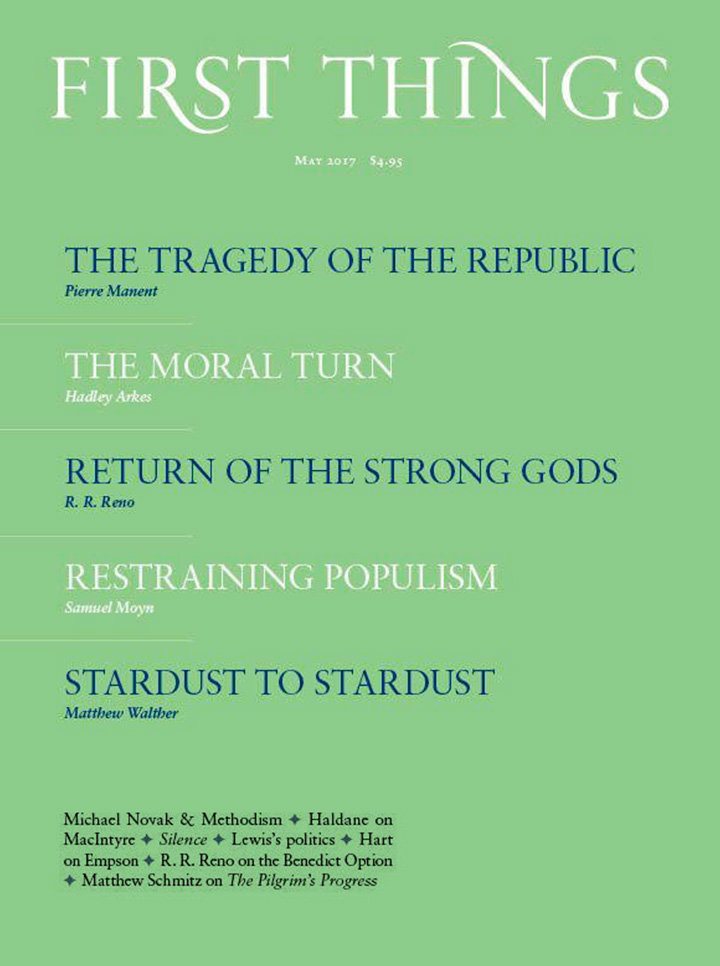
Samuel Moyn, who teaches law and history at Harvard, is author of Christian Human Rights.
Follow the conversation on this article in the Letters section of our August/September 2017 issue.

YOU MIGHT ALSO LIKE
The Fraying Fabric of the Church of England
St. Paul’s Cathedral has come up with a novel way to fill the pews: It is becoming…
Talkin’ God and Football
Paul Finebaum is known as “the mouth of the South,” but he does a lot of listening.…
Letters—October 2026
I’m grateful for Stephan Pax Leonard’s essay on his conversion to Orthodoxy (“Why I Became Orthodox,” June/July…
